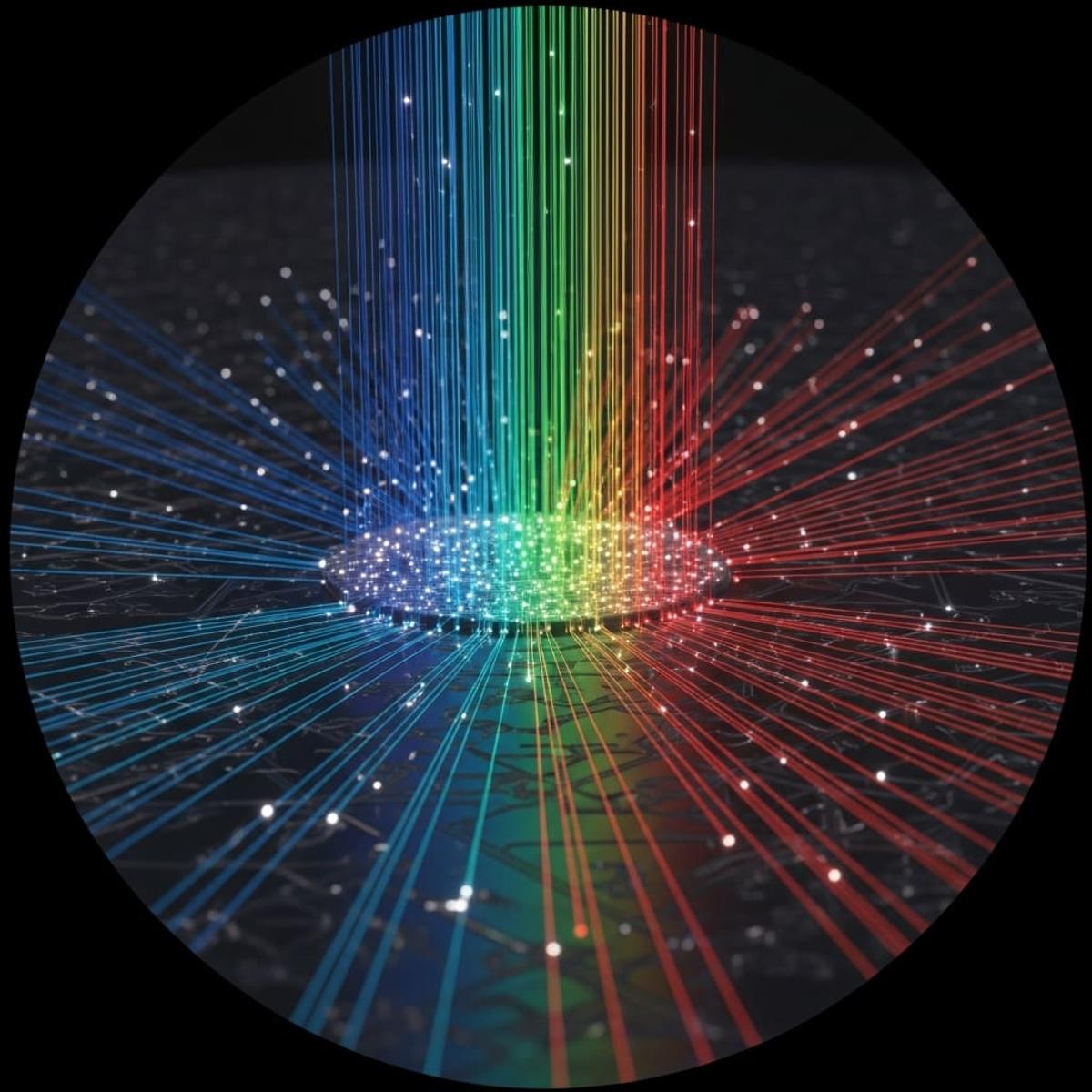
Stimulated Magnonic Frequency Combs Achieve Efficient Control over Spectral Line Number

Key Takeaways
- •Stimulated three‑magnon scattering generates magnonic frequency combs
- •Modulation frequency controls comb spacing and line count
- •Power threshold reduced compared to traditional methods
- •Comb lines span six octaves, up to 60th harmonic
- •Edge‑localized modes enable sub‑FMR frequency access
Pulse Analysis
Frequency combs have reshaped precision metrology in optics, and their magnonic counterparts promise similar breakthroughs in the microwave domain. Magnons—collective spin‑wave excitations—exhibit strong nonlinear interactions, low damping, and high tunability, making them ideal for generating dense, phase‑coherent spectral lines on a chip. By leveraging the intrinsic three‑magnon process and introducing a modest modulation tone, researchers can stimulate energy redistribution across a broad frequency range without the high drive powers traditionally required.
The experimental platform centers on a nanoscale Permalloy element integrated with a gold microwave antenna. A primary excitation at the ferromagnetic resonance (≈4 GHz) combines with a sub‑FMR modulation signal (0.5 GHz), producing a cascade of equally spaced sidebands. Micro‑focused Brillouin light scattering maps reveal distinct edge‑localized and standing‑wave modes, confirming that the comb structure arises from both spatial confinement and stimulated three‑magnon scattering. Quantum sensing with nitrogen‑vacancy centers validates the phase stability of up to 60 harmonics, demonstrating six‑octave coverage and confirming the method’s coherence.
These findings unlock practical pathways for magnonic frequency combs in emerging technologies. The ability to tailor comb spacing and tooth count via modulation power offers a versatile toolbox for on‑chip frequency synthesis, neuromorphic computing, and ultra‑sensitive magnetometry. Moreover, operating below the ferromagnetic resonance expands compatibility with existing CMOS‑compatible spintronic circuits. Future work will explore diverse magnetic materials, integrate comb generators with magnon‑photon hybrid platforms, and assess performance under real‑world conditions, positioning stimulated magnonic combs as a cornerstone of low‑power, high‑frequency spintronic systems.
Stimulated Magnonic Frequency Combs Achieve Efficient Control over Spectral Line Number
Comments
Want to join the conversation?