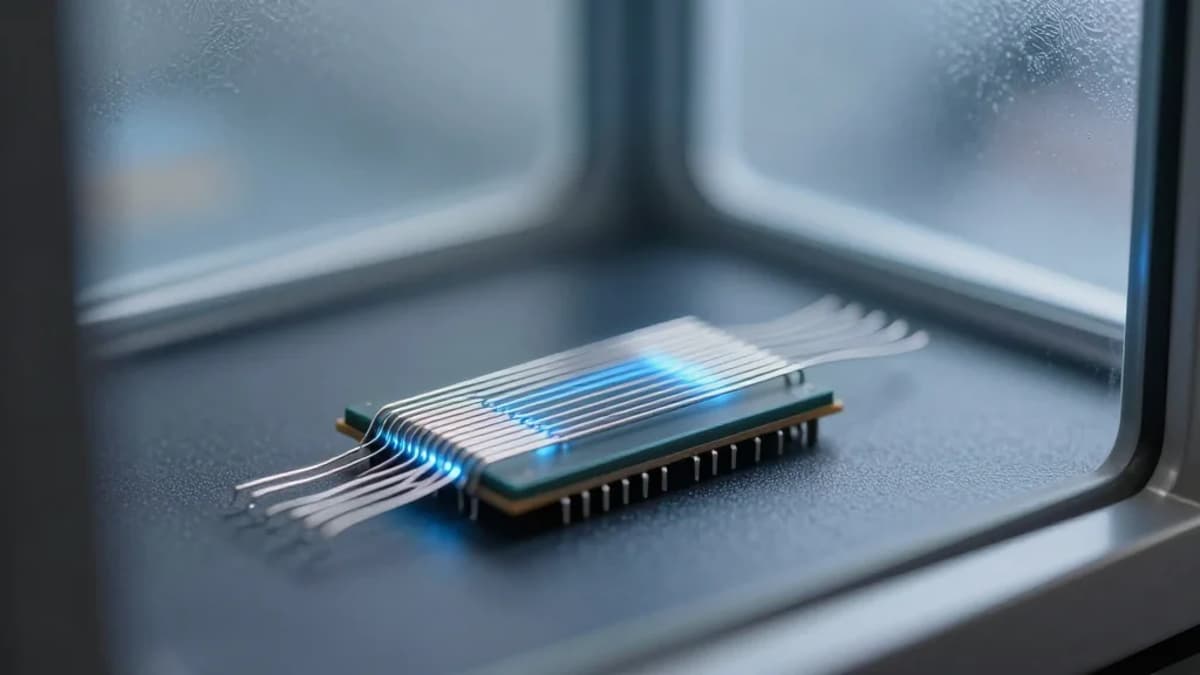
Superconducting Nanowire Memory Array Achieves Significantly Lower Error Rate
•January 25, 2026
0
Why It Matters
A dramatically lower error rate makes superconducting memory practical for fault‑tolerant quantum processors, accelerating the path to scalable, energy‑efficient computing architectures.
Key Takeaways
- •4×4 nanowire array achieves 10⁻⁵ bit error rate.
- •Functional density reaches 2.6 Mbit cm⁻².
- •Operates at 1.3 K with row‑column addressing.
- •Compact design reduces footprint versus conventional superconducting memory.
- •Enables scalable low‑power quantum computing architectures.
Pulse Analysis
Superconducting memory has long been hailed as the missing link for ultra‑fast, near‑zero‑power processors, yet high error rates and bulky footprints have limited adoption. Conventional Josephson‑based cells consume significant chip area and require complex biasing, making large‑scale integration costly. Nanowire technology, by contrast, leverages one‑dimensional superconductors that switch rapidly with minimal energy, but early prototypes suffered from stochastic switching and readout noise. The MIT team’s approach—embedding temperature‑sensitive switches and a kinetic inductor within a nanowire loop—addresses these shortcomings, delivering deterministic flux storage and reliable destructive read‑out.
The 4 × 4 array showcases a functional density of 2.6 Mbit cm⁻², comparable to emerging cryogenic SRAM, while operating at a modest 1.3 K. By fine‑tuning write and read pulse amplitudes, the researchers suppressed spurious transitions, achieving a bit‑error rate of 10⁻⁵ across 200 k cycles. Row‑column addressing further demonstrates that the architecture can scale without a linear increase in control lines, a critical advantage for future quantum processors where wiring overhead is a primary bottleneck. Circuit‑level simulations confirm robust margins, suggesting that larger arrays could maintain similar reliability.
For the quantum computing ecosystem, this breakthrough reduces one of the most energy‑intensive components—memory—bringing cryogenic systems closer to practical deployment. Fault‑tolerant architectures require rapid, repeatable storage of calibration data and intermediate results; a low‑error superconducting memory fulfills that need while preserving the overall power budget. Industry players developing superconducting logic, such as adiabatic quantum‑flux‑parametron (AQFP) platforms, can now envision tighter integration with memory, shortening data paths and improving latency. Continued scaling, material optimization, and integration with 3‑D packaging are likely to push error rates even lower, cementing nanowire memory as a cornerstone of next‑generation quantum and superconducting computers.
Superconducting nanowire memory array achieves significantly lower error rate
0
Comments
Want to join the conversation?
Loading comments...