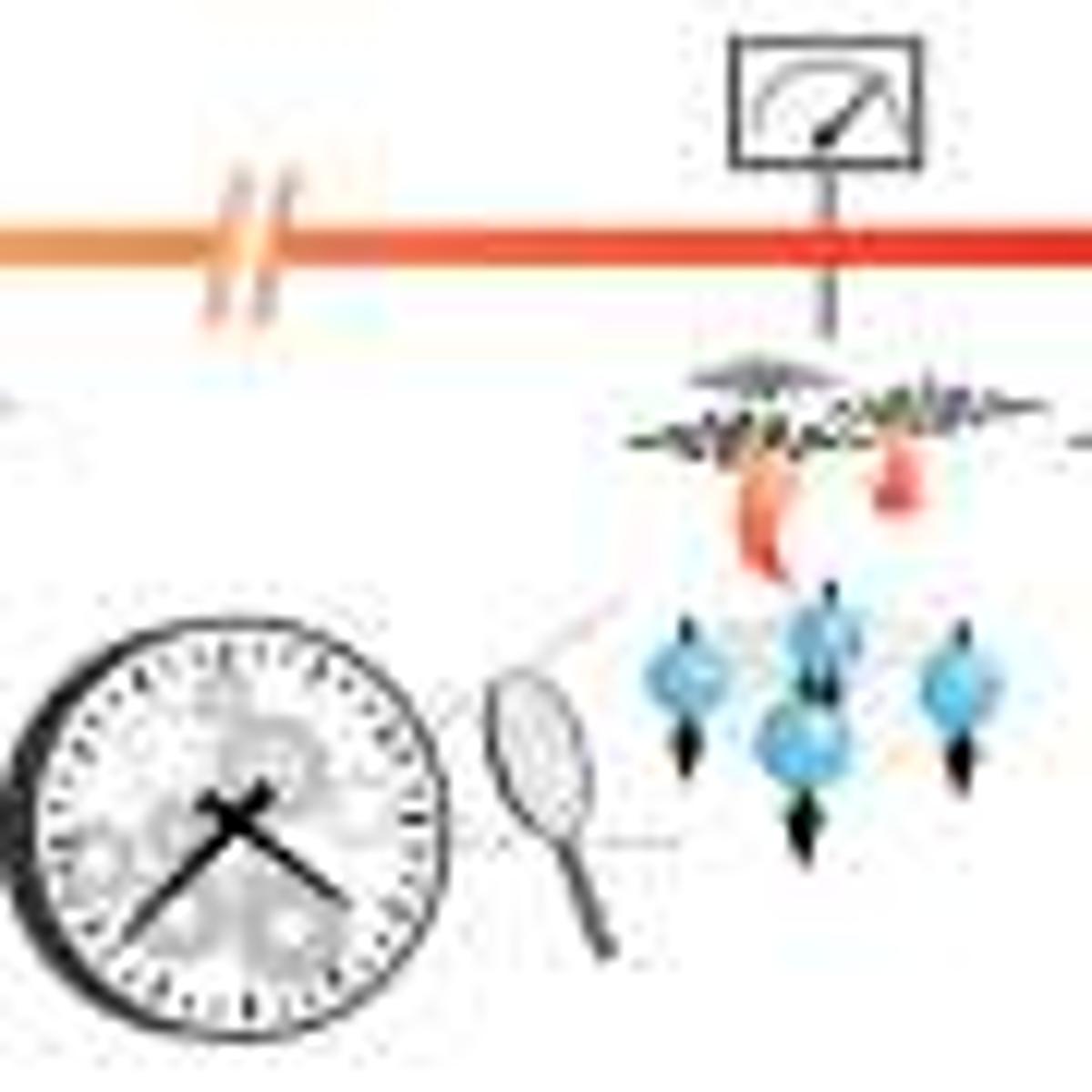
Time Crystals Could Become Accurate and Efficient Timekeepers
•February 13, 2026
0
Why It Matters
If realized, time‑crystal clocks could cut energy use and complexity in precision timing, reshaping navigation, sensing and other quantum‑enabled markets.
Key Takeaways
- •Time crystals sustain oscillations without external driving.
- •Simulations show higher precision than conventional phase.
- •No continuous laser cooling reduces energy consumption.
- •Practical implementation still years away, needs experimental validation.
- •Could improve satellite navigation and magnetic sensing.
Pulse Analysis
Time crystals, first observed in 2016, represent a radical departure from ordinary solids by repeating their internal order in time rather than space. Their ability to generate a persistent rhythm without external forcing has intrigued physicists seeking new platforms for quantum technologies. Recent theoretical work by Ludmila Viotti’s team extends this curiosity into the realm of metrology, proposing that the intrinsic periodicity of a time‑crystalline phase can act as a natural reference for quantum clocks, potentially surpassing the stability of laser‑driven atomic standards.
The researchers modeled an ensemble of one hundred spin‑½ particles, allowing the system to evolve in two distinct regimes: a conventional, laser‑driven phase and a self‑organized time‑crystalline phase. By measuring how accurately each configuration resolved increasingly fine time intervals, they found that the time‑crystalline clock retained its precision where the conventional counterpart degraded rapidly. This robustness stems from the collective interactions that lock the system into a stable oscillation, eliminating the need for continuous energy input and reducing susceptibility to external noise. Such characteristics could translate into clocks that are both more accurate and less power‑hungry, addressing a key limitation of today’s optical atomic clocks.
Despite the promising simulation results, turning time‑crystal clocks into deployable hardware will require breakthroughs in material synthesis, control of many‑body quantum states, and integration with existing timing infrastructure. If these hurdles are overcome, the technology could ripple across sectors that depend on precise timing, from global navigation satellite systems to quantum‑enhanced magnetometers used in medical imaging and fundamental physics experiments. The prospect of a low‑energy, high‑precision timekeeper underscores the broader trend of leveraging exotic quantum phases to unlock new commercial capabilities, positioning time‑crystal research at the forefront of next‑generation quantum innovation.
Time crystals could become accurate and efficient timekeepers
0
Comments
Want to join the conversation?
Loading comments...