Tiny 3D-Printed Light Cages Could Unlock the Quantum Internet
•January 6, 2026
0
Why It Matters
The technology provides a practical, mass‑producible quantum memory essential for quantum repeaters and photonic computing, accelerating the deployment of secure quantum networks.
Key Takeaways
- •3D‑nanoprinted light cages store photons in atomic vapor
- •Filling time cut from months to days with open core
- •Memory performance consistent across chips with sub‑15 nm variation
- •Operates near room temperature, eliminating need for cryogenic cooling
- •Supports scalable quantum repeaters and photonic computing feed‑forward delays
Pulse Analysis
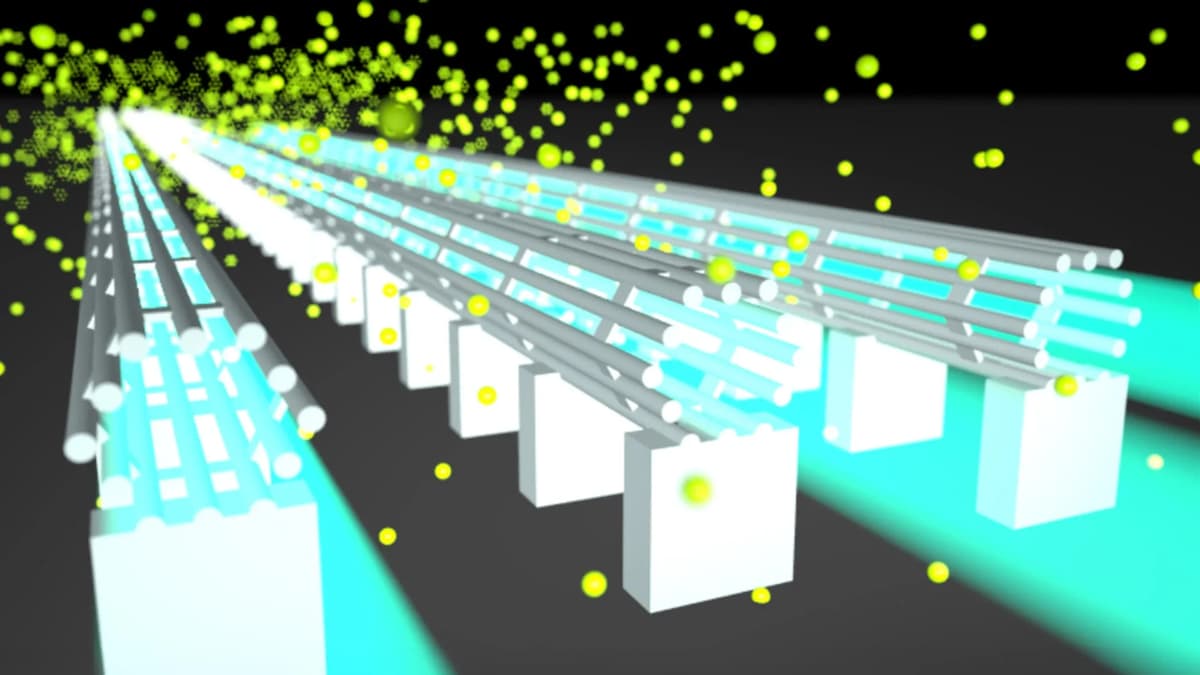
Quantum memories are the linchpin of any future quantum internet, allowing entangled photons to be stored and released on demand. Traditional hollow‑core fibers suffer from slow vapor loading and require complex vacuum systems, limiting their practicality for large‑scale deployment. The newly demonstrated “light cages” combine a hollow‑core waveguide with cesium vapor on a single silicon chip, turning a photonic pulse into a collective atomic excitation and back again. This approach not only shortens the storage cycle but also aligns with existing photonic integration platforms, bridging a critical gap between laboratory prototypes and commercial hardware.
The breakthrough rests on two‑photon polymerization lithography, a commercial 3D‑nanoprinting technique capable of sub‑2 nm dimensional control. By printing the hollow core directly onto the chip, researchers eliminated the months‑long diffusion process typical of conventional fibers, achieving full vapor loading in a matter of days. Protective coatings shield the polymer from reactive cesium, and long‑term tests show no degradation after five years. Moreover, intra‑chip variations stay below 2 nm while inter‑chip differences remain under 15 nm, guaranteeing near‑identical performance across dozens of memory units.
From a business perspective, light‑cage memories could accelerate the rollout of quantum repeaters, the backbone of long‑distance quantum key distribution networks, by providing room‑temperature operation and high bandwidth per mode. In photonic quantum computing, deterministic delays enable feed‑forward logic essential for measurement‑based architectures. The ability to fabricate multiple identical memories on a single wafer also opens a clear path to mass production, reducing unit costs and simplifying supply chains. As telecom operators explore quantum‑secure channels, this scalable, low‑maintenance technology positions itself as a strong candidate for the next generation of quantum infrastructure.
Tiny 3D-printed light cages could unlock the quantum internet
0
Comments
Want to join the conversation?
Loading comments...