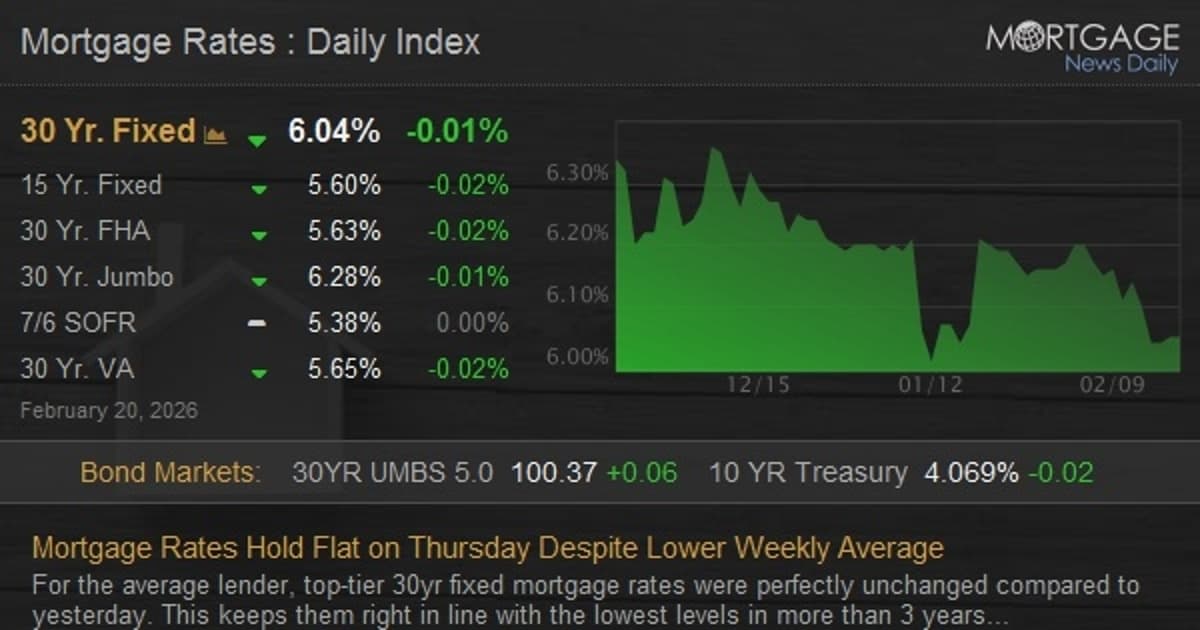
Mortgage Rates Hold Flat on Thursday Despite Lower Weekly Average
•February 19, 2026
0
Why It Matters
Flat, near‑record mortgage rates can boost home‑buyer confidence and influence refinancing activity, while methodological nuances affect market perception and policy decisions.
Key Takeaways
- •30‑yr fixed rates unchanged Thursday
- •Weekly average hits three‑year low per Freddie Mac
- •Daily index shows rates slightly higher today
- •Methodology difference drives headline discrepancies
- •Flat rates signal market stability for borrowers
Pulse Analysis
The mortgage market has entered a rare phase of stability, with the benchmark 30‑year fixed rate holding steady at levels not seen since early 2023. After a period of volatility driven by inflation concerns and shifting Federal Reserve policy, lenders are now offering rates that hover around the three‑year low threshold. This steadiness benefits prospective homebuyers, who can lock in financing costs without fearing sudden spikes, and it also supports the broader housing market by sustaining demand for new purchases and refinances.
Understanding the apparent contradiction between daily rate indices and Freddie Mac’s weekly survey is essential for investors and analysts. Freddie Mac aggregates rates over a seven‑day window, smoothing out day‑to‑day fluctuations, whereas daily indices capture real‑time pricing from lenders. Consequently, the weekly average can register a historic low even when the most recent day's rate is marginally higher. This methodological nuance explains why headlines may proclaim record lows while on‑the‑ground rates appear unchanged, underscoring the importance of scrutinizing data sources before drawing conclusions about market trends.
For borrowers, the current environment presents an opportune moment to consider refinancing or entering the market, as the cost of borrowing remains competitive. Lenders, meanwhile, can leverage the perception of low rates to attract volume without sacrificing margins. Looking ahead, any shift in monetary policy or macro‑economic indicators could disrupt this equilibrium, but for now, the flat rate landscape offers a predictable backdrop for both consumers and industry stakeholders.
Mortgage Rates Hold Flat on Thursday Despite Lower Weekly Average
0
Comments
Want to join the conversation?
Loading comments...