Private Residential Construction Spending Increases in April
Companies Mentioned
Why It Matters
The modest rise signals resilient demand for new homes and renovations despite higher borrowing costs, shaping builder strategies and supply‑chain planning. It also highlights divergent trends between single‑family, multifamily, and improvement markets, informing investors and policymakers about housing‑sector health.
Key Takeaways
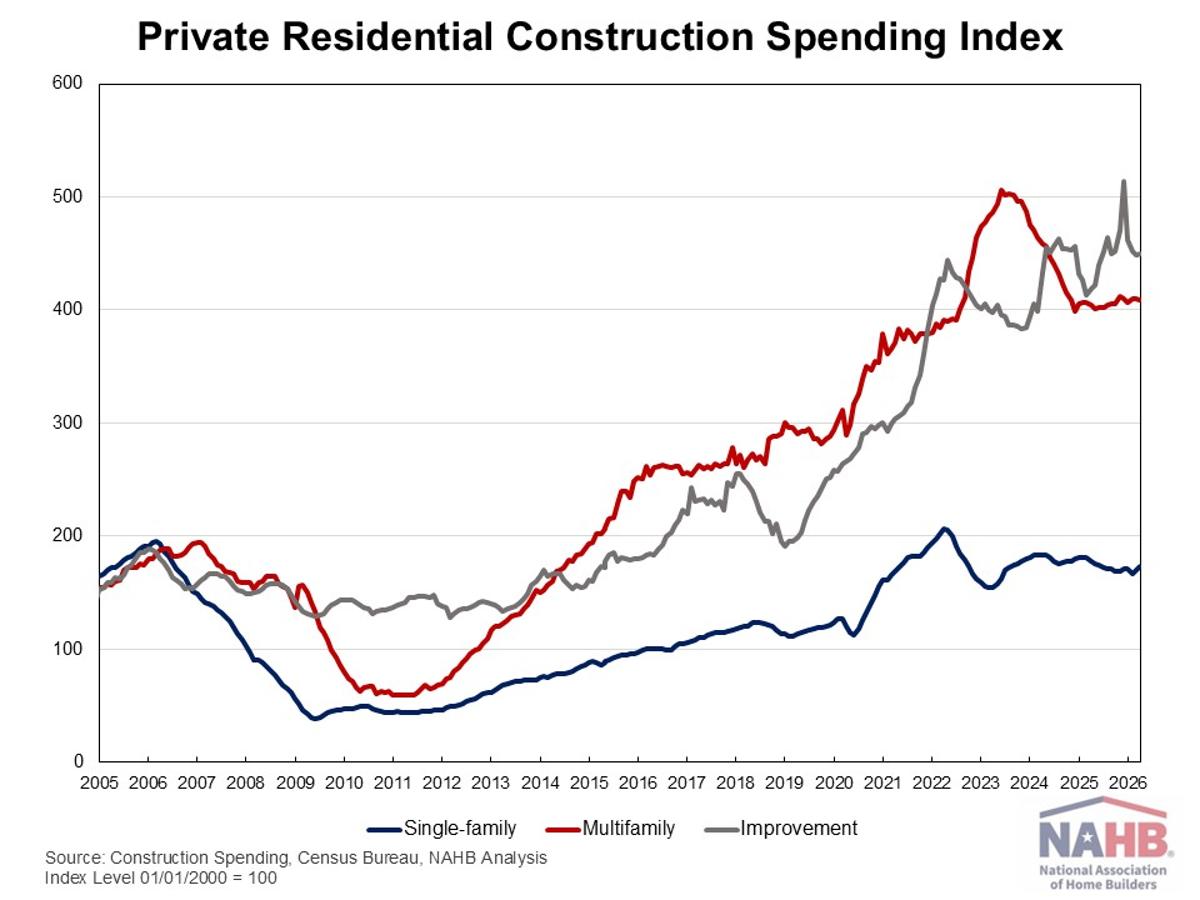
- •Private residential construction spending rose 0.8% in April 2026.
- •Single‑family construction up 1.4% month‑over‑month, but down 2.9% YoY.
- •Home‑improvement spending increased 0.4% monthly and 7.5% YoY.
- •Multifamily construction slipped 0.3% in April, ending two‑month gain streak.
- •Builder confidence remains steady despite higher interest rates and material tariffs.
Pulse Analysis
The U.S. Census Bureau’s latest construction‑spending report shows private residential activity edging higher in April, driven primarily by single‑family builds and a robust remodeling market. A 0.8% month‑over‑month gain marks the second consecutive rise, suggesting that home‑buyer demand remains solid even as mortgage rates hover near historic highs. Builders are cautiously optimistic, as reflected in the NAHB/Wells Fargo Housing Market Index, which continues to register confidence levels above the neutral threshold.
Single‑family construction posted a 1.4% monthly increase, yet it remains 2.9% below its April 2025 level. The slowdown traces back to tighter credit conditions and lingering tariffs on lumber and steel, which have compressed profit margins. Multifamily projects, while still 1.1% ahead of a year ago, fell 0.3% in April, indicating that developers are pausing new units amid uncertainty over rental demand and financing costs. This divergence underscores a market pivot: developers are favoring smaller, owner‑occupied projects over larger, higher‑risk multifamily ventures.
Conversely, home‑improvement spending is the bright spot, climbing 0.4% month‑over‑month and 7.5% year‑over‑year. An aging housing stock, with nearly half of owner‑occupied homes built before 1980, fuels demand for renovations, energy‑efficiency upgrades, and kitchen remodels. Lenders are responding with tailored loan products, keeping the renovation pipeline full despite tighter credit standards. For investors, the data suggest that while new‑home construction faces headwinds, the remodeling sector offers a resilient growth avenue, especially as demographic trends push older homeowners toward upgrades rather than new purchases.
Private Residential Construction Spending Increases in April
Comments
Want to join the conversation?
Loading comments...