Student Housing Construction Investment Holds Steady in the First Quarter of 2026
Why It Matters
The steady investment signals confidence in student‑housing construction despite tighter financing, and highlights how demographic trends will shape the sector’s growth trajectory.
Key Takeaways
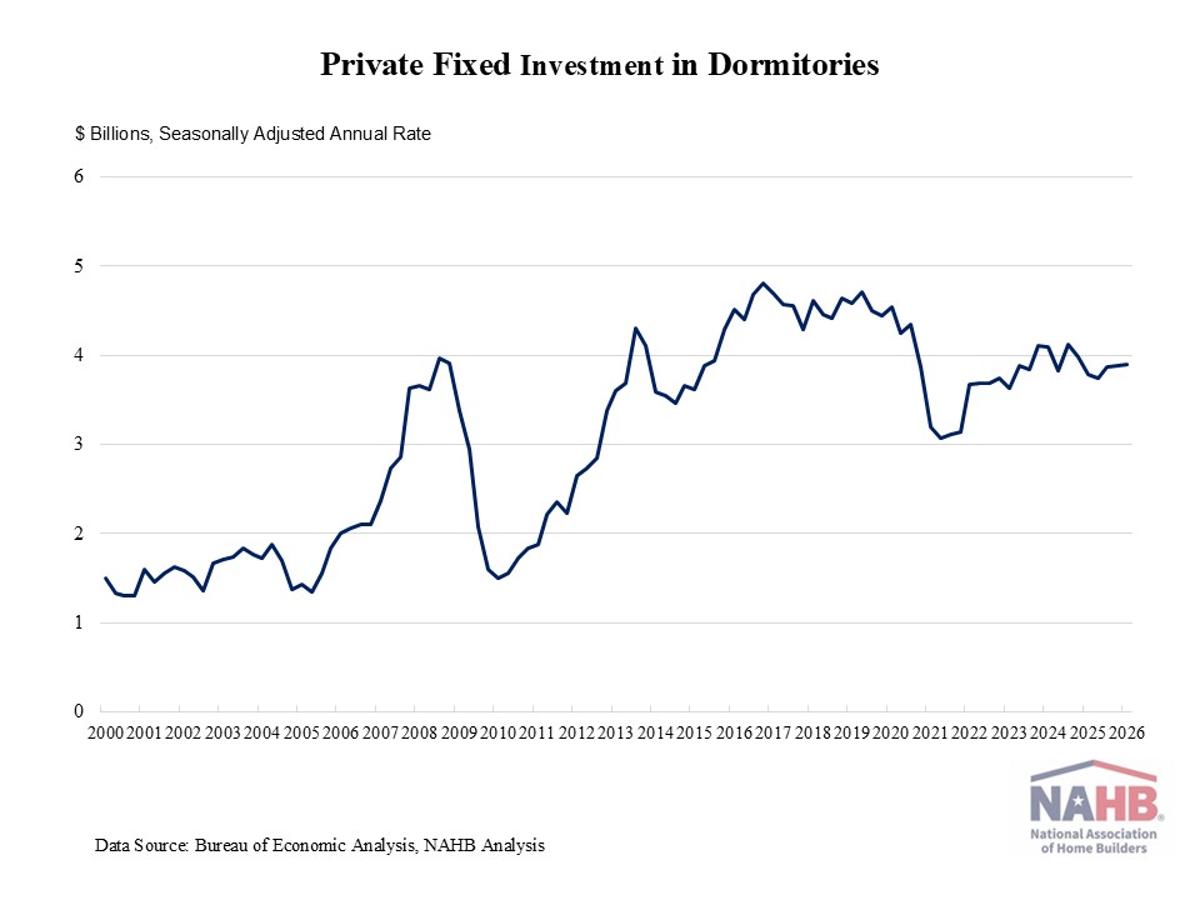
- •Q1 2026 dorm investment rose 0.1% to $3.9 billion SAAR.
- •Investment marks third straight quarterly increase despite high interest rates.
- •Year‑over‑year dorm investment remains essentially flat.
- •Enrollment recovery fuels construction, but college‑age population growth slows.
- •Projected 8% enrollment rise 2020‑2030 limits long‑term demand.
Pulse Analysis
The latest data from the Federal Reserve shows private fixed investment in student housing edging higher for a third straight quarter, reaching a $3.9 billion seasonally adjusted annual rate. After a steep pandemic‑era decline that saw investment dip to $3 billion in 2021, the sector has recovered modestly even as borrowing costs stay elevated. This resilience reflects a renewed demand for on‑campus living as universities shift back to in‑person instruction, providing a short‑term boost to construction firms and lenders focused on higher‑education assets.
Underlying this uptick is a nuanced enrollment picture. While post‑pandemic enrollment has rebounded from the 3‑plus percent drops recorded in 2020‑21, the overall college‑age population is growing more slowly due to lower birth rates after the Great Recession. The National Center for Education Statistics projects only an 8% increase in total enrollment from 2020 to 2030, far below the 37% surge of the previous decade. Consequently, developers must balance the immediate need for new dormitory capacity with a longer‑term outlook that may feature flatter demand, prompting a shift toward mixed‑use projects and adaptive‑reuse of existing spaces.
For investors and university operators, the steady investment flow suggests that financing remains accessible, but risk assessments will increasingly factor demographic headwinds. Lenders are likely to scrutinize cash‑flow projections more closely, while universities may explore public‑private partnerships to share construction costs. Developers that can integrate flexible design—accommodating both traditional dorms and co‑living or short‑term rental models—will be better positioned to capture market share as enrollment growth moderates. Overall, the sector’s near‑term outlook is positive, but strategic adaptation will be key to sustaining growth through the 2030 horizon.
Student Housing Construction Investment Holds Steady in the First Quarter of 2026
Comments
Want to join the conversation?
Loading comments...