Fannie Mae Raises Mortgage Rate Forecast Through 2027
Companies Mentioned
Why It Matters
Higher mortgage rates curb refinancing and purchase activity, pressuring housing affordability and GSE earnings, while signaling that monetary policy and geopolitical risk will dominate mortgage market dynamics through 2027. Lenders and investors must adjust pricing and capital strategies accordingly.
Key Takeaways
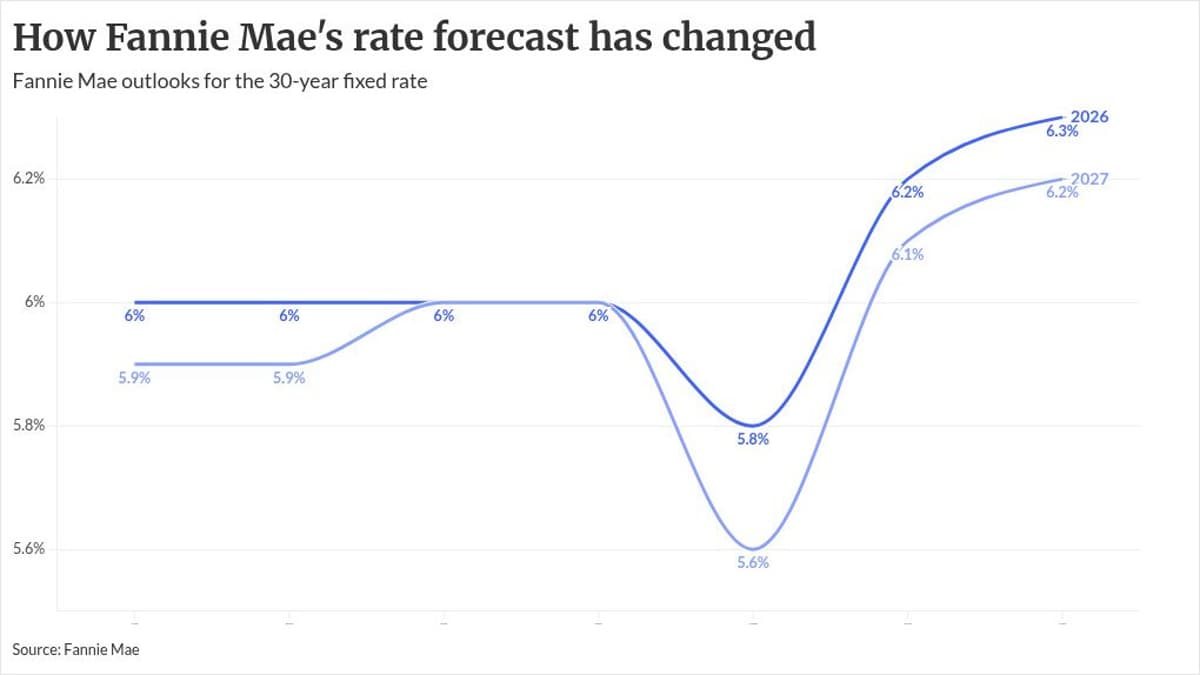
- •30‑year fixed mortgage average set at 6.3% through 2026
- •Rates stay near 6.2% until Q2 2027, then flat
- •Iran war and oil prices drive stickier mortgage rates
- •Fannie Mae trims 2024 originations to $2.36 trillion
- •2027 loan volume forecast lowered to $2.49 trillion
Pulse Analysis
The latest Fannie Mae outlook pushes the average 30‑year fixed mortgage rate to 6.3% for the rest of 2024 and holds it steady through 2026, a clear departure from the 6% ceiling the GSE projected at the end of 2025. The revision is anchored in a confluence of factors: a sudden 48‑basis‑point jump in March triggered by the Iran war, soaring oil prices that have lifted headline inflation, and a Federal Reserve that appears unlikely to ease policy before 2026. Together, these forces have made rates more persistent than analysts previously expected.
Persistently high rates translate into fewer refinance applications and a slowdown in purchase‑side demand, especially among price‑sensitive first‑time buyers. Fannie Mae’s own originations forecast reflects this pressure, trimming 2024 loan volume to $2.36 trillion and cutting the 2027 projection to $2.49 trillion, down from earlier estimates of $2.38 trillion and $2.52 trillion respectively. Mortgage lenders are likely to tighten underwriting standards and reprice loans to protect margins, while servicers anticipate a shift toward higher‑rate, lower‑balance mortgages that could affect cash‑flow projections for years to come.
The outlook underscores how geopolitical risk and energy markets now rival traditional economic indicators in shaping mortgage pricing. Investors in mortgage‑backed securities should factor in a longer‑term rate plateau when modeling prepayment speeds and credit performance. For policymakers, the forecast signals that any attempt to stimulate the housing market will need to address inflation‑linked rate rigidity rather than rely on conventional monetary easing. As the Middle East conflict evolves, oil‑price volatility will remain a key driver of mortgage‑rate trajectories through the late 2020s.
Fannie Mae raises mortgage rate forecast through 2027
Comments
Want to join the conversation?
Loading comments...