Private Residential Construction Spending Increases in March
Companies Mentioned
Why It Matters
The turnaround signals renewed builder confidence and consumer demand for housing upgrades, which can lift related supply chains and influence monetary‑policy outlooks. It also underscores a shift toward residential activity as non‑residential spending weakens.
Key Takeaways
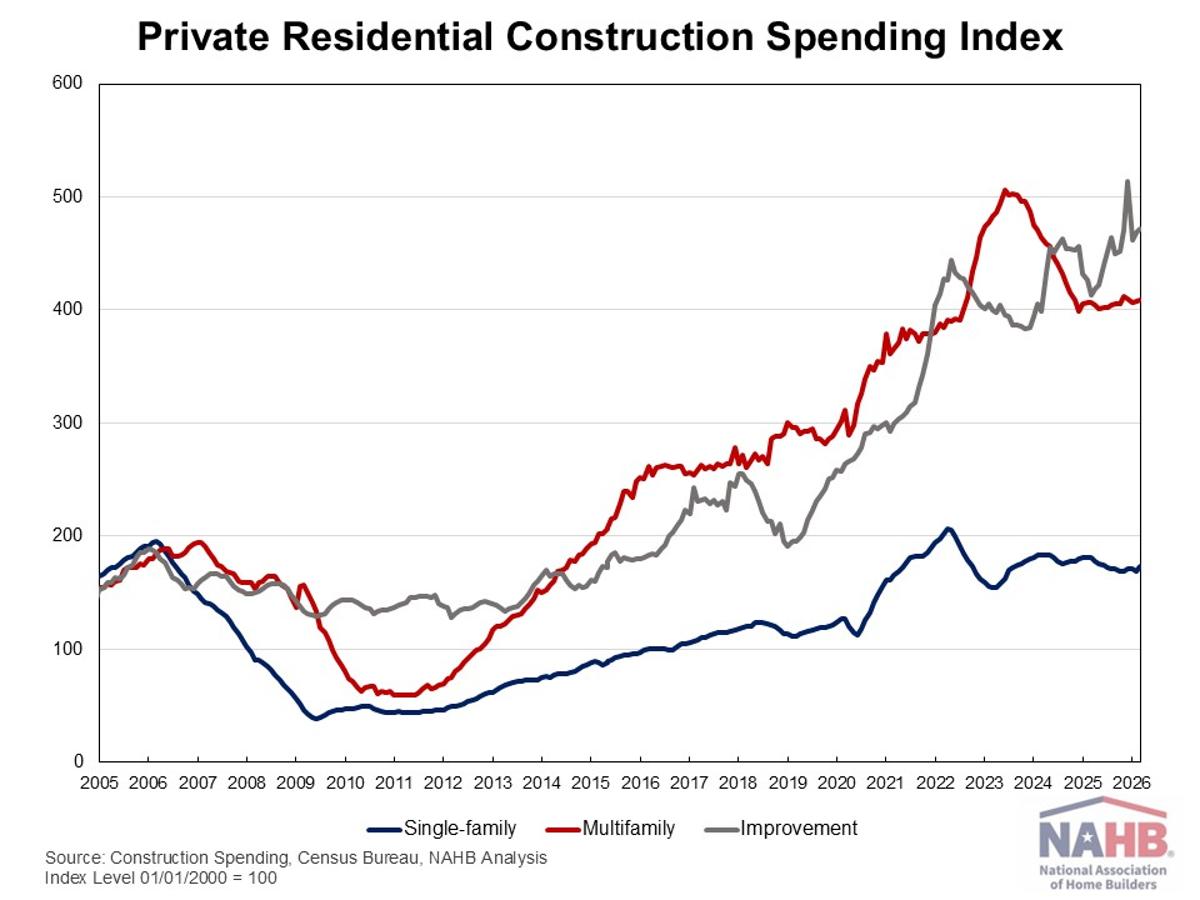
- •March residential spending rose 1.7% after two months of decline
- •Single‑family construction up 2.7% month‑over‑month, still down 4.2% YoY
- •Multifamily spending edged up 0.3% in March, 0.5% higher YoY
- •Home‑improvement spending grew 0.9% monthly, 14.3% YoY
- •Nonresidential construction fell 2.1% YoY, driven by $39 B manufacturing drop
Pulse Analysis
The latest U.S. Census data shows private residential construction spending climbing 1.7% in March 2026, snapping a two‑month slide. This modest rebound reflects a broader stabilization of the housing market after the Federal Reserve’s aggressive rate hikes in 2023‑24, which had dampened new‑home starts. While the year‑over‑year gain of 3.6% signals renewed demand, the pace remains constrained by lingering financing costs and material‑price volatility. Analysts view the March uptick as a tentative but positive signal that builder confidence is recovering.
Sector‑level detail reveals divergent dynamics. Single‑family construction posted a 2.7% month‑over‑month increase, yet its annual output remains 4.2% below March 2025 levels, underscoring the lingering impact of higher mortgage rates on new‑home buyers. Multifamily projects edged up 0.3% and are now 0.5% ahead of a year ago, suggesting steady rental‑market fundamentals. The most robust growth came from home‑improvement spending, which rose 0.9% in March and is up 14.3% year‑over‑year, driven by an aging housing stock and consumer willingness to invest in renovations.
The contrast between residential resilience and a 2.1% decline in private non‑residential construction—anchored by a $39 billion drop in manufacturing projects—highlights a sectoral shift toward consumer‑driven activity. Investors and policymakers should monitor the trajectory of builder sentiment indices, such as the NAHB/Wells Fargo Housing Market Index, for clues about future supply pipelines. If financing conditions ease and material‑tariff uncertainties recede, the modest March gains could accelerate, bolstering related industries from lumber to home‑improvement retailers.
Private Residential Construction Spending Increases in March
Comments
Want to join the conversation?
Loading comments...