Nvidia Releases Open Source Tools and Skills for Devs Working on Physical AI
Companies Mentioned
NVIDIA
NVDA
Foxconn Technology Group
2317
Pegatron
4938
Compal
2324
Dassault Systèmes
DSY
Siemens
SIE
Synopsys
SNPS
Lightwheel
PTC
PTC
Nebius
Microsoft
MSFT
SK hynix
000660
Taiwan Semiconductor Manufacturing Company
TSM
SK Telecom
SKM
Inventec
2356
Cadence
CDNS
CoreWeave
CRWV
Agile Robots
1X
Neura Robotics
Skild
Universal Robots
FieldAI
GitHub
Why It Matters
By making physical‑AI pipelines agent‑ready, Nvidia lowers barriers to building complex autonomous systems, accelerating innovation across manufacturing, transportation and healthcare. This shift promises faster time‑to‑market and cost savings for enterprises adopting AI‑driven hardware.
Key Takeaways
- •Nvidia Agent Toolkit now includes open‑source physical AI skills
- •Skills accelerate robotics, AV, vision, and industrial AI pipelines
- •Pegatron cut model training time 67% using synthetic data skill
- •Li Auto generates over 300K daily simulations with Omniverse NuRec
- •Microsoft and CoreWeave integrate Nvidia tools for cloud‑scale AI development
Pulse Analysis
Nvidia’s latest open‑source release positions the company at the forefront of the emerging "physical AI" market, where intelligent agents move beyond code generation to orchestrate real‑world systems. By exposing core libraries—Cosmos, Omniverse, Isaac, Metropolis, Alpamayo and Jetson—as agent‑callable skills, Nvidia eliminates the manual glue that traditionally slows robotics and autonomous‑vehicle development. Developers can now script end‑to‑end pipelines that generate synthetic data, run high‑fidelity simulations, and fine‑tune models without hand‑crafting each step, dramatically cutting iteration cycles.
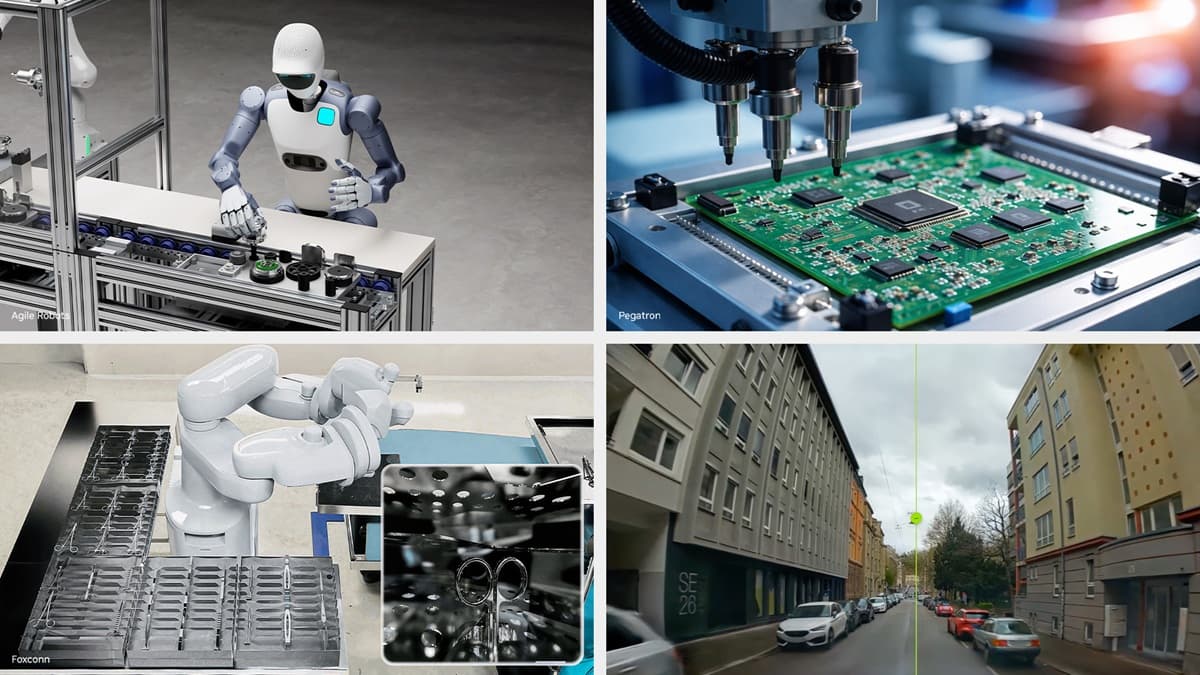
The impact is already visible in early deployments. Taiwanese manufacturers such as Pegatron and Delta Electronics leveraged the Defect Image Generation skill to slash model training time by 67% and boost defect detection rates by 17%, respectively. In the autonomous‑driving arena, Li Auto and DeepRoute.ai are producing over 300,000 daily scene reconstructions using Nvidia’s Omniverse NuRec models, expanding training coverage and safety validation. Industrial giants like Siemens and SK hynix are building digital twins of semiconductor fabs, accelerating design verification and predictive maintenance.
Cloud providers are also embracing the toolkit, with Microsoft Azure, CoreWeave and Nebius embedding Nvidia’s agent skills into their AI services. This integration enables developers to spin up scalable synthetic‑data pipelines on demand, reducing the need for costly on‑prem hardware. As agent‑driven development matures, Nvidia’s open‑source approach is likely to become a de‑facto standard, fostering a more collaborative ecosystem and speeding the commercialization of next‑generation robotics, autonomous vehicles, and AI‑powered healthcare solutions.
Nvidia releases open source tools and skills for devs working on physical AI
Comments
Want to join the conversation?
Loading comments...