AMD Backs Hybrid Quantum-Classical Computing to Accelerate Commercial Quantum Adoption
Key Takeaways
- •AMD positions CPUs, GPUs, FPGAs as quantum accelerator infrastructure
- •U.S. Commerce Dept commits >$2 B to quantum ecosystem
- •Hybrid quantum‑classical workloads reduce error and scaling challenges
- •Partnerships with IBM, JPMorgan Chase, Oak Ridge drive real‑world use cases
Pulse Analysis
Quantum computing is moving from a purely experimental field to a strategic technology, driven by massive public and private funding. The U.S. Department of Commerce’s recent $2 billion commitment signals confidence that quantum will soon impact sectors ranging from national security to drug discovery. Yet quantum processors alone cannot solve real‑world problems; they require a robust classical layer for control, error correction, and data handling. This hybrid model mirrors high‑performance computing, where specialized accelerators complement general‑purpose CPUs to maximize efficiency.
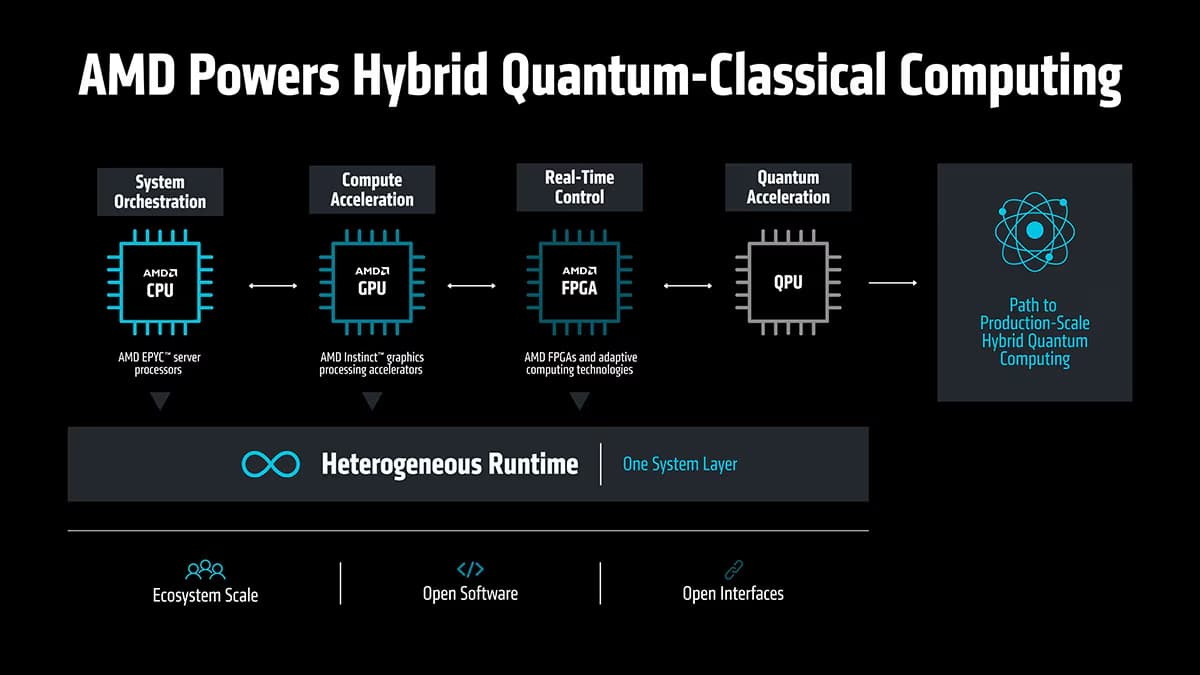
AMD’s extensive portfolio makes it uniquely suited to fill that classical gap. Its EPYC server CPUs manage orchestration and workflow, while Instinct GPUs accelerate simulation and AI‑assisted research. Adaptive FPGAs provide low‑latency control and real‑time error correction, and AMD’s networking and software stack bind these components into scalable platforms. By evolving the ROCm ecosystem to support quantum accelerators, AMD is turning its existing HPC tools into a bridge for quantum workloads, ensuring developers can leverage familiar APIs while tapping quantum advantage.
The industry impact is already visible through AMD’s partnerships with IBM, JPMorgan Chase, and Oak Ridge National Laboratory. These collaborations test hybrid workloads in finance, scientific research, and supercomputing, demonstrating tangible value beyond theoretical speedups. As quantum hardware matures, the demand for integrated, high‑performance classical infrastructure will grow, positioning AMD as a critical enabler of the quantum era and opening new revenue channels across cloud, enterprise, and research markets.
AMD Backs Hybrid Quantum-Classical Computing to Accelerate Commercial Quantum Adoption
Comments
Want to join the conversation?