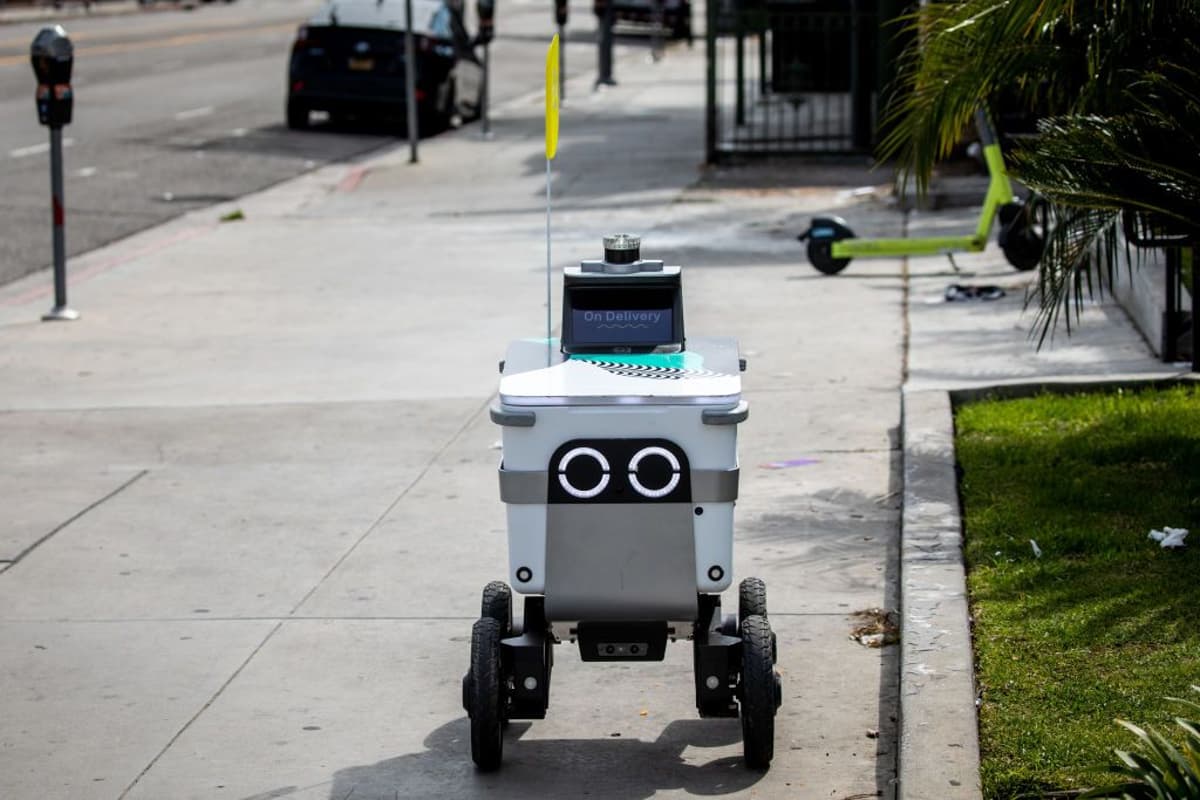
Serve Robotics Fails to Deliver for Investors – Here's How to Play It
Companies Mentioned
Why It Matters
The stark valuation gap versus operational reality signals heightened risk for investors and underscores broader challenges for the last‑mile robot delivery sector.
Key Takeaways
- •Serve Robotics operates ~2,000 delivery robots as of Feb 2026.
- •Robots frequently get stuck, lost, or face theft, hurting reliability.
- •Major U.S. cities restrict or ban robots, limiting market expansion.
- •Valuation at 20× forward sales and 262× revenue exceeds peers.
- •Analyst advises short at $9.40, stop‑loss $18.40 (~$1.15k).
Pulse Analysis
The promise of autonomous delivery robots has long enticed investors seeking to disrupt the $150 billion U.S. food‑delivery market. Serve Robotics entered the arena with a fleet of box‑shaped units designed to shuttle meals from restaurants to doorsteps, touting lower labor costs and reduced emissions. Early pilots generated buzz, but as the fleet expanded to roughly 2,000 units, practical flaws emerged: navigation errors, mechanical jams, and even food theft eroded the cost‑advantage narrative. Restaurants, the primary customers, report that the robots rarely deliver measurable savings, prompting many to abandon the service altogether.
Regulatory resistance compounds the operational woes. Cities such as San Francisco and Chicago have imposed strict limits or outright bans on sidewalk robots, citing pedestrian safety and accessibility concerns. Public sentiment is equally hostile; incidents of vandalism and pedestrian hazards have fueled calls for broader prohibitions. These headwinds limit Serve’s ability to scale, especially in the United States where the majority of its target market resides. Meanwhile, competitors like Starship Technologies and Coco Robotics are racing ahead, leveraging more refined hardware and stronger municipal partnerships.
Despite these challenges, Serve’s market valuation remains inflated, trading at about 20 × forward sales and an astronomical 262 × current revenue—multiples that dwarf the 7‑10 × range typical for high‑growth tech firms. This disparity reflects speculative optimism rather than fundamentals, creating a fertile ground for short‑selling strategies. The MoneyWeek recommendation to short at $9.40 with a stop‑loss at $18.40 translates to a potential loss ceiling of roughly $1,150 per position, highlighting the high‑risk, high‑reward profile of betting against a company whose hype outpaces its execution.
Serve Robotics fails to deliver for investors – here's how to play it
Comments
Want to join the conversation?
Loading comments...