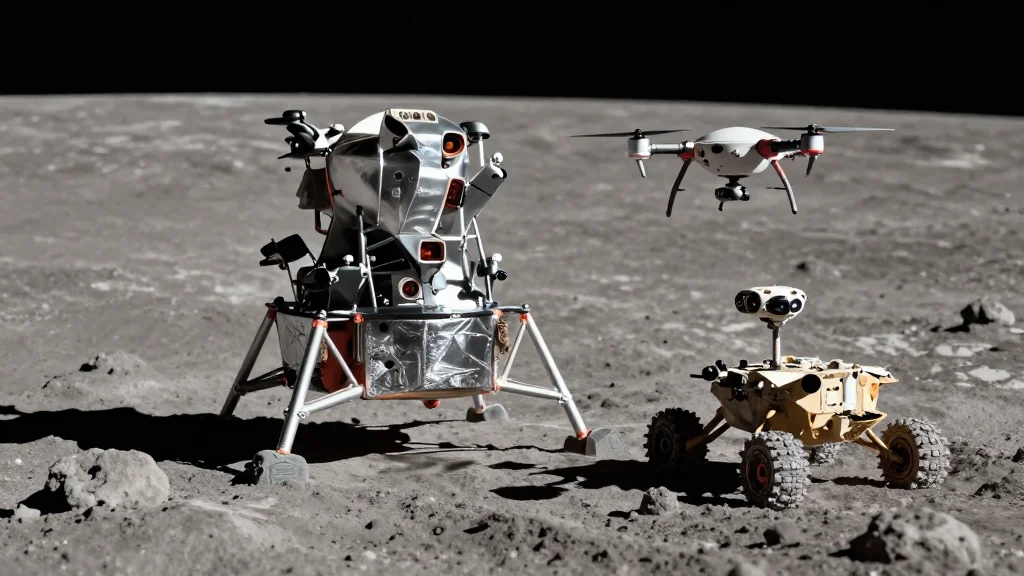
NASA Awards Contracts to Blue Origin, Astrolab and Lunar Outpost for Lunar Lander and Rover Work

Companies Mentioned


Why It Matters
The contracts mark the first concrete step toward NASA’s ambitious Moon Base program, translating policy goals into hardware that will test autonomous landing, surface mobility and payload integration. By involving multiple commercial partners, the agency is diversifying risk and fostering a nascent lunar supply chain that could support not only NASA missions but also private scientific and mining ventures. Successful demonstrations will prove the viability of a reusable, modular architecture, accelerating the timeline for a permanently crewed outpost and strengthening U.S. leadership in a domain where China and Russia are also investing heavily. Beyond the immediate technical objectives, the awards signal a broader shift in how deep‑space exploration is funded and executed. Instead of relying solely on internal NASA development, the agency is leveraging market competition to drive down costs, spur innovation, and create a commercial ecosystem that can sustain long‑term operations on the Moon and, eventually, on Mars.
Key Takeaways
- •NASA awarded contracts to Blue Origin, Astrolab and Lunar Outpost for Phase 1 Moon Base hardware
- •Contracts cover robotic landers, hopping drones and lunar terrain vehicles for launches as early as autumn 2026
- •Program manager Carlos Garcia‑Galan called the awards "incredibly important" for Phase 1
- •Administrator Jared Isaacman said the Moon base will be "America's and humanity's first outpost on another celestial world"
- •Phase 1 aims to deliver ~4 metric tons of cargo by 2029, scaling to 150 metric tons by Phase 3
Pulse Analysis
NASA’s decision to split the Moon Base hardware procurement among three firms reflects a deliberate risk‑mitigation strategy. By not placing the entire burden on a single prime contractor, the agency can compare performance metrics across different architectures—Blue Origin’s Endurance lander, Astrolab’s terrain vehicles and Lunar Outpost’s modular rovers—while preserving schedule flexibility. This multi‑vendor approach also creates a competitive market that could drive down per‑mission costs, a critical factor as the program scales to the 150‑metric‑ton payloads envisioned for Phase 3.
Historically, lunar hardware development has been dominated by large aerospace primes with deep government ties. The inclusion of a European‑based firm (Astrolab) and a boutique rover specialist (Lunar Outpost) signals a democratization of lunar services, likely spurred by the Artemis Accords’ emphasis on international collaboration. If these smaller players can deliver on time and on budget, they will set a precedent for future open‑competition solicitations, potentially opening the door for even more diverse participants, including university spin‑outs and non‑U.S. entities.
From a market perspective, the contracts could catalyze a cascade of ancillary investments. Launch providers, component manufacturers, and software firms that support autonomous navigation and surface communications stand to benefit from the increased demand. Moreover, the contracts reinforce the notion that the Moon will become a testbed for technologies—such as in‑situ resource utilization and autonomous swarm robotics—that are essential for Mars missions. As NASA demonstrates these capabilities, commercial confidence in lunar‑based business models—whether scientific, tourism‑focused, or resource‑extraction oriented—will likely rise, shaping the next decade of space economics.
NASA awards contracts to Blue Origin, Astrolab and Lunar Outpost for lunar lander and rover work
Comments
Want to join the conversation?
Loading comments...