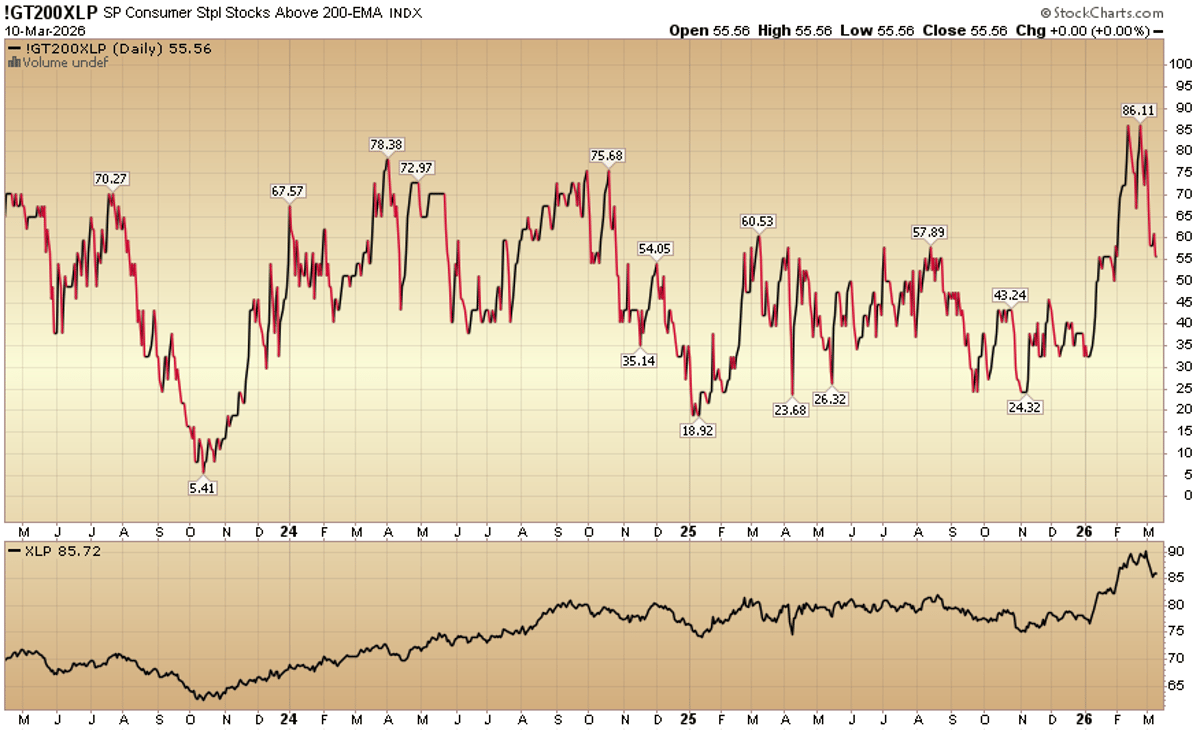
Indicator of the Day (Video): S&P Consumer Staples Stocks Above 200 EMA
•March 11, 2026
0
Key Takeaways
- •Index trading above 200‑day EMA signals bullish momentum
- •Consumer staples show resilience amid inflation pressures
- •Trend may attract defensive investors seeking stable returns
- •Technical breakout could precede sector outperformance
- •Monitoring volume confirms strength of upward move
Summary
The S&P Consumer Staples Index has moved above its 200‑day exponential moving average, a key technical signal often interpreted as a bullish trend. The crossover suggests that the defensive sector is gaining upward momentum after a period of volatility. Investors may view this as a cue to increase exposure to staple stocks, which historically perform well in uncertain economic environments. The indicator aligns with broader market sentiment favoring stable, cash‑generating businesses.
Pulse Analysis
A 200‑day exponential moving average (EMA) is a widely watched benchmark among technical analysts because it smooths price data while still reflecting recent market sentiment. When an index crosses above this line, it often marks the start of a sustained uptrend, especially if accompanied by rising volume. Historical back‑tests of the S&P Consumer Staples sector reveal that EMA breakouts have preceded periods of relative outperformance, as the sector’s defensive nature tends to draw capital during market uncertainty.
Consumer staples companies—ranging from food producers to household goods manufacturers—benefit from inelastic demand, making earnings less sensitive to economic cycles. Recent earnings reports show modest revenue growth despite lingering inflationary pressures, as firms passed higher input costs onto consumers without eroding market share. Additionally, many staple firms have strong dividend yields, enhancing their appeal for income‑focused investors. The sector’s resilience is further supported by demographic trends that sustain consumption of essential goods, providing a solid earnings foundation even when discretionary spending wanes.
For portfolio managers, the EMA crossover offers a tactical entry point to overweight a traditionally low‑volatility asset class. However, prudent investors will seek confirmation through ancillary indicators such as relative strength index levels, trading volume spikes, and macro‑economic data on consumer confidence. Potential risks include unexpected supply‑chain disruptions or abrupt shifts in monetary policy that could compress margins. Monitoring these factors alongside the technical signal can help investors balance the upside of a bullish trend with the inherent steadiness of the consumer staples sector.
Comments
Want to join the conversation?