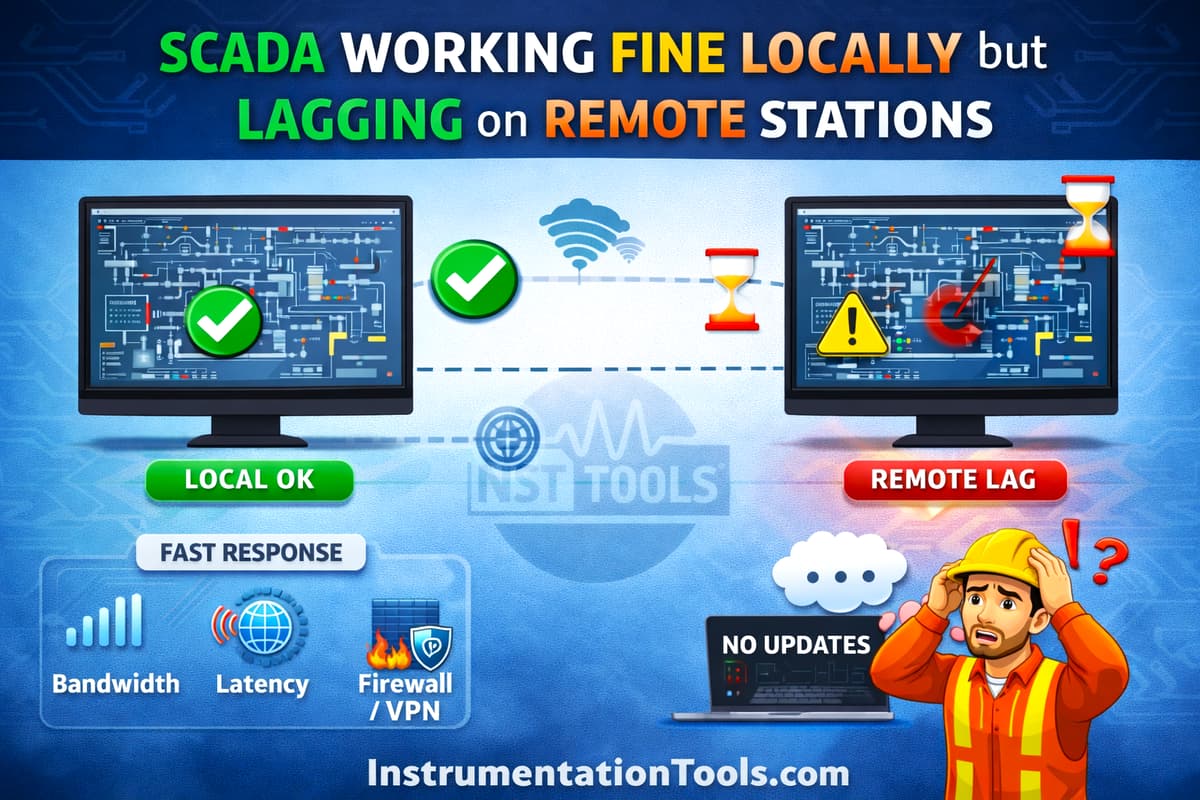
SCADA Working Fine Locally but Lagging on Remote Stations
Key Takeaways
- •Network latency and bandwidth limit remote SCADA responsiveness.
- •Over‑subscribing tags overloads server and network traffic.
- •Complex graphics increase data transfer and client rendering time.
- •Under‑powered client PCs struggle with real‑time SCADA visuals.
- •Aggressive update rates or security scans add communication delays.
Pulse Analysis
Industrial operators increasingly rely on distributed SCADA workstations to monitor processes from plant floors to remote control centers. While the central server can access PLC data over a high‑speed Ethernet backbone, remote clients depend on the broader corporate network, VPN tunnels, or even Wi‑Fi links. Even modest latency spikes—common on long‑haul or congested links—compound when hundreds of tags are refreshed every second, leading to perceptible lag. Recognizing that the bottleneck often lies outside the SCADA software itself is the first step toward a systematic remediation plan.
Effective SCADA design now emphasizes data efficiency as much as visual fidelity. Engineers should audit tag subscriptions, grouping rarely‑changed variables into slower scan classes and limiting the number of active tags per graphic page. Simplifying graphics—using vector‑based elements, reducing high‑resolution backgrounds, and disabling non‑essential animations—cuts the payload sent to remote stations. Adjusting server‑to‑client update rates to match the criticality of each tag prevents unnecessary traffic bursts. Moreover, scaling OPC server resources or distributing data acquisition across edge gateways can alleviate processing queues that otherwise delay tag propagation.
Finally, remote client hardware and security policies must align with real‑time requirements. Upgrading RAM, CPUs, and graphics adapters on operator PCs ensures they can render complex screens without stutter. Coordinating with IT to whitelist SCADA protocols, tune firewall inspection depths, and schedule antivirus scans during off‑peak windows reduces artificial latency. As edge computing and thin‑client technologies mature, many plants are moving processing closer to the data source, further mitigating network‑induced delays and delivering a smoother remote SCADA experience.
SCADA Working Fine Locally but Lagging on Remote Stations
Comments
Want to join the conversation?