Time Synchronization Issues Between PLC, SCADA and Historian
Key Takeaways
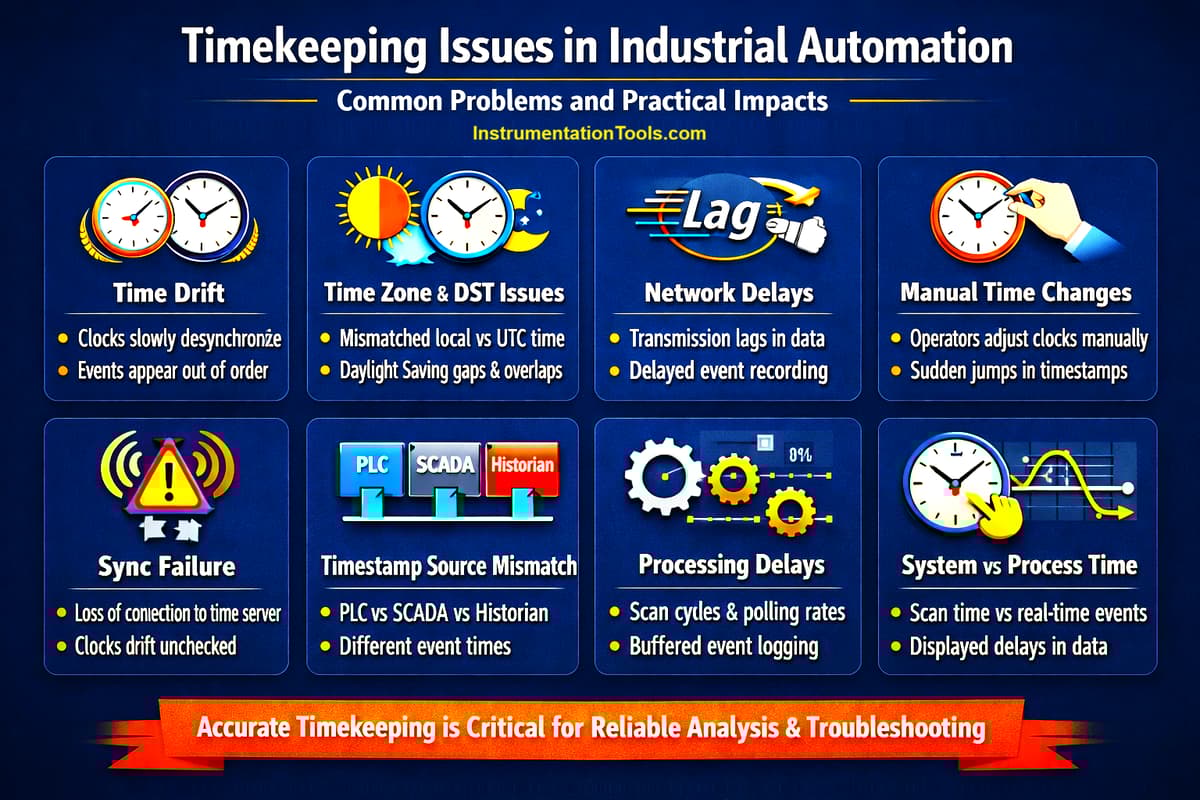
- •PLC clocks can drift 20–30 seconds ahead of SCADA in days
- •Mismatched time zones cause historian logs to appear hours apart from SCADA
- •Network latency can offset event timestamps by seconds, skewing sequence analysis
- •Manual clock adjustments create gaps or duplicate timestamps in alarm histories
- •Scan cycles and polling rates add processing delays beyond clock sync
Pulse Analysis
Industrial automation relies on precise event sequencing, and time synchronization is the backbone of that precision. Modern plants typically adopt Network Time Protocol (NTP) or the more accurate Precision Time Protocol (PTP) to distribute a single reference clock across PLCs, SCADA workstations, and historians. By anchoring all devices to Coordinated Universal Time (UTC), operators eliminate the ambiguity introduced by local time zones and daylight‑saving shifts, creating a uniform temporal framework that supports reliable alarm correlation and trend analysis.
Despite a common time source, practical issues still arise. Clock drift—often 20 to 30 seconds over several days—can accumulate unnoticed, especially when devices run on independent hardware timers. Network latency, even a few milliseconds, may appear negligible but can reorder events in fast‑acting processes. Moreover, manual clock corrections, though well‑intentioned, generate abrupt timestamp jumps that corrupt historical continuity. These factors combine to obscure the true cause‑effect chain, forcing engineers to spend valuable time reconciling disparate logs.
Mitigation starts with a centralized, high‑precision time server and strict configuration policies that enforce UTC across the entire stack. Automated synchronization should run at intervals short enough to prevent drift, while monitoring tools alert operators to any deviation beyond a defined threshold. Additionally, aligning PLC scan cycles and SCADA polling rates reduces processing lag, and employing timestamping at the point of data acquisition—rather than at storage—preserves event fidelity. Together, these best practices ensure that time‑related data remains trustworthy, enabling faster decision‑making and reducing the risk of production downtime.
Time Synchronization Issues Between PLC, SCADA and Historian
Comments
Want to join the conversation?