Why Does PLC Redundancy Fails During Switchover?
Key Takeaways
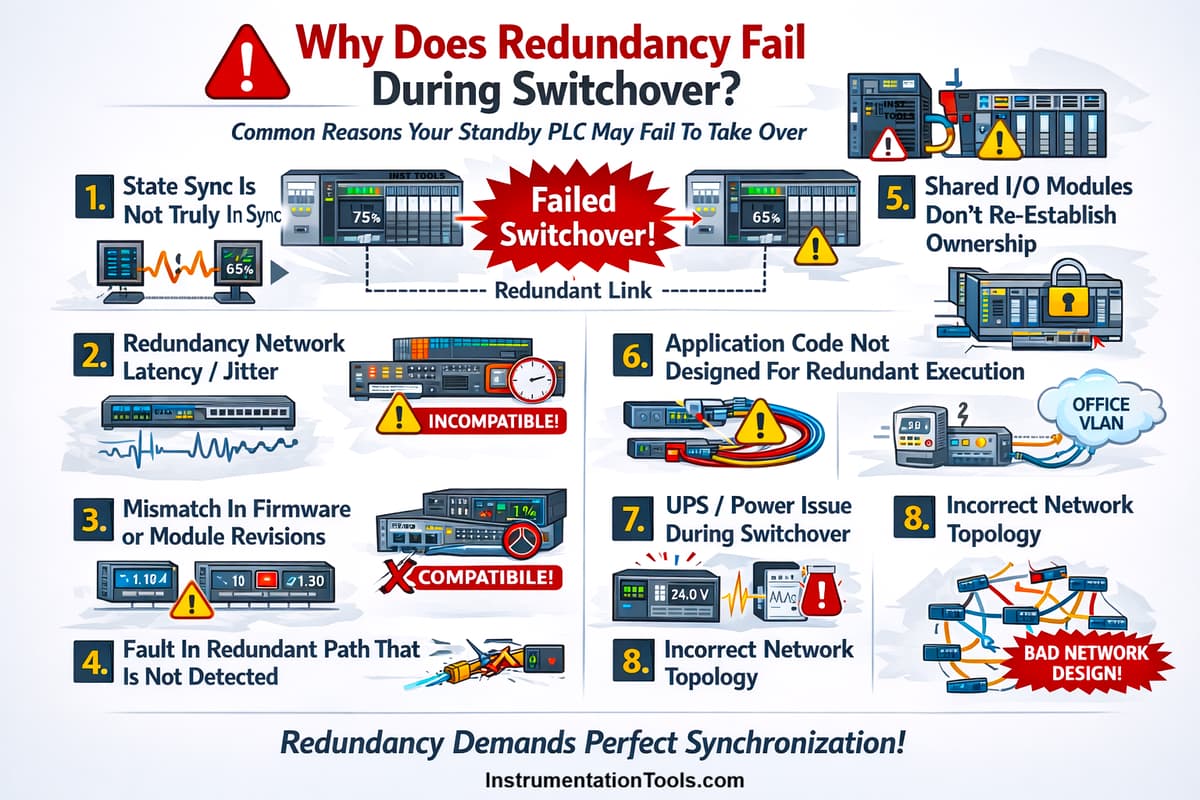
- •Imperfect state sync causes millisecond mismatches that break switchover
- •Redundancy link latency above 20 ms triggers heartbeat timeouts
- •Firmware or module version differences prevent proper packet decoding
- •Slow I/O ownership transfer stalls standby controller during failover
- •Power dips or poor network topology cause hidden sync failures
Pulse Analysis
In industrial automation, PLC redundancy is the backbone of high‑availability control systems. By continuously mirroring runtime data— I/O images, timers, PID states, and communication buffers— the standby controller can assume the primary role without a noticeable gap. However, this seamless handoff hinges on perfect timing and identical runtime states, a condition that is difficult to guarantee in real‑world plants where microsecond variations can cascade into equipment mis‑behaviour.
Technical investigations reveal several repeatable failure mechanisms. Minute synchronization errors, often caused by network jitter or delayed heartbeat packets, can leave the standby a scan behind, prompting a protective shutdown. Firmware mismatches between the twin CPUs alter packet parsing logic, while differing module revisions shift buffer timings. The ownership transfer of field I/O—especially Ethernet/IP or Profinet adapters—must complete within a few milliseconds; any delay leaves outputs frozen or inputs stale. Power sags affecting both controllers simultaneously, and network topologies that introduce loops or excessive VLAN traffic, further compromise the deterministic communication required for a clean switchover.
Mitigating these risks starts with strict configuration discipline: identical firmware versions, matching hardware revisions, and redundant‑ready I/O modules. Engineers should design deterministic network paths, using dedicated redundancy links and avoiding shared switches with non‑control traffic. Redundancy‑aware programming—marking critical tags as retained, synchronizing PID internal states, and avoiding non‑volatile timing constructs—ensures logical parity. Continuous health monitoring, latency measurement, and periodic failover drills allow plants to detect hidden gaps before a real fault occurs, preserving uptime and safeguarding costly process equipment.
Why Does PLC Redundancy Fails During Switchover?
Comments
Want to join the conversation?