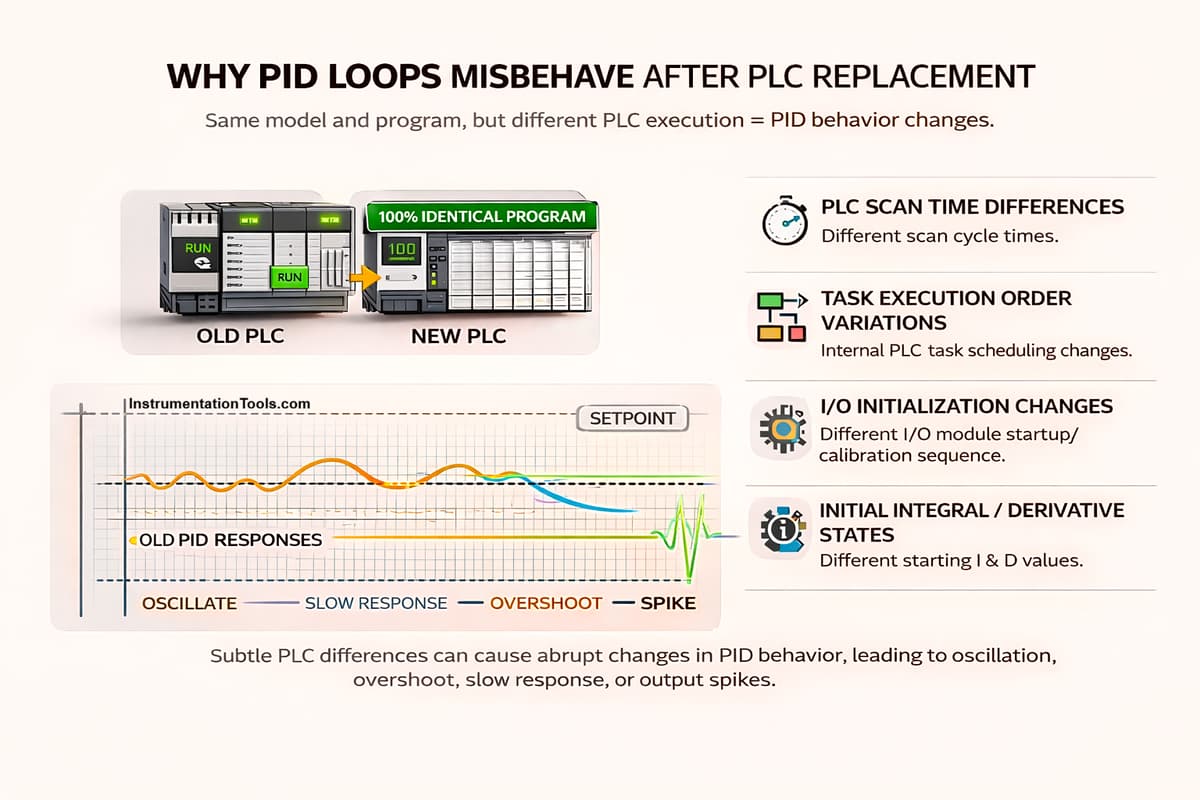
Why PID Loops Oscillate After PLC Replacement?
Key Takeaways
- •Scan time and task order shifts cause temporary PID overshoot
- •Firmware revisions modify integral, derivative, and anti‑windup behavior
- •I/O update timing changes loop delay, affecting fast control loops
- •Initial instability usually settles; persistent issues signal hardware faults
- •Verify and retune PID loops after any PLC hardware or firmware change
Pulse Analysis
PID loops are the workhorse of modern process plants, keeping temperature, pressure, flow and level variables tightly anchored to setpoints. When a plant replaces a PLC, engineers often assume the control performance will remain unchanged because the ladder logic and tuning parameters are identical. In reality, the PLC’s scan cycle—how often it reads inputs, executes logic, and writes outputs—can vary by a few milliseconds. That tiny timing shift alters the moment the PID sees the process variable, which can trigger brief overshoot or oscillation as the controller transitions from manual to automatic mode.
The deeper, less obvious factor is firmware evolution. PLC manufacturers continuously refine their built‑in PID blocks, tweaking integral accumulation methods, anti‑windup limits, and derivative filtering. A newer firmware may clamp the integral earlier or compute the derivative on the process variable instead of the error, changing the loop’s dynamic response even though the user‑defined gains stay the same. These algorithmic nuances are especially pronounced in fast or tightly tuned loops, where a millisecond of extra delay can shift a smooth response into a noisy or sluggish one, necessitating a quick retuning session to restore optimal performance.
Practically, plants should treat any PLC hardware swap as a control‑system change event. Maintain a firmware version baseline, document scan times, and run a short‑duration validation after installation—monitoring for overshoot, settling time, and output spikes. If instability persists beyond the initial cycles, inspect I/O modules, wiring, and consider minor gain adjustments. Proactive verification protects product quality, reduces unplanned shutdowns, and ensures the automation investment continues to deliver expected ROI.
Why PID Loops Oscillate After PLC Replacement?
Comments
Want to join the conversation?