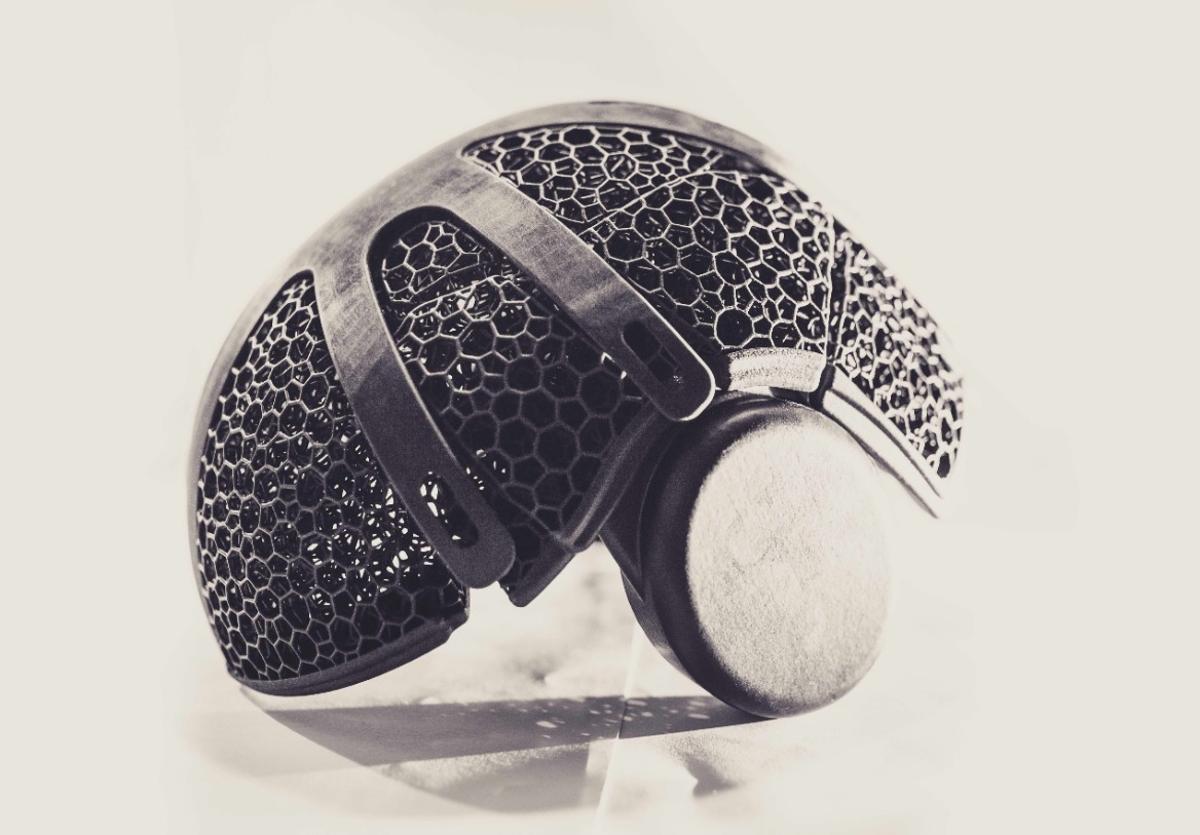
3D-Printed Padding System Aims to Improve Safety and Quality of EOD Helmets
•March 10, 2026
0
Why It Matters
The innovation demonstrates that additive manufacturing can meet the stringent safety and documentation standards of defense equipment, potentially reshaping supply chains for critical protective gear. It also showcases a scalable model for customizing high‑performance components across the security sector.
Key Takeaways
- •Lattice padding replaces traditional foam in EOD helmets
- •Additive manufacturing enables tailored stiffness and damping
- •Data-driven QA ensures reproducible performance and traceability
- •Reduced weight improves comfort and ventilation for technicians
- •Industrial Farsoon printers support scalable serial production
Pulse Analysis
Explosive ordnance disposal technicians rely on helmets that not only shield against blasts but also provide consistent comfort during prolonged missions. Traditional foam inserts, while effective at absorbing impact, suffer from variability in density, limited ventilation, and cumbersome cleaning procedures. By leveraging additive manufacturing, rpm introduces a lattice‑based padding that can be precisely engineered for region‑specific stiffness, delivering superior energy absorption while reducing overall helmet weight. This shift addresses long‑standing ergonomic challenges and aligns with the defense sector’s push for modular, high‑performance equipment.
The technical breakthrough stems from the ability to generate complex geometries on Farsoon’s industrial 3D printers, whose open architecture permits fine‑tuned process parameters. Coupled with amsight’s software suite, each print is continuously monitored, capturing real‑time data on temperature, laser power and layer adhesion. Fraunhofer IPA’s scientific input further refines the data‑driven quality backbone, enabling early detection of anomalies and systematic process stabilization. The resulting padding exhibits predictable damping characteristics, documented traceability, and repeatable batch‑to‑batch performance—critical attributes for safety‑critical applications.
Beyond the immediate performance gains, this project signals a broader market transformation. Data‑centric additive manufacturing reduces reliance on legacy foam suppliers, shortens lead times, and supports on‑demand customization for diverse operational requirements. As defense procurement increasingly prioritizes documented quality and lifecycle management, solutions like rpm’s lattice padding set a new benchmark for integrating hardware, software and analytics. Companies that adopt similar end‑to‑end digital manufacturing pipelines are likely to capture a competitive edge in the growing niche of high‑value protective gear.
3D-printed padding system aims to improve safety and quality of EOD helmets
0
Comments
Want to join the conversation?
Loading comments...