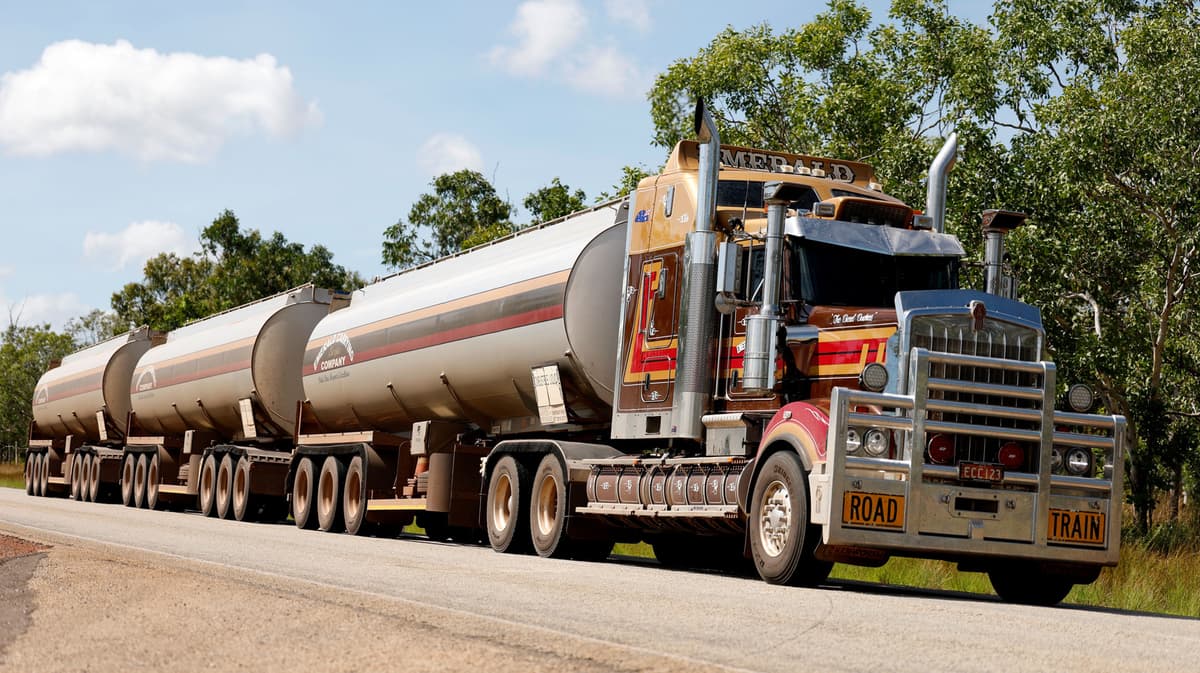
Australia's Longest Road Trains Dwarf American Semi Trucks (But They'd Never Work In The US)

Why It Matters
Road trains illustrate how geography and regulation shape freight efficiency; understanding their limits highlights why US logistics rely on smaller, more flexible rigs.
Key Takeaways
- •Australian Type 2 road trains reach 175 ft, five times US semi weight.
- •US federal length limit caps trucks at ~80 ft, 80,000 lb.
- •Infrastructure overhaul would cost billions to accommodate road trains.
- •Only sparsely populated corridors could feasibly host road trains.
- •Safety and braking distances make road trains unsuitable for congested US highways.
Pulse Analysis
Australia’s road trains are a logistical marvel, chaining together two to five trailers on a single prime mover. Their sheer length—up to 175 feet for a Type 2 configuration—allows a single vehicle to move the equivalent of several standard semis, cutting handling steps and fuel consumption per ton‑mile. In the remote Outback, where intersections are few and road surfaces are built for massive turning radii, these behemoths operate efficiently, moving bulk commodities such as livestock, minerals, and fuel across thousands of miles.
In the United States, the picture changes dramatically. Federal regulations cap overall vehicle length at roughly 80 feet and total weight at 80,000 lb, reflecting the design of the interstate system with tight cloverleaf interchanges, dense urban access points, and bridges engineered for conventional axle loads. A 380,000‑lb road train would exceed axle‑weight limits, overtax bridges, and require turning circles far larger than any existing ramp. Moreover, the braking distance of a 175‑foot train at highway speeds poses a severe safety risk amid the nation’s high traffic volumes and stop‑and‑go conditions.
Even if policymakers entertained the idea, retrofitting key corridors—such as Nevada’s I‑80 or West Texas’s I‑10—would demand billions in road widening, bridge reinforcement, and specialized staging areas. While niche routes with low congestion could theoretically host road trains, the economic calculus remains unfavorable compared with existing intermodal and rail solutions. The Australian example underscores that freight innovation is as much about compatible infrastructure and regulatory frameworks as it is about vehicle technology.
Australia's Longest Road Trains Dwarf American Semi Trucks (But They'd Never Work In The US)
Comments
Want to join the conversation?
Loading comments...