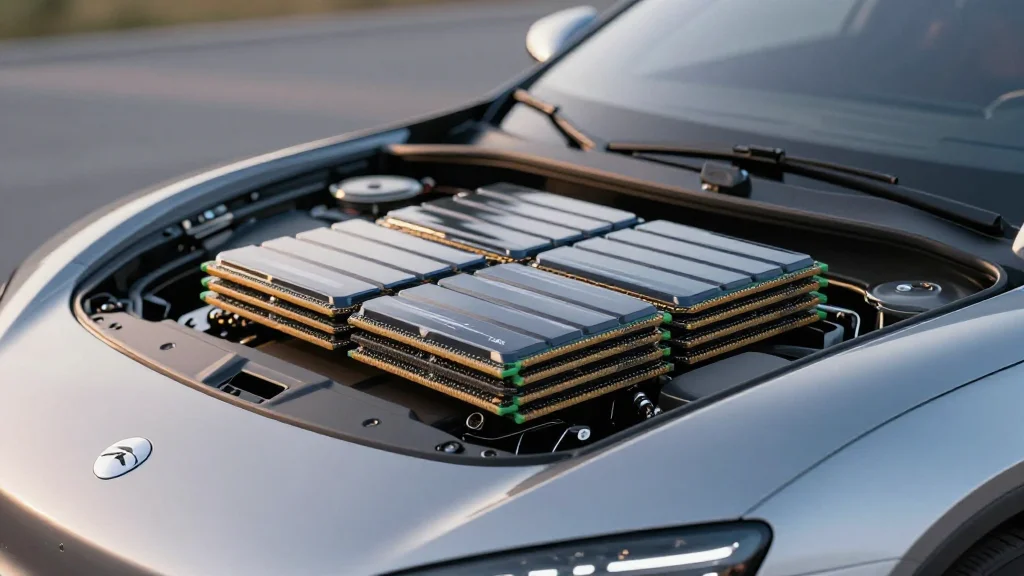
Automakers Face Memory Shock as AI Uses Up Semiconductor Supply
Companies Mentioned

Why It Matters
The shortage raises vehicle costs and slows the rollout of advanced driver‑assistance and autonomous features, reshaping the automotive supply chain and profit margins.
Key Takeaways
- •AI data centers hog DRAM, squeezing automotive memory supply
- •EU safety rules boost car memory demand to ~278 GB per vehicle
- •DRAM prices rise ~100% each quarter, adding $880‑$1,470 per car
- •OEMs adopt mixed‑criticality strategy, using consumer‑grade memory for infotainment
- •Direct deals and local fabs emerge as long‑term mitigation
Pulse Analysis
The 2026 memory crunch stems from a structural shift rather than a temporary pandemic‑related bottleneck. AI‑driven data centers have commandeered advanced‑node fabs to produce high‑bandwidth memory, leaving traditional DRAM and NAND manufacturers to allocate capacity primarily to the AI market. This reallocation has turned a once‑predictable commodity market into a supply‑constrained arena, with price escalations that dwarf the modest 2021 semiconductor squeeze. For automakers, the timing is especially painful as they race to meet software‑intensive vehicle architectures.
European safety mandates now require every new car sold in the EU to embed advanced driver‑assistance systems, dramatically inflating on‑board memory requirements. A typical 2026 connected vehicle needs about 278 GB of RAM to run up to 100 million lines of code, and Level‑3/4 autonomous platforms can exceed 300 GB. This surge, combined with "memflation"—quarterly DRAM price doublings—adds roughly $880‑$1,470 to the bill of a premium electric model. OEMs are responding with mixed‑criticality strategies, allocating automotive‑grade memory to safety‑critical functions while repurposing consumer‑grade chips for infotainment, and exploring zonal architectures that consolidate processing to reduce overall memory demand.
Looking ahead, manufacturers are betting on longer‑term fixes. Direct procurement agreements with memory fabs, joint ventures to build local DRAM capacity, and strategic inventory buffers are gaining traction despite the capital intensity. While these moves may mitigate immediate shortages, they also signal a broader realignment of automotive supply chains away from just‑in‑time models toward more resilient, vertically integrated approaches. The net effect will likely temper the pace of autonomous feature deployment, push up vehicle prices, and force the industry to prioritize memory efficiency as a core design criterion.
Automakers Face Memory Shock as AI Uses Up Semiconductor Supply
Comments
Want to join the conversation?
Loading comments...