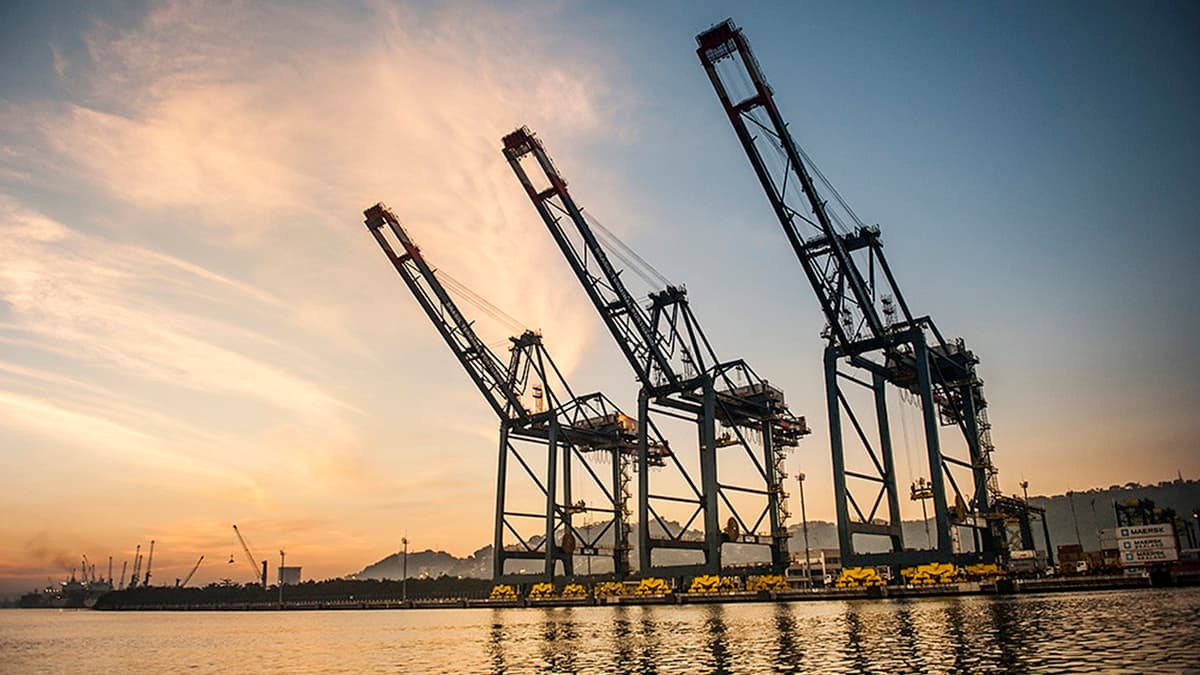
Brazil Clears Shipping Lines to Bid for Santos Mega Terminal
Companies Mentioned
Why It Matters
Opening the bid to global carriers and raising the fee intensifies competition, which could lower Brazil’s logistics costs and accelerate the modernization of its key gateway to global trade.
Key Takeaways
- •Minimum concession fee raised to ~BRL 1.04bn ($200m)
- •Shipping lines MSC, Maersk now permitted to bid
- •STS 10 will lift Santos capacity by 50%
- •Auction slated for H2 2026, risk of 2027 delay
- •Winning bidders must divest other Santos assets
Pulse Analysis
Brazil’s port strategy has taken a decisive turn as the presidential office cleared the way for major carriers to compete for the Tecon Santos 10 (STS 10) mega‑terminal. Santos, handling roughly 30 million TEUs annually, is nearing saturation, prompting the government to pursue a $1.2 billion expansion that could add 50 percent more handling capacity. By removing the earlier ban on shipping‑line participation, the state hopes to attract operators with deep global networks, leveraging their expertise to improve berth productivity and hinterland connectivity.
The technical note also doubles the minimum concession fee to about BRL 1.04 billion—approximately $200 million—signaling a push for higher‑quality bidders and greater fiscal returns. International players such as China’s Cosco, Europe’s MSC and Maersk, and Brazil’s own JBS can now enter the auction, provided they sell any existing stakes in Santos terminals before signing a new contract. This divestiture clause aims to prevent market concentration while ensuring that the eventual concessionaire can focus resources on the new facility without conflicts of interest.
If the auction proceeds as planned in the latter half of 2026, the upgraded terminal could slash Brazil’s logistics costs, a critical factor for a country whose export‑driven economy relies heavily on efficient maritime routes. Faster turnaround times and expanded capacity would benefit commodity exporters, manufacturers, and import‑dependent retailers, potentially enhancing Brazil’s competitiveness in global supply chains. However, lingering uncertainties—such as the risk of a 2027 delay—underscore the need for clear regulatory certainty and sustained investment to fully realize the terminal’s economic promise.
Brazil clears shipping lines to bid for Santos mega terminal
Comments
Want to join the conversation?
Loading comments...