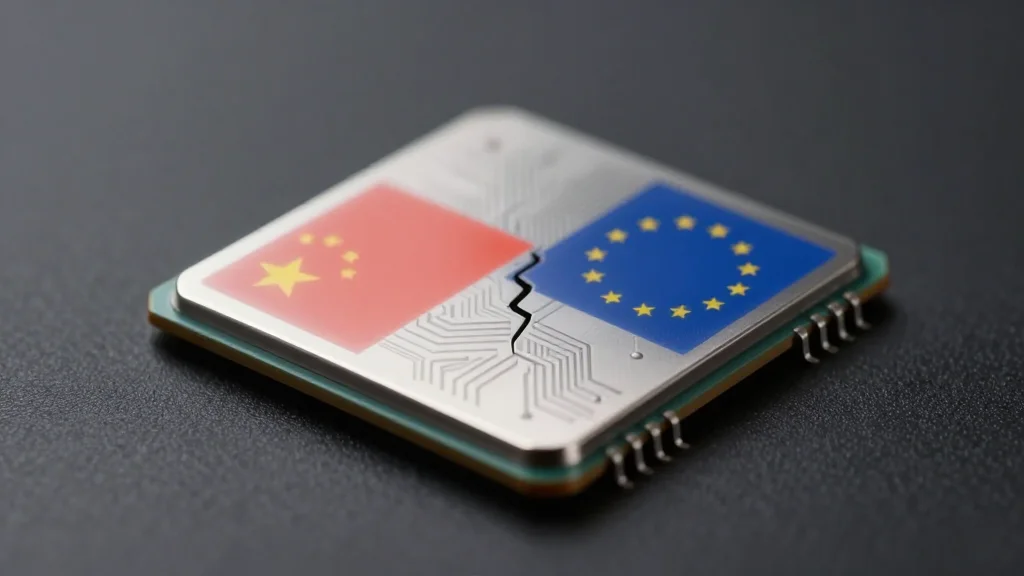
China Bans Dual‑use Exports to Seven European Firms over Taiwan Arms Sales

Companies Mentioned
Why It Matters
The ban illustrates how political tensions over Taiwan can cascade into tangible supply‑chain risks for European defence and high‑tech manufacturers. Dual‑use components are essential for everything from semiconductor fabrication to drone production; restricting access forces firms to re‑engineer sourcing strategies, potentially raising costs and delaying projects. Moreover, the episode signals a shift in China’s export‑control policy, extending pressure beyond the United States to European actors, thereby reshaping the geopolitical calculus for companies operating in global value chains. For the broader supply‑chain ecosystem, the development underscores the need for diversified sourcing and robust risk‑management frameworks. Companies that rely heavily on Chinese inputs for critical technologies may now face heightened scrutiny and must consider alternative suppliers or stockpiling strategies. Policymakers in the EU are likely to weigh the trade‑off between economic ties with China and the strategic imperative of safeguarding defence‑related supply chains, potentially prompting new regulatory or investment initiatives to bolster domestic capabilities.
Key Takeaways
- •China bans dual‑use exports to seven European firms over Taiwan arms sales.
- •The list includes German Hensoldt AG, Belgian FN Browning and four Czech entities.
- •Dual‑use items cover rare‑earths, semiconductors, drones and other critical tech.
- •Exporters can apply for case‑by‑case approvals, but uncertainty remains high.
- •EU has been notified via bilateral export‑control dialogue; no coordinated response yet.
Pulse Analysis
China’s decision to target European firms marks a strategic escalation in its use of export controls as a geopolitical lever. Historically, Beijing has focused sanctions on U.S. companies, but extending the approach to Europe reflects growing frustration with the continent’s tacit support for Taiwan’s defence procurement. This shift could fragment the global high‑tech supply chain, prompting European firms to accelerate diversification away from Chinese inputs. In the short term, the ban may cause supply bottlenecks for rare‑earths and advanced components, driving up prices and prompting firms to seek alternative sources in the United States, Japan or domestic EU programs.
Long‑term, the move may catalyse a broader re‑orientation of Europe’s industrial policy. The EU has already pledged to achieve strategic autonomy in critical technologies; a concrete sanction like this could accelerate funding for domestic rare‑earth processing, semiconductor fabs, and defence R&D. However, the effectiveness of such a pivot depends on the speed and scale of investment, as well as the willingness of member states to coordinate.
From a market perspective, investors will likely scrutinise the exposure of European defence and high‑tech companies to Chinese dual‑use inputs. Firms with diversified supply chains may see a relative advantage, while those heavily reliant on Chinese components could experience margin pressure. The episode also serves as a cautionary tale for multinational corporations: geopolitical risk assessments must now factor in not only direct sanctions but also secondary measures that can disrupt critical supply lines.
China bans dual‑use exports to seven European firms over Taiwan arms sales
Comments
Want to join the conversation?
Loading comments...