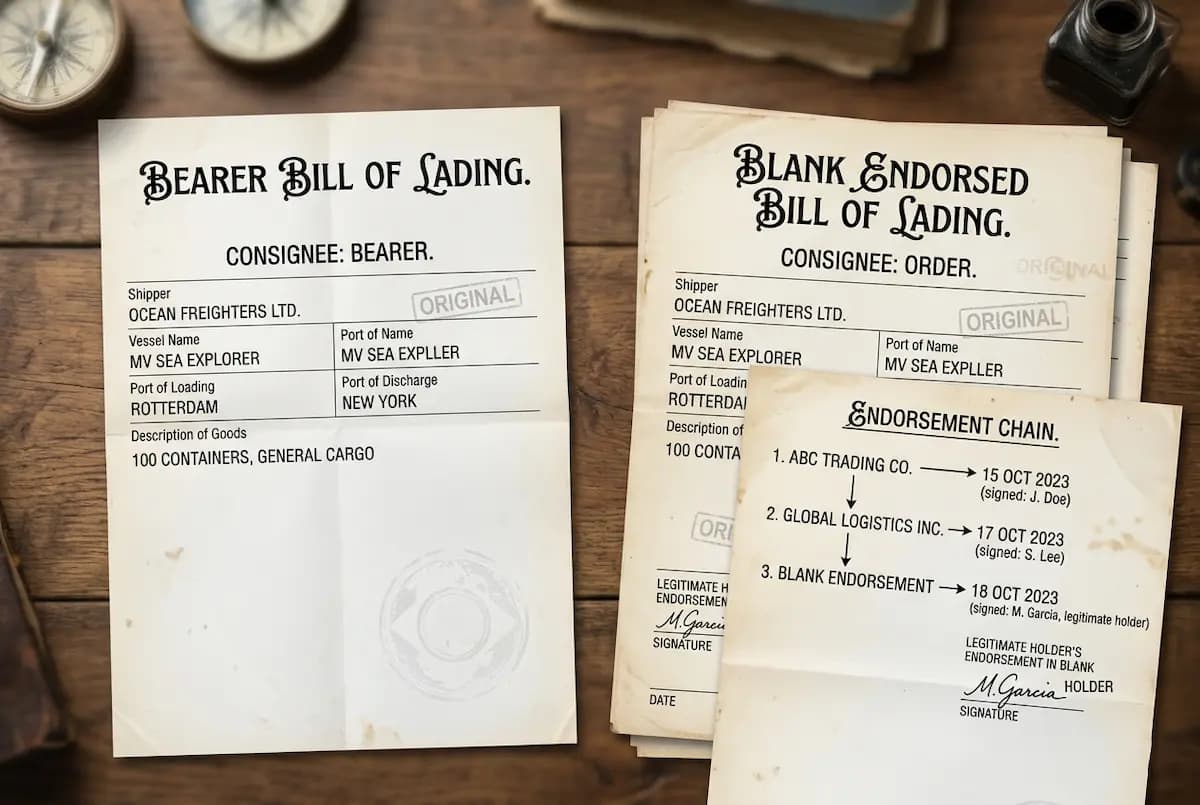
Distinguishing Bearer Bill of Lading and Blank Endorsed Bill of Lading
Why It Matters
The legal origin of the bill determines the traceability of title and the carrier’s exposure, influencing banks’ collateral strategies and the potential for disputes over cargo ownership.
Key Takeaways
- •Bearer BL issued blank; holder can claim cargo immediately.
- •Blank endorsed BL starts as order BL, becomes bearer after endorsement.
- •Carriers prefer order BLs; bearer BLs create high liability risk.
- •Banks leverage blank endorsement in eBLs to hold collateral securely.
Pulse Analysis
In international shipping, the bill of lading serves as the primary document of title, yet its form dictates how risk travels through the supply chain. A bearer bill of lading is born without a named consignee, turning the physical paper into a de‑facto key to the cargo. Because there is no traceable chain of title, carriers treat it as a liability hotspot, often refusing to issue one without special approval. By contrast, a blank‑endorsed bill starts as a conventional order bill, preserving a clear ownership trail until a holder signs the back in blank, effectively converting it into a bearer instrument at that moment.
Trade financiers exploit the blank‑endorsement feature to secure loans and facilitate secondary market transactions. Electronic bill of lading (eBL) platforms now embed a "blank endorsement" function, allowing banks to hold the digital document as collateral without naming a subsequent holder. This preserves liquidity while maintaining an auditable history of endorsements, satisfying regulatory expectations and reducing fraud risk. Importantly, banks are not seeking true bearer bills; they require the ability to transform an order bill into a bearer‑type instrument under controlled conditions.
For carriers and shippers, understanding the distinction is critical to managing operational risk. Jurisdictions differ on the presumption of ownership attached to bearer bills, and a stolen or forged document can trigger costly legal battles despite the carrier’s duty to release cargo to the holder of a valid bill. Best practice calls for meticulous endorsement tracking, clear contractual language on title transfer, and, where possible, adoption of secure eBL standards that retain the endorsement chain while offering the flexibility of blank endorsement when needed. As digital trade matures, the industry will likely see tighter integration of these concepts, balancing efficiency with the need for robust title verification.
Distinguishing Bearer Bill of Lading and Blank Endorsed Bill of Lading
Comments
Want to join the conversation?
Loading comments...