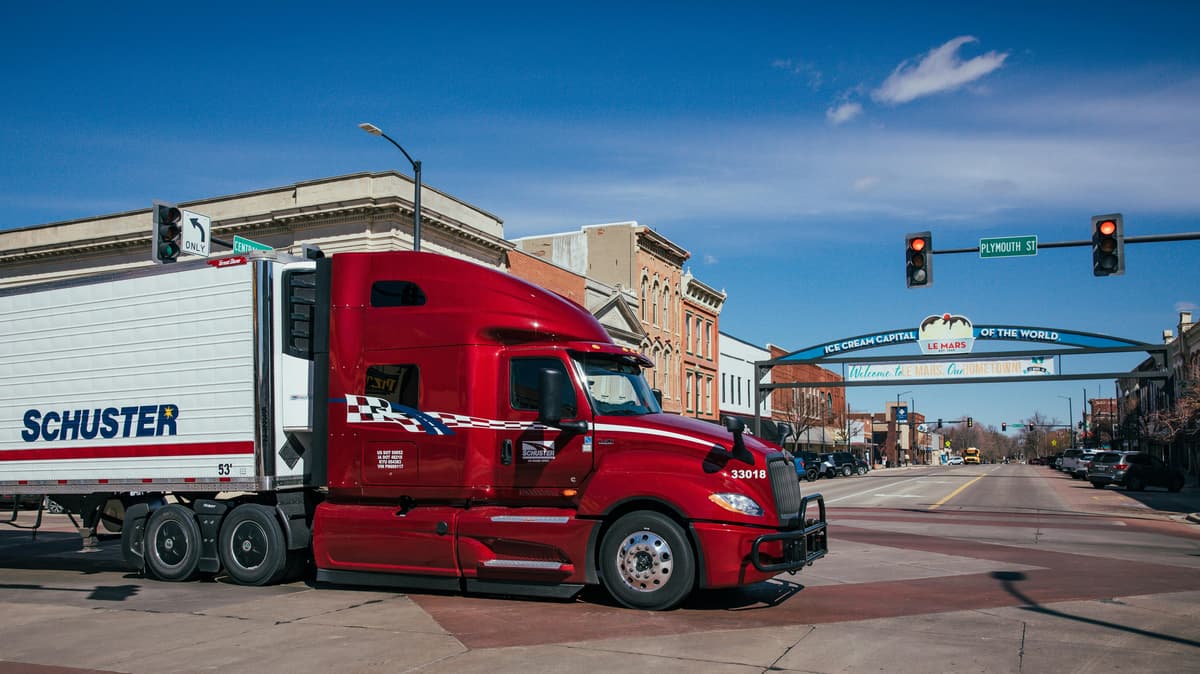
How Schuster Trucking Handles Capacity Swings and Profitability Pressure
Companies Mentioned
Why It Matters
By aligning equipment acquisition with upcoming emissions standards, Schuster protects margins while maintaining service reliability for temperature‑sensitive loads. Its cost‑control and compliance focus offers a blueprint for midsize carriers facing similar capacity and regulatory pressures.
Key Takeaways
- •Schuster delayed tractor purchases 18 months, now resuming amid higher freight volumes
- •Fleet of 420 LT625 trucks targets 2026 models before 2027 emissions rules
- •Ice‑cream loads, 30% of revenue, require -20 °F refrigeration reliability
- •Fuel‑economy tools and McLeod software mitigate rising fuel surcharge impact
- •Owner‑operator program and driver compliance sustain staffing despite tighter CDL rules
Pulse Analysis
Schuster Trucking’s equipment strategy illustrates how midsize carriers can turn regulatory timelines into competitive advantages. By ordering 2026‑model International LT625 tractors before manufacturers roll out 2027 emissions‑compliant trucks, the firm sidesteps the premium pricing and certification delays that could erode profit margins. This forward‑looking approach also aligns with the carrier’s need to keep refrigerated units—especially those hauling ice‑cream, which accounts for roughly a third of revenue—operationally reliable at -20 °F, a temperature critical to product integrity.
Cost control remains a cornerstone of Schuster’s operations. The carrier leverages Hendrickson TireMaxx Pro tire‑inflation monitoring, evaluates Revvo and PressurePro solutions for tractors, and relies on the McLeod Software suite, which it has used for over a decade, to fine‑tune dispatch and fuel‑surcharge calculations. These technologies collectively cushion the impact of volatile diesel prices, allowing the company to pass most fuel cost increases to shippers while preserving a healthy bottom line. The emphasis on fuel‑efficient International S13 powertrains further underscores a commitment to sustainable, low‑cost operations.
Driver staffing and compliance present another strategic frontier. Schuster maintains a hybrid workforce of about 80 owner‑operators and company drivers, offering competitive pay, wellness programs, and newer equipment to attract talent. Recent FMCSA‑driven CDL reforms have tightened the driver pool, but the carrier’s proactive safety culture—evidenced by a satisfactory FMCSA rating and weekly inspection reviews—helps retain qualified operators. This blend of regulatory alignment, technology adoption, and human‑resource focus positions Schuster Trucking to weather freight‑volume swings and set a benchmark for peers navigating the evolving logistics landscape.
How Schuster Trucking handles capacity swings and profitability pressure
Comments
Want to join the conversation?
Loading comments...