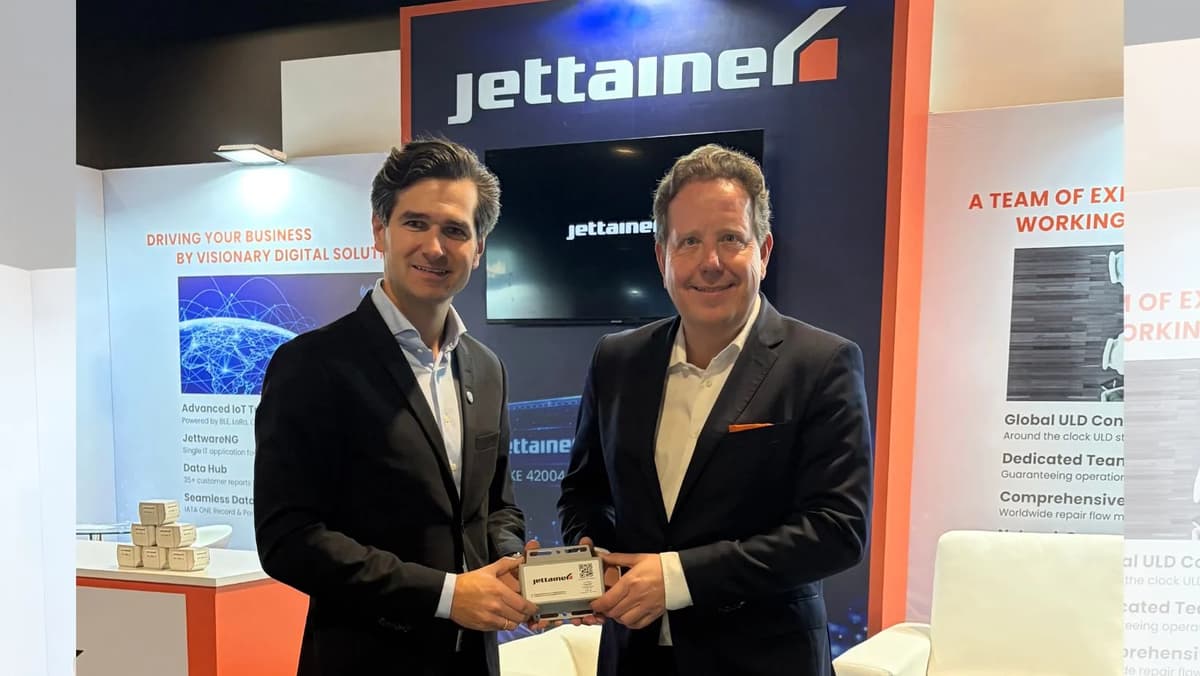
IATA WCS: Lufthansa Cargo Becomes Launch Customer for Jettainer’s New IoT ULD Tracking Solution
•March 11, 2026
0
Why It Matters
Real‑time ULD visibility cuts operational costs and boosts service reliability, giving airlines a competitive edge in an increasingly data‑driven cargo market.
Key Takeaways
- •Lufthansa Cargo pilots IoT ULD tracking across entire fleet.
- •Real-time visibility reduces blind spots and equipment loss.
- •Mobile and stationary readers enable tracking in low‑tech airports.
- •Data-driven insights improve dwell‑time management and recovery speed.
- •Partnership sets new standard for digital cargo operations.
Pulse Analysis
The air‑cargo industry has long wrestled with limited visibility of unit‑load devices, relying on manual checks and airport‑based RFID gates that leave gaps in the supply chain. Recent advances in low‑power IoT sensors and edge‑computing have made it feasible to embed continuous tracking directly on pallets and containers. Jettainer’s hybrid architecture, which couples fixed readers at hubs with handheld mobile units, bridges the infrastructure divide, ensuring that every ULD can be located regardless of airport capability. This shift mirrors broader logistics trends where end‑to‑end asset monitoring is becoming a baseline expectation.
Lufthansa Cargo’s decision to adopt the solution as its launch customer signals strong confidence in the technology’s scalability. The rollout, announced at the IATA World Cargo Symposium, will see the IoT tags installed on all of the airline’s ULDs, providing instant alerts on location, dwell time, and irregularities. Early pilots indicate a measurable drop in search effort for missing containers and quicker re‑allocation of assets, directly translating into tighter schedules and lower ground‑handling expenses. Executives stress that the enhanced data stream enables predictive steering of the fleet, allowing crews to pre‑empt bottlenecks and improve on‑time performance for shippers.
Beyond Lufthansa, the deployment sets a benchmark for the wider cargo ecosystem. Real‑time transparency can feed into airline operating systems, freight forwarder platforms, and customs workflows, creating a unified digital twin of the air‑freight network. As more carriers adopt similar IoT solutions, industry standards for data formats and security are likely to converge, fostering interoperability and reducing integration costs. Ultimately, the move accelerates the transition toward a fully digitized, resilient cargo supply chain, where reliability and efficiency become quantifiable assets rather than operational assumptions.
IATA WCS: Lufthansa Cargo becomes launch customer for Jettainer’s new IoT ULD tracking solution
0
Comments
Want to join the conversation?
Loading comments...