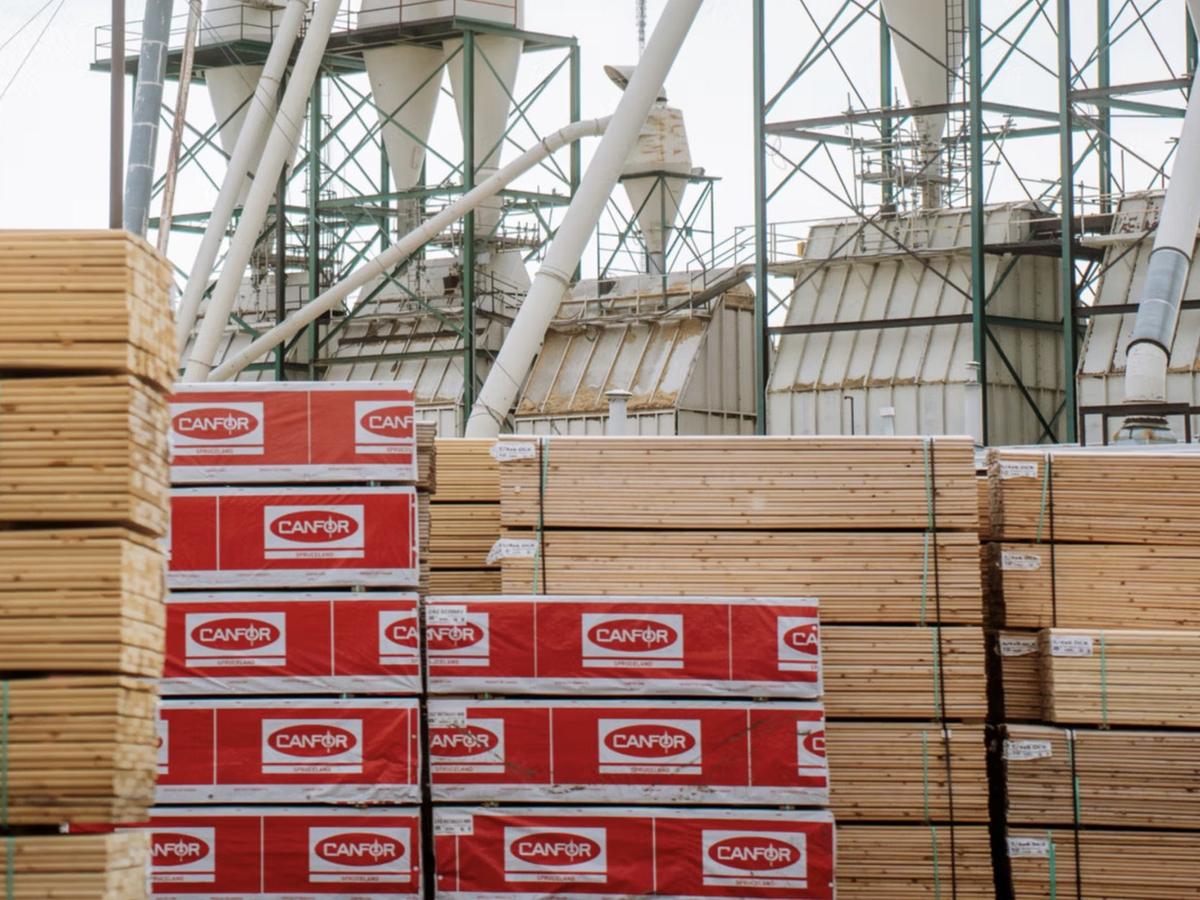
Iran Conflict Hits Lumber — and Canfor Warns $72M Loss Is Just the Start
Why It Matters
The loss underscores how geopolitical shocks can quickly translate into higher construction costs and tighter supply in North America’s lumber market, threatening the fragile housing recovery. Investors and builders must watch the evolving Iran conflict and upcoming U.S. tariff rulings for further pressure on margins.
Key Takeaways
- •Canfor Q1 operating loss CAD $72.5M (~$53M) driven by Iran conflict.
- •Diesel in Asia up 140%; crude above $110/barrel, freight $5k/container.
- •US single‑family starts fell 7% in 2025, raising housing costs.
- •Section 232 duties impose 34.8% effective tariff on Canadian lumber.
- •Canfor cash $44M; $322M drawn on loans, $662M undrawn facility.
Pulse Analysis
The sudden shutdown of the Strait of Hormuz in late February sent ripples through global commodity markets, pushing Asian diesel prices 140% higher and crude oil above US $110 per barrel. Shipping firms now face surcharges of up to US $5,000 per container, a cost that quickly filters into timber freight rates. For a lumber producer like Canfor, whose supply chain relies on Gulf‑transit routes, these petroleum‑driven expenses erode profit margins and depress demand from cost‑sensitive homebuilders.
Canfor’s first‑quarter report reflects the immediate financial fallout. After a CAD $415.9 million (≈ US $304 million) Q4 profit surge, the company swung to a CAD $72.5 million operating loss, with lumber accounting for CAD $43.7 million and pulp‑and‑paper for CAD $16.2 million of the deficit. Production modestly increased to 1.21 billion board feet, yet price gains for Western SPF 2×4s (+10%) and SYP East 2×4s (+35%) were largely offset by a stronger Canadian dollar and weaker offshore sales. The balance sheet shows roughly US $44 million in cash against $322 million already drawn on operating loans and $662 million of undrawn credit, highlighting liquidity pressures ahead of the August soft‑wood determination.
The broader market outlook remains precarious. U.S. single‑family housing starts slipped 7% in 2025, the weakest post‑pandemic level, while Section 232 duties keep an effective 34.8% tariff on Canadian lumber. Combined with the Iran‑related cost surge, these factors could further tighten supply and push construction costs higher. Analysts will watch Canfor’s Q2 results, the upcoming U.S. soft‑wood ruling, and any de‑escalation in the Middle East to gauge whether the current loss is a one‑off shock or the start of a prolonged earnings drag.
Iran Conflict Hits Lumber — and Canfor Warns $72M Loss is Just the Start
Comments
Want to join the conversation?
Loading comments...