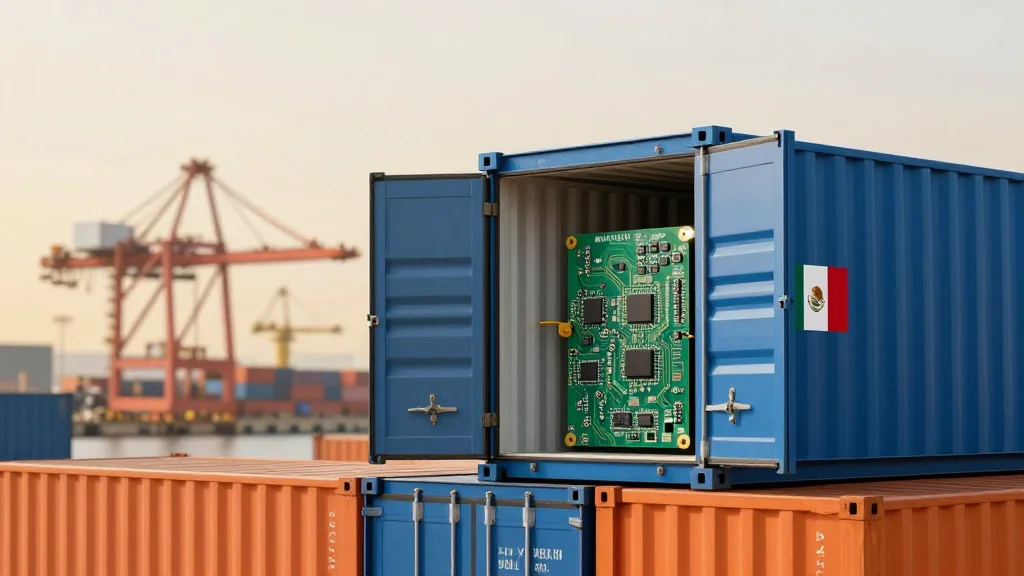
Mexico Export Gains Face Trump Tariff, Supply Chain Risks
Why It Matters
The trend signals Mexico’s manufacturing base may revert to low‑margin assembly, jeopardizing job growth and the country’s strategic push for higher‑value exports, while U.S. tariff policy reshapes North‑American supply chains.
Key Takeaways
- •April exports hit $72 billion, up 33% YoY
- •Imports rose 24%, 80% intermediate goods
- •Auto exports flat as US tariffs bite
- •Computer equipment exports jumped 144%, now 13% of total
- •Reliance on Asian inputs threatens higher‑value manufacturing shift
Pulse Analysis
Mexico’s export surge in April set a new high watermark, but the headline numbers hide a structural shift. While total shipments climbed to $72 billion, nearly four‑fifths of the country’s imports were intermediate components, indicating that most of the value is added abroad. This pattern reflects a deepening dependence on Asian parts that are merely assembled in Mexican factories, a dynamic that erodes the potential for genuine value creation and limits the multiplier effect on the domestic economy.
U.S. tariff policy is a key driver of the emerging risk profile. Higher duties on automotive parts have stalled light‑vehicle exports, a sector that employs roughly 800,000 workers. The same tariffs, coupled with broader supply‑chain disruptions, push Mexican manufacturers toward a “triangulation” model—receiving high‑value inputs, packaging them, and shipping them back to the United States. As the USMCA review looms, policymakers face pressure to address these imbalances; otherwise, Mexico could slip back into a low‑margin maquiladora paradigm that offers few high‑skill jobs.
Opportunities remain, however, in fast‑growing niches such as computer‑equipment assembly, which jumped 144% and now accounts for 13% of total exports. The boom is tied to AI‑driven data‑center demand, but the sector employs only about 60,000 workers, underscoring the limited breadth of its impact. For Mexico to achieve Sheinbaum’s “Plan Mexico” vision, it must diversify beyond assembly, incentivize domestic component production, and negotiate trade terms that protect higher‑value industries. Investors and regional planners should watch how tariff adjustments and USMCA outcomes shape the next phase of Mexico’s manufacturing evolution.
Mexico Export Gains Face Trump Tariff, Supply Chain Risks
Comments
Want to join the conversation?
Loading comments...