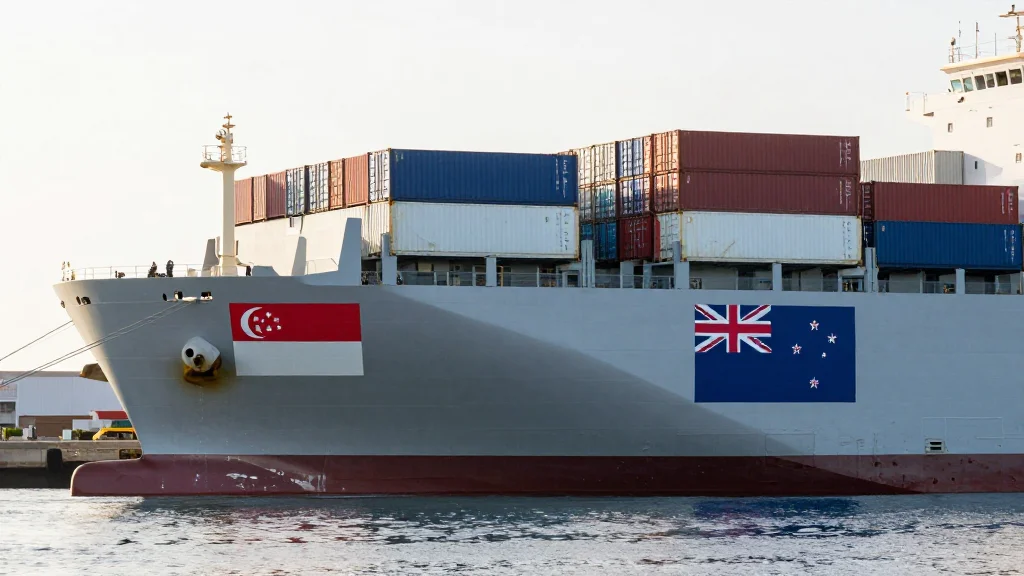
Singapore, New Zealand Ink Supply‑Chain Pact to Safeguard Fuel, Food, Medical Goods

Why It Matters
The agreement directly addresses the fragility exposed by recent energy market turbulence and pandemic‑era supply shortages. By locking in reliable sources of fuel and food, Singapore and New Zealand reduce the risk of domestic shortages that could ripple through manufacturing, logistics and consumer markets. The pact also signals a shift toward bilateral, trust‑based trade frameworks that bypass more volatile multilateral channels, a trend that could reshape how nations secure essential inputs in an increasingly contested global environment. Beyond immediate resilience, the deal may accelerate deeper integration in related sectors such as defence, unmanned systems and digital trade. The joint military training component hints at a broader strategic alignment, suggesting that supply‑chain security is being treated as a component of national security. If successful, the model could be replicated by other like‑minded economies, creating a lattice of dependable trade routes that collectively buffer the Indo‑Pacific against future disruptions.
Key Takeaways
- •Singapore and New Zealand signed the Agreement on Trade in Essential Supplies on Monday.
- •The pact guarantees continued trade in fuel, food, medical and construction goods during crises.
- •New Zealand sources about one‑third of its fuel from Singapore refineries; Singapore imports ~14% of its food from New Zealand.
- •Dairy makes up 31.6% of New Zealand’s total exports to Singapore.
- •A joint task force will be created within 30 days to operationalise the agreement.
Pulse Analysis
The Singapore‑New Zealand supply‑chain pact arrives at a moment when both economies are recalibrating their exposure to external shocks. Singapore, a global trans‑shipment hub, has long leveraged its strategic location to secure energy imports, while New Zealand’s agricultural export model depends heavily on a handful of destination markets. By formalising a reciprocal safety net, each country mitigates a key vulnerability: Singapore’s dependence on external fuel supplies and New Zealand’s reliance on a narrow set of food import partners.
Historically, supply‑chain resilience has been pursued through multilateral agreements—such as ASEAN’s trade facilitation frameworks—that can be hampered by divergent political agendas. This bilateral approach sidesteps those complexities, allowing for rapid decision‑making and joint stock‑piling strategies that are difficult to achieve in larger fora. The inclusion of defence and unmanned‑systems cooperation further embeds the pact within a broader security architecture, reinforcing the notion that logistics and military readiness are increasingly interlinked.
Looking ahead, the pact could catalyse a regional shift toward ‘trusted partner’ networks, where countries with complementary resource endowments lock in mutual support clauses. If other Indo‑Pacific nations adopt similar models, we may see a parallel trade lattice emerging alongside existing free‑trade agreements, offering a more robust buffer against supply shocks. However, the success of this arrangement will hinge on the operational effectiveness of the joint task force, the transparency of stock‑piling data, and the willingness of private sector actors to align with government‑mandated contingency plans.
Singapore, New Zealand Ink Supply‑Chain Pact to Safeguard Fuel, Food, Medical Goods
Comments
Want to join the conversation?
Loading comments...