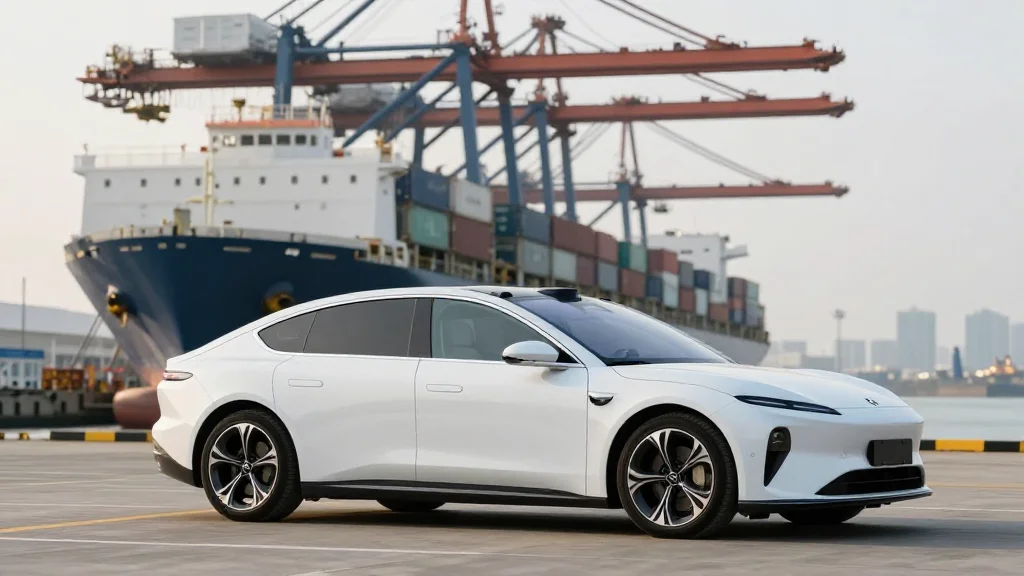
Starvia Automotive Expands One‑Stop Export Services Amid Surge in Global Demand for Chinese EVs

Why It Matters
The expansion underscores a maturing Chinese NEV export market where service reliability is becoming as critical as vehicle price. By offering a comprehensive export solution, Starvia reduces friction for overseas buyers, potentially accelerating the penetration of Chinese EVs into mature markets that have traditionally favored domestic or European manufacturers. This could reshape global automotive supply chains, shifting volume and bargaining power toward Chinese producers and their service partners. For logistics providers and customs brokers, the trend signals a growing demand for specialized expertise in electric‑vehicle compliance, battery handling and cross‑border documentation. Companies that can integrate these capabilities into a single offering may capture a larger share of the burgeoning NEV trade, while those that remain siloed risk losing business to more integrated competitors.
Key Takeaways
- •Starvia Automotive launches a full‑service export platform covering procurement, inspection, documentation, customs and logistics.
- •The service targets overseas dealers, fleet operators and procurement firms seeking reliable NEV sourcing from China.
- •Company spokesperson highlighted buyer demand for partners that understand the entire export process.
- •Expansion aligns with rising global demand for Chinese electric and plug‑in hybrid vehicles across Europe, North America and Asia.
- •Analysts view the move as a catalyst for faster, more compliant Chinese NEV exports and a shift in automotive supply‑chain dynamics.
Pulse Analysis
Starvia’s expanded service reflects a broader inflection point in the automotive supply chain: the transition from product‑centric to service‑centric trade models. Historically, vehicle exporters relied on fragmented networks of agents, freight forwarders and customs brokers, each adding layers of cost and delay. By consolidating these functions, Starvia not only improves efficiency but also creates a data‑rich interface that can feed predictive analytics into OEM production planning, inventory management and after‑sales support.
The timing is strategic. China’s NEV production surged past 7 million units in 2025, outpacing many Western manufacturers. Yet export growth has lagged due to regulatory complexity and brand perception challenges. A one‑stop export solution mitigates these barriers, offering a turnkey pathway for overseas buyers to access Chinese models without navigating a maze of paperwork. This could accelerate market share gains for Chinese OEMs in regions where policy incentives for EV adoption are strong but supply‑chain confidence remains low.
Looking forward, the competitive landscape will likely see other Chinese logistics firms and OEMs launching similar integrated platforms. Success will hinge on the ability to provide real‑time visibility, guarantee compliance across divergent regulatory regimes, and maintain cost competitiveness. If Starvia can scale its model while preserving service quality, it may set a new industry standard that reshapes how automotive supply chains operate in a decarbonizing world.
Starvia Automotive Expands One‑Stop Export Services Amid Surge in Global Demand for Chinese EVs
Comments
Want to join the conversation?
Loading comments...