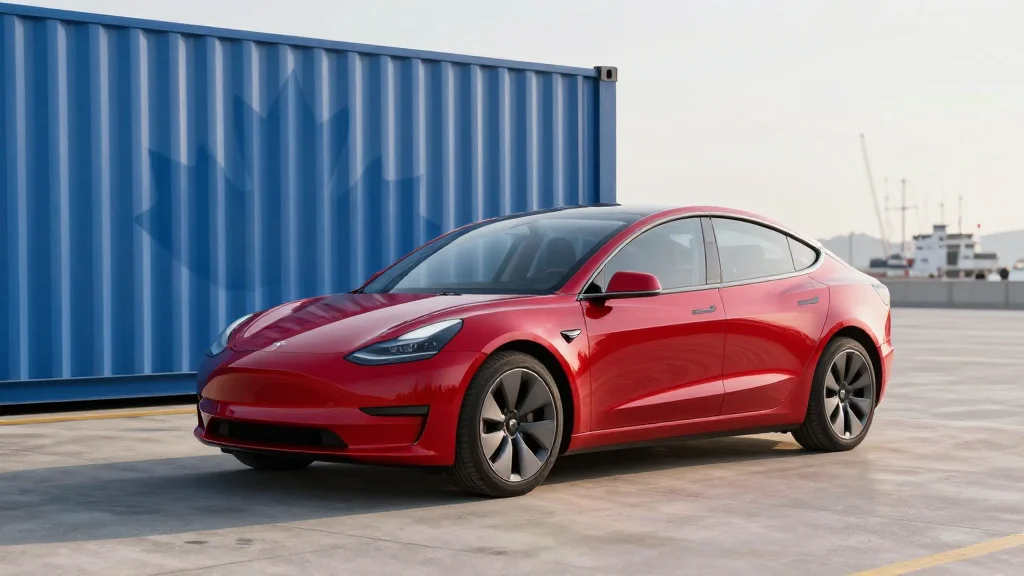
Tesla Launches Chinese‑made Model 3 in Canada at $29,000, Slashing Price by Half

Companies Mentioned
Why It Matters
The price cut demonstrates how tariff policy can instantly reshape automotive supply chains, turning a high‑cost, domestically produced vehicle into a competitively priced import. For Canadian consumers, the $29,000 price point makes electric mobility accessible to a broader demographic, potentially accelerating EV adoption rates and reducing reliance on fossil‑fuel vehicles. For the industry, Tesla’s move pressures legacy automakers to reassess their own cross‑border sourcing strategies, as the cost advantage of Asian manufacturing becomes more pronounced under favorable trade terms. Moreover, the shift highlights the geopolitical dimension of supply‑chain risk management. By leveraging a lower‑tariff environment, Tesla reduces exposure to U.S.‑centric production bottlenecks and labor cost escalations, setting a precedent for other manufacturers to diversify production footprints. The outcome will influence future trade negotiations, investment decisions in North American factories, and the overall competitiveness of the EV market.
Key Takeaways
- •Tesla launches Shanghai‑built Model 3 Premium RWD in Canada at $39,490 CAD (≈$29,000 USD)
- •Price is nearly 50% lower than the previous $79,990 CAD entry‑level price
- •Canada reduces tariff on Chinese EVs to 6.1% after a year of 100% duties
- •Model 3 Performance price drops to $74,990 CAD (≈$55,000 USD)
- •Vehicle not eligible for Canada’s $5,000 CAD EV Affordability Program incentive
Pulse Analysis
Tesla’s decision to re‑introduce Shanghai‑built Model 3s into Canada is a textbook case of supply‑chain agility meeting trade policy. By capitalizing on a reduced tariff, Tesla sidesteps the higher marginal cost of its Fremont plant, which includes labor rates that are roughly double those in Shanghai and a more complex parts‑sourcing network. The resulting price shock forces competitors to confront a stark reality: without comparable cost structures, they risk losing price‑sensitive buyers in a market where government incentives are already generous.
Historically, North American automakers have guarded domestic production as a strategic asset, citing job creation and supply‑chain resilience. Tesla’s model flips that narrative, treating the supply chain as a fluid asset that can be re‑positioned in response to policy shifts. If the Canadian tariff remains low, we may see a cascade of similar moves, with other manufacturers exploring Chinese‑based export strategies for their entry‑level EVs. This could erode the perceived advantage of “Made in North America” branding, especially as consumers prioritize price and range over origin.
Looking forward, the sustainability of Tesla’s pricing hinges on two variables: the durability of the 6.1% tariff and the elasticity of Canadian demand at the $29,000 price point. Should demand surge, Tesla could leverage economies of scale to further compress costs, potentially expanding the Shanghai‑built portfolio beyond the Model 3. Conversely, any reversal in tariff policy would force a rapid recalibration, likely inflating prices and testing the brand’s ability to maintain market share. Stakeholders—from policymakers to parts suppliers—must monitor these dynamics closely, as they will shape the competitive contours of the North American EV market for years to come.
Tesla launches Chinese‑made Model 3 in Canada at $29,000, slashing price by half
Comments
Want to join the conversation?
Loading comments...