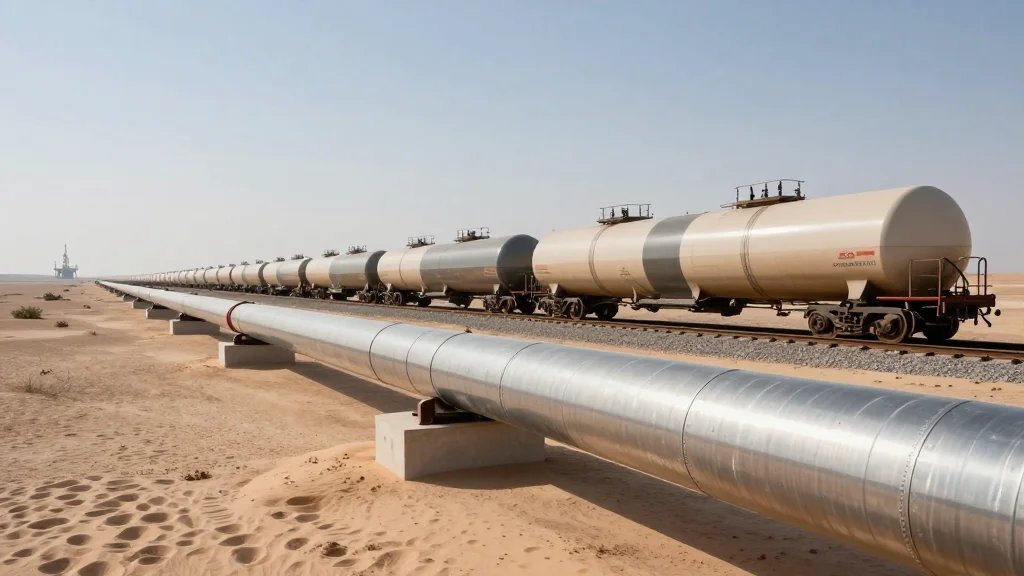
UAE to Spend Billions Cutting Strait of Hormuz Reliance to ‘Zero’
Why It Matters
By removing a geopolitical bottleneck, the UAE safeguards its export revenues and strengthens energy security for global buyers, reshaping trade routes in a volatile region.
Key Takeaways
- •UAE plans multi-billion-dollar pipeline network to bypass Hormuz
- •New rail links will transport oil inland, reducing tanker dependence
- •Investment aims to secure energy exports against geopolitical disruptions
- •Project timeline targets operational capacity by early 2030s
Pulse Analysis
The Strait of Hormuz has long been a strategic artery for roughly a third of the world’s oil trade, making any disruption a flashpoint for price volatility. Recent geopolitical frictions, including regional conflicts and diplomatic standoffs, have heightened concerns among exporters about the reliability of this narrow passage. For the United Arab Emirates, whose economy is heavily tied to hydrocarbon exports, the risk of a closed or contested Hormuz translates directly into fiscal uncertainty and potential supply chain chaos.
In response, the UAE is channeling billions of dollars into an integrated transport infrastructure that sidesteps the chokepoint entirely. Massive pipeline projects will link offshore fields to inland processing hubs, while new rail corridors will ferry crude to Mediterranean and Red Sea ports, dramatically cutting transit times. State‑backed financing, combined with private sector partnerships, is accelerating construction, with key segments slated for operation by the early 2030s. These investments not only diversify export routes but also create ancillary economic activity, from logistics services to regional manufacturing, reinforcing the UAE’s position as a resilient energy hub.
The broader market will feel the ripple effects. A reduced dependence on Hormuz could lower the premium placed on Gulf oil, stabilizing global benchmarks and easing insurance costs for tankers. Competing exporters in the region may feel pressure to adopt similar diversification strategies, potentially reshaping the geopolitical calculus of energy security. However, the ambitious timeline faces challenges, including technical hurdles, regulatory approvals, and the need for coordinated regional cooperation. If successful, the UAE’s zero‑Hormuz vision could set a new standard for risk‑mitigated oil logistics in an increasingly uncertain world.
UAE to spend billions cutting Strait of Hormuz reliance to ‘zero’
Comments
Want to join the conversation?
Loading comments...