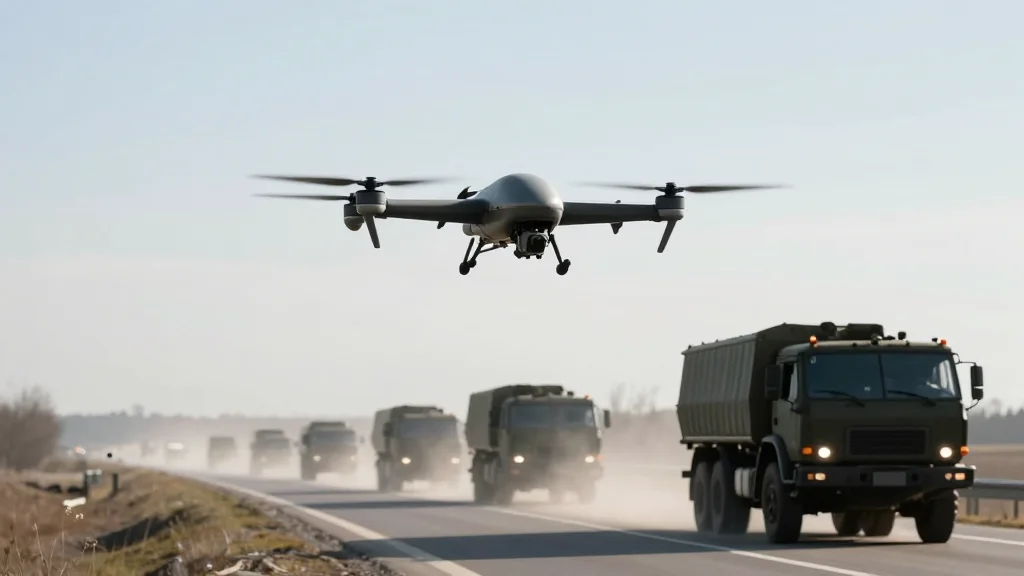
Ukraine's $113 M Drone Offensive Cripples Russia's Southern Highway

Why It Matters
The R‑280 campaign illustrates how modern drone warfare can directly attack a nation’s logistics backbone, turning a single road into a strategic chokepoint. By forcing Russia to reroute supplies, Ukraine not only hampers military operations but also destabilizes regional trade flows, driving up costs for commodities that move through the Black Sea corridor. For the broader supply‑chain industry, the episode underscores the vulnerability of critical transport routes to low‑cost autonomous technologies. Companies that rely on just‑in‑time deliveries may need to reassess risk models that traditionally focus on natural disasters or labor strikes, now adding state‑level drone threats to the equation. Governments and firms alike will likely invest in hardened infrastructure, alternative routing, and counter‑drone capabilities to safeguard essential freight corridors.
Key Takeaways
- •$113 million "logistics lockdown" announced by Ukraine’s defense minister
- •483 Russian transport vehicles destroyed on May 29
- •R‑280 (M‑14) is Russia’s only overland supply route to Crimea
- •AI‑assisted Hornet drones operate autonomously via Starlink, evading jamming
- •Crimea reports fuel shortages and gasoline rationing as a direct result
Pulse Analysis
The Ukrainian drone offensive marks a turning point in how asymmetric forces can leverage inexpensive technology to impose strategic costs on a superior adversary. Historically, supply‑chain disruption in warfare relied on targeting bridges, rail hubs or ports – assets that are costly to replace and can be repaired. By turning the highway itself into a moving target, Kyiv forces Moscow to confront a logistical nightmare that cannot be solved with a single engineering project.
Economically, the $113 million budget reflects a calculated trade‑off: a modest investment in autonomous systems yields a multiplier effect far beyond the price tag of each drone. Analysts estimate that each Hornet, priced at a few thousand dollars, can deny the enemy tens of thousands of dollars worth of fuel, ammunition and spare parts per strike. This cost asymmetry reshapes the procurement calculus for both state and private actors, encouraging a shift toward rapid‑prototype, low‑cost UAV programs.
Looking ahead, the sustainability of the logistics lockdown will depend on Ukraine’s ability to scale production and maintain the AI software pipeline. Russia’s response – likely a mix of hardened convoys, mobile anti‑drone nets and accelerated rail‑to‑road projects – will test the resilience of its own supply chain. For commercial logistics firms operating in Eastern Europe, the conflict serves as a case study in the need for diversified routing, real‑time threat intelligence, and investment in counter‑UAV technologies to protect critical freight arteries.
Ukraine's $113 M Drone Offensive Cripples Russia's Southern Highway
Comments
Want to join the conversation?
Loading comments...