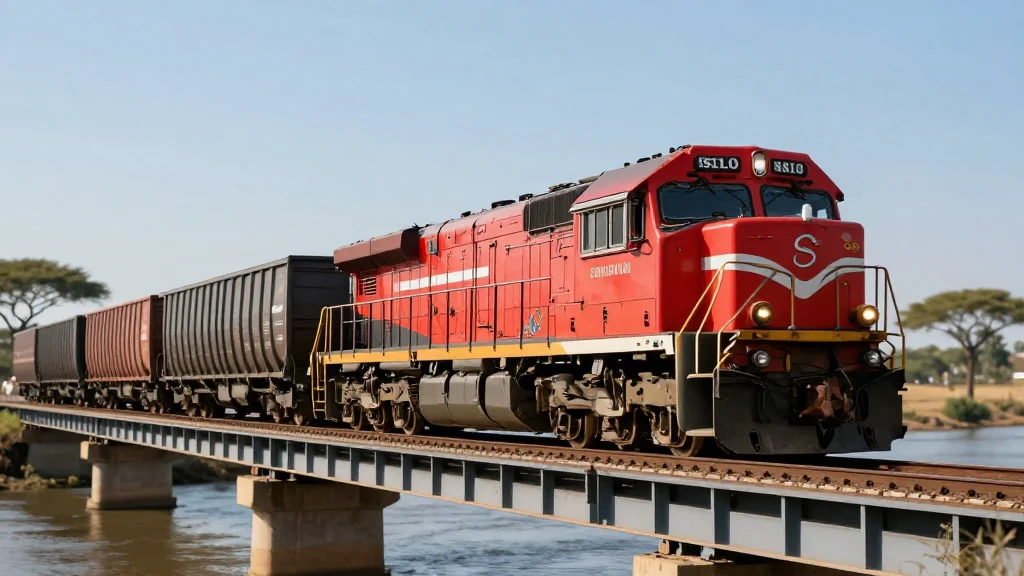
China’s African Mineral Strategy Threatens Kansas City’s Rail Hub, Endangering 30,000 Jobs

Companies Mentioned
Why It Matters
The battle for African mineral logistics illustrates how geopolitics can reshape domestic freight patterns. If U.S.-backed corridors succeed, they could lower the cost of critical minerals for American manufacturers, reinforcing supply‑chain resilience and sustaining jobs in the Midwest. A failure to diversify logistics away from Chinese‑controlled routes would embed higher material costs into U.S. production, potentially eroding the competitiveness of Kansas City’s rail hub and its associated industries. Beyond Kansas City, the outcome signals how infrastructure financing can be wielded as a geoeconomic tool. The $753 million U.S. loan and the $1.4 billion Chinese upgrade are not merely construction projects; they are strategic levers that determine which nations control the flow of essential resources. The transportation sector, from rail operators to intermodal terminals, will feel the ripple effects of whichever network becomes the dominant conduit for African minerals.
Key Takeaways
- •Kansas City’s Argentine Yard supports ~30,000 jobs and $10 B in annual activity.
- •DRC holds ~70% of global cobalt reserves, a key input for batteries and electric vehicles.
- •China is upgrading the Tanzania‑Zambia railway with $1.4 B to move minerals to Dar es Salaam.
- •U.S. financed a $753 M loan for Angola’s Lobito Corridor to create an alternative export route.
- •DRC rail capacity operates at <5% of potential, leaving Chinese logistics as the default path.
Pulse Analysis
China’s long‑term infrastructure strategy in Africa is a textbook case of using capital to lock in supply‑chain dominance. By securing concessions on key rail lines and guaranteeing mineral access through joint ventures, Beijing has effectively created a closed loop: raw material extraction, eastward transport, Chinese processing, and re‑entry into global markets. This model reduces reliance on external logistics and gives Chinese manufacturers a pricing edge that can be passed downstream to U.S. consumers.
For the United States, the response hinges on replicating that loop with alternative corridors that can compete on cost and reliability. The Lobito Corridor, funded by a $753 million loan, aims to divert a portion of the mineral flow to Atlantic ports under Western control. However, the project faces steep challenges: construction timelines, political stability in Angola, and the need to attract private shippers away from entrenched Chinese routes. If the corridor can achieve even a modest share of the export volume, it could lower input costs for Midwest manufacturers and preserve freight traffic through Kansas City’s rail hub.
The broader transportation implication is that rail networks are increasingly becoming strategic assets in the geopolitics of critical minerals. Operators that can align with emerging logistics corridors will capture new business, while those tied to legacy routes risk obsolescence. Kansas City’s recent intermodal investments position it to benefit from any shift toward U.S.-controlled pathways, but the city must also diversify its freight mix to mitigate the risk of a single commodity‑driven downturn. The next phase of infrastructure financing will likely determine whether the Midwest retains its freight leadership or cedes ground to a new, China‑centric logistics architecture.
China’s African Mineral Strategy Threatens Kansas City’s Rail Hub, Endangering 30,000 Jobs
Comments
Want to join the conversation?
Loading comments...