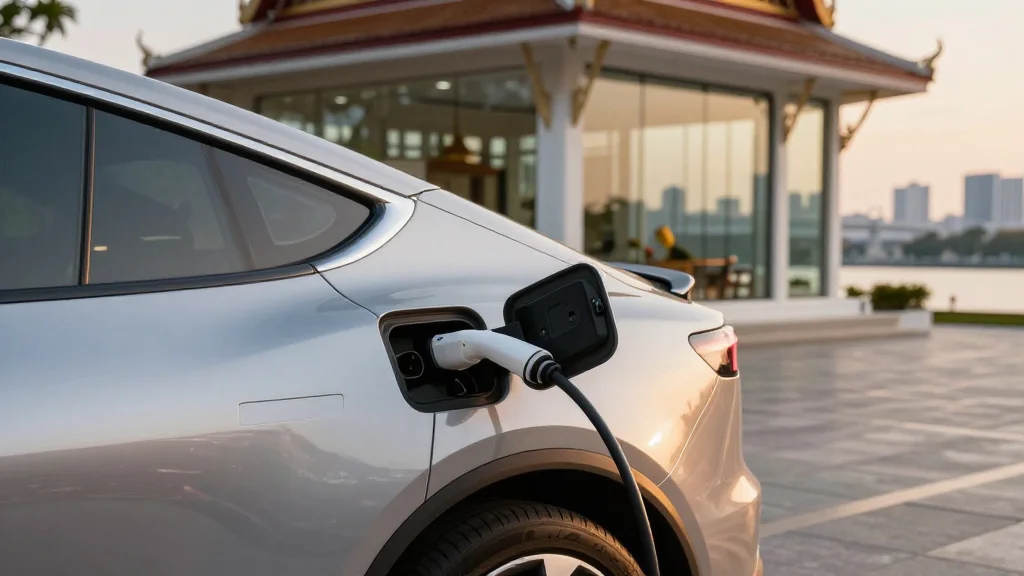
Did The Bangkok Motor Show Reveal An EV Tipping Point In Thailand?
Why It Matters
Thailand’s auto sector is pivoting from a diesel‑pickup hub to a mass EV market, reshaping regional supply chains and forcing legacy manufacturers to accelerate electrification. The rapid price erosion expands consumer access, accelerating adoption and influencing ASEAN‑wide mobility trends.
Key Takeaways
- •BYD tops bookings; Chinese EVs hold 8 of top 10 spots
- •Sub‑700k Baht EVs (~$16k) now available, driving mass‑market adoption
- •Japanese EVs launch above $35k, targeting premium segment
- •Government NEV tax break cut spurs 30% price reductions
- •European and Tesla premium models emphasize luxury, not volume
Pulse Analysis
Thailand’s automotive landscape has long been anchored by diesel pickups, but the 2026 Bangkok International Motor Show revealed a seismic shift. Chinese manufacturers, led by BYD, flooded the market with sub‑700,000 Baht electric models—roughly $16,000 to $18,000—undercutting legacy pricing and capturing eight of the top ten booking slots. This price aggression was amplified by the Thai government’s decision to halve the NEV purchase tax incentive, prompting a cascade of up‑to‑30% price cuts across the board. The result is a burgeoning EV inventory that rivals traditional ICE offerings in affordability, positioning Thailand as a potential low‑cost EV hub for Southeast Asia.
The competitive pressure forced Japanese giants to recalibrate. Honda, Nissan, Toyota, and Isuzu unveiled higher‑priced EVs and hybrids, generally above $35,000, targeting premium and commercial segments such as the Isuzu D‑Max EV workhorse. European brands and Tesla doubled down on luxury, presenting models with 800‑plus kilometre ranges and premium interiors, but their impact remains niche compared with the volume‑driven Chinese surge. Supply‑chain dynamics are also evolving; local parts suppliers must adapt to battery‑centric designs, while foreign OEMs negotiate joint‑venture arrangements to secure Thai production capacity. The policy shift, combined with aggressive pricing, accelerates the transition timeline that analysts previously projected over a decade.
Looking ahead, the Thai market’s rapid EV adoption could ripple across the ASEAN region. Affordable, locally‑priced EVs lower the barrier for middle‑class consumers, while the government’s evolving tax framework may further incentivize charging infrastructure development. As Japanese and European players intensify R&D investment to close the price gap, competition will likely drive innovation in battery technology and after‑sales services. For investors and industry stakeholders, the Bangkok show signals that Thailand is moving from speculation to execution in the EV arena, making the next few years critical for market share battles and regional export opportunities.
Did The Bangkok Motor Show Reveal An EV Tipping Point In Thailand?
Comments
Want to join the conversation?
Loading comments...