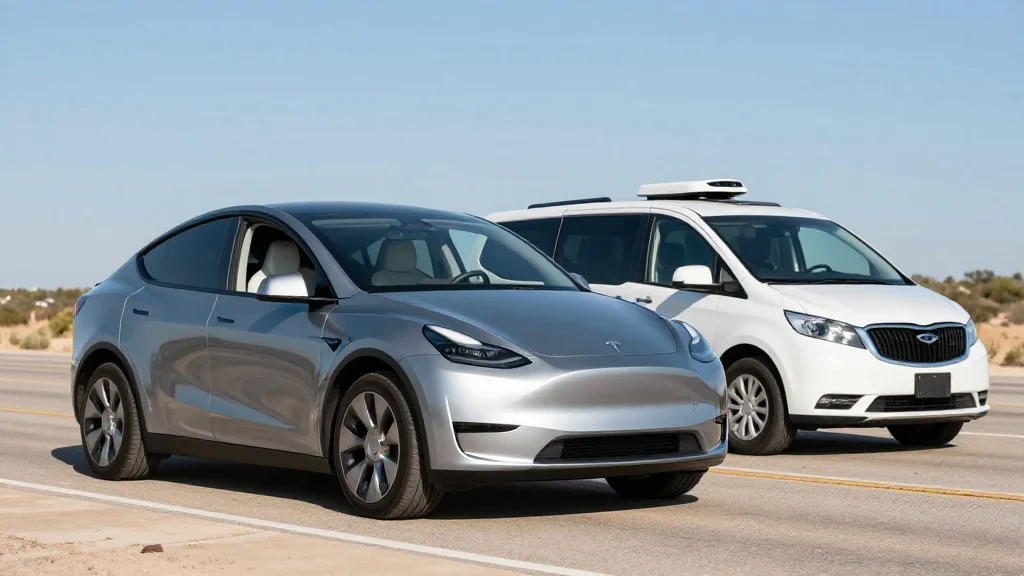
Elon Musk Promised 1,000 Texas Robotaxis Last Year. It’s Nowhere Near That
Why It Matters
The shortfall exposes Tesla’s lag in autonomous‑driving execution, jeopardizing its revenue outlook and market credibility against faster‑moving rivals like Waymo.
Key Takeaways
- •Tesla operates fewer than 50 robotaxis in Texas.
- •Musk promised 1,000 vehicles within months, fell short.
- •Waymo leads with over 570 autonomous taxis in Texas.
- •Tesla removed safety monitors, now runs unsupervised fleet.
- •Retrofit plans for older Teslas remain undefined.
Pulse Analysis
The Texas robotaxi market has become a litmus test for autonomous‑driving ambitions, and Tesla’s rollout has starkly lagged behind its own hype. While Elon Musk boasted that a thousand unsupervised Model Y cabs would be cruising Austin, Dallas and Houston within a few months, the latest Texas Department of Motor Vehicles filing shows only 42 registered robotaxis, with third‑party trackers confirming roughly 30 operating without a safety driver. By contrast, Waymo, the sector’s de‑facto leader, fields more than 570 autonomous vehicles across the state, underscoring a widening performance gap.
Tesla’s shift from safety‑monitor‑equipped prototypes to fully unsupervised operation in January 2026 raised both technical and regulatory eyebrows. The company’s sole Full Self‑Driving (FSD) software version is still labeled “Unsupervised,” and older models lack the hardware needed for true autonomy, prompting Musk to suggest costly micro‑factory retrofits with no clear timeline. Meanwhile, Texas regulators have tightened reporting requirements, yet they provide limited city‑level data, making it difficult for policymakers to assess safety outcomes. The disparity between promised scale and current fleet size highlights lingering software validation challenges.
For investors and industry observers, Tesla’s modest Texas footprint signals a potential recalibration of its autonomous‑driving revenue forecasts. Waymo’s aggressive expansion, coupled with new entrants such as Lucid’s Gravity robotaxi and Zoox’s Austin push, intensifies competition for market share and talent. If Tesla cannot accelerate hardware upgrades or demonstrate consistent safety metrics, it may cede the premium robotaxi segment to rivals that already command larger, fully autonomous fleets. The next twelve months will be critical as regulators, consumers, and shareholders watch whether Tesla can translate its lofty promises into measurable deployment.
Elon Musk Promised 1,000 Texas Robotaxis Last Year. It’s Nowhere Near That
Comments
Want to join the conversation?
Loading comments...