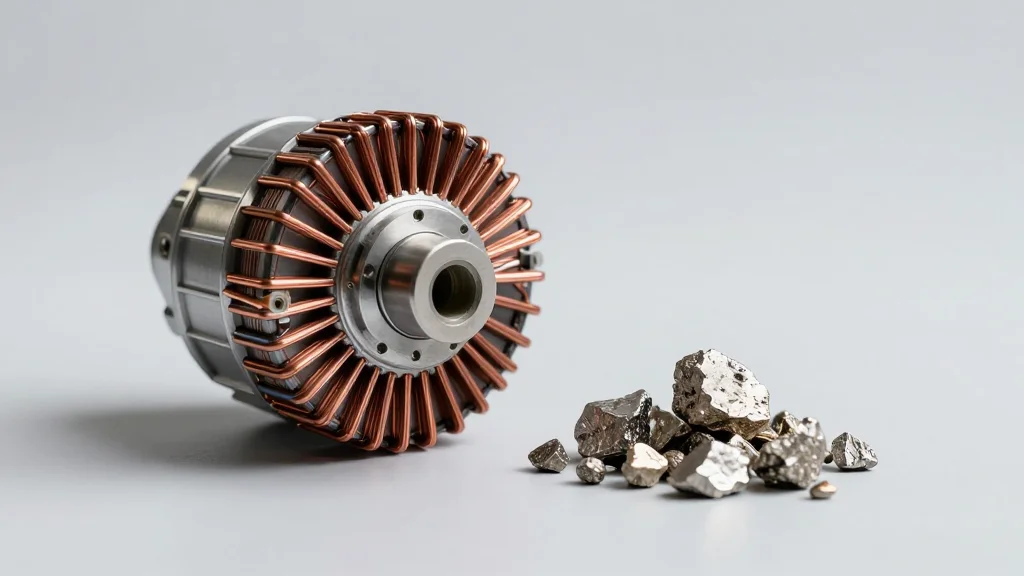
Is the BEV World Moving Away From Rare-Earth Magnets?
Companies Mentioned
Why It Matters
The move toward magnet‑free motors reflects growing geopolitical and supply‑chain concerns, forcing automakers to balance efficiency with material security. Diversifying motor architectures could reshape component sourcing, cost structures, and competitive dynamics in the global BEV market.
Key Takeaways
- •PMSMs still power ~86% of BEV motors in 2025
- •Magnet‑free CESM and EESM are gaining share from AC induction motors
- •Supply risk drives OEMs to diversify motor architectures beyond rare‑earth magnets
- •Europe leads adoption, with Nissan and BMW piloting EESM and CESM
Pulse Analysis
The rapid expansion of battery electric vehicles has intensified scrutiny of every efficiency lever, and the electric motor sits at the core of that equation. While battery capacity continues to rise, added weight and cost make drivetrain efficiency a decisive factor for range‑conscious consumers. Permanent‑magnet synchronous motors have long been the benchmark, delivering high efficiency across typical driving speeds, but their reliance on neodymium‑iron‑boron magnets ties the supply chain to China, where over 90% of refined rare‑earth material is processed. This concentration exposes automakers to price spikes, export controls, and broader geopolitical risk, prompting a strategic reassessment of motor technology.
Alternative architectures are emerging as viable hedges. AC asynchronous induction motors, once relegated to secondary drives, remain the primary magnet‑free choice but lag in low‑speed efficiency, limiting their appeal for mainstream models. More promising are current‑excited and externally‑excited synchronous motors, which replace permanent magnets with electrically powered rotors. Although they introduce excitation losses and added thermal management complexity, they reduce dependence on critical minerals and are already seeing limited production runs—Nissan’s latest Leaf employs an EESM, while BMW’s new platform integrates a CESM. European policy incentives aimed at strategic autonomy are accelerating these pilots, positioning the region as a potential leader in magnet‑free adoption.
Looking ahead, market forecasts suggest PMSMs will retain an 80%‑plus share through the 2030s, but the growth trajectory of CESM and EESM could erode the niche occupied by AC induction motors. Should supply constraints tighten or trade barriers intensify, OEMs may accelerate the shift toward magnet‑free solutions, reshaping supply chains and prompting new partnerships with material innovators. For investors and industry watchers, the evolving motor mix signals not just a technical evolution but a broader geopolitical realignment of the BEV ecosystem.
Is the BEV world moving away from rare-earth magnets?
Comments
Want to join the conversation?
Loading comments...