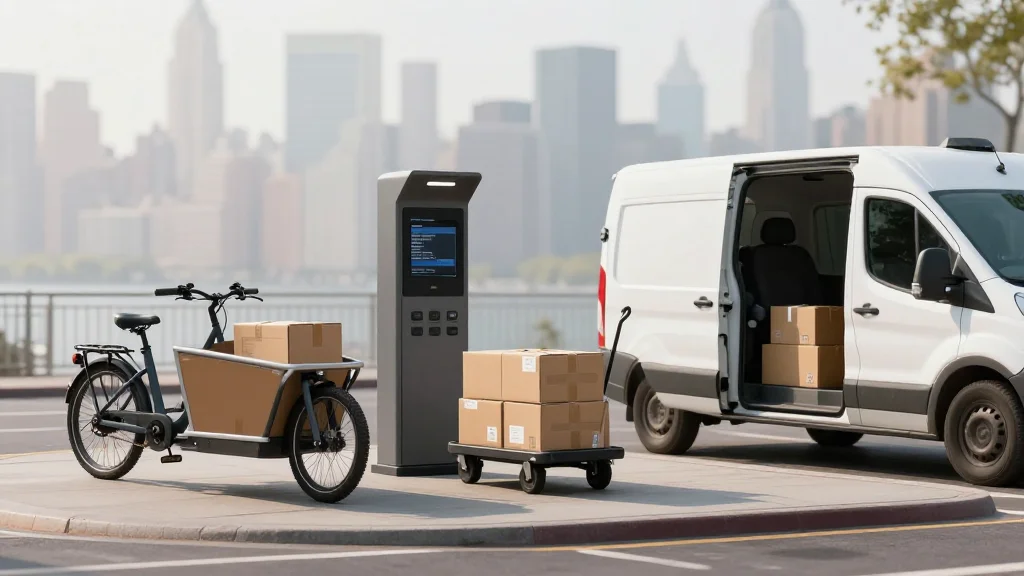
NYC Microhubs Eliminated 3,000 Truck Trips in Just One Year
Companies Mentioned
Why It Matters
Reducing truck traffic cuts congestion, emissions, and delivery costs, positioning NYC as a model for sustainable urban logistics. The initiative demonstrates how coordinated micro‑distribution can meet rising freight demand without overburdening city streets.
Key Takeaways
- •Over 3,000 truck trips removed in first year of microhub pilot
- •Daily handling of 860 handcart and 110 cargo‑bike packages
- •New microhub sites added in Financial District and Upper East Side
- •Freight volume in NYC projected to rise 46% by 2055
- •Amazon joins program, showcasing public‑private urban delivery innovation
Pulse Analysis
Urban freight faces a paradox: demand is soaring while street space shrinks. New York City’s microhub model tackles this by creating dedicated curbside transfer points where large trucks offload parcels to smaller, zero‑emission vehicles. By decoupling the heavy‑truck leg from the final‑mile, the city not only trims vehicle‑miles traveled but also frees up curb space for pedestrians and cyclists, aligning with broader sustainability goals and congestion‑mitigation policies.
The pilot’s early metrics are compelling. More than 3,000 truck trips have been avoided, and today the hubs handle roughly 970 packages each day via handcarts and e‑cargo bikes. This shift translates into measurable reductions in fuel consumption, noise, and emissions, while improving delivery speed in dense neighborhoods. Amazon’s involvement signals confidence from the private sector, suggesting that larger carriers see microhubs as a viable complement to traditional fleets. The recent addition of sites in Manhattan’s Financial District and Upper East Side expands coverage to high‑density commercial zones, amplifying the program’s impact.
Looking ahead, freight volumes in NYC are projected to increase 46% by 2055, intensifying pressure on already congested arteries. Scaling microhubs could become a cornerstone of the city’s long‑term logistics strategy, offering a template for other metropolises grappling with similar challenges. Policymakers will need to integrate microhub planning with zoning, curb management, and electric‑vehicle incentives to sustain momentum. As the model matures, data‑driven optimization—such as dynamic hub placement and real‑time load balancing—could further enhance efficiency, making low‑impact urban delivery the new industry standard.
NYC Microhubs Eliminated 3,000 Truck Trips in Just One Year
Comments
Want to join the conversation?
Loading comments...