Retailers Juggle Last-Mile Carriers as Shoppers Demand Free Delivery
Companies Mentioned
Why It Matters
The shift in delivery expectations forces retailers to re‑engineer last‑mile logistics, turning shipping from a cost center into a competitive differentiator that directly impacts loyalty and profit margins.
Key Takeaways
- •94% of shoppers say free shipping influences purchase decisions
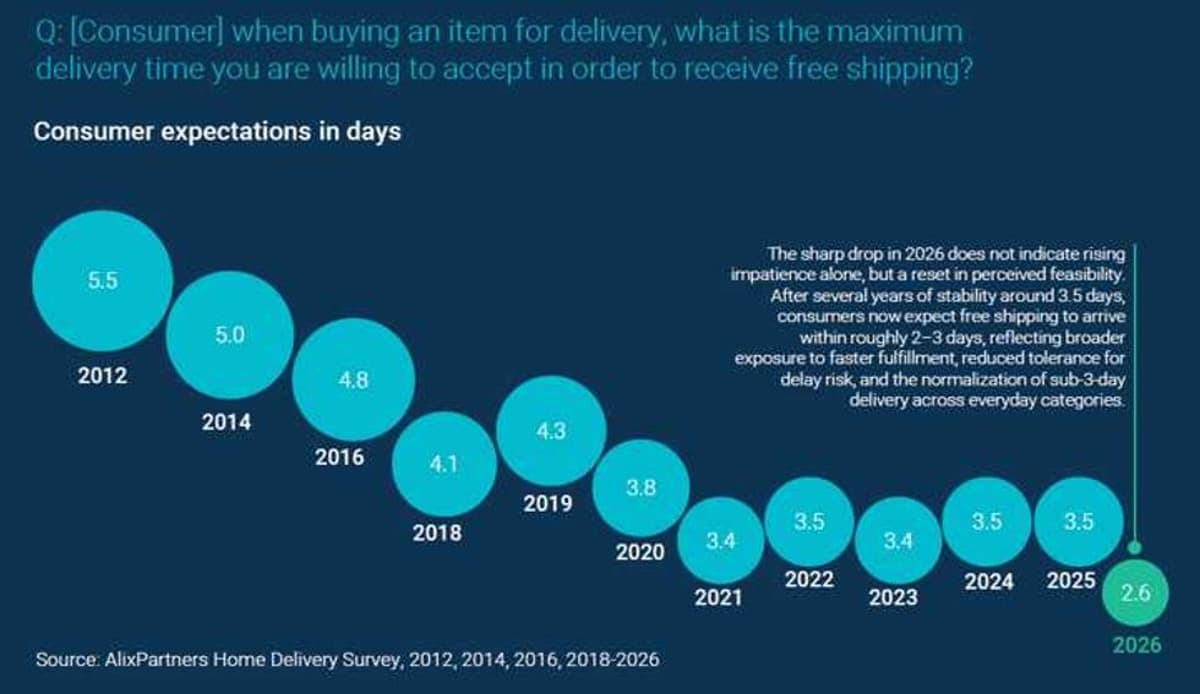
- •Average free‑delivery expectation fell to 2.7 days, under 3 days
- •64% of retailers claim home delivery is not yet profitable
- •55% of retailers now use carriers beyond UPS, FedEx, USPS
- •FedEx tops primary carrier for 38% of retailers, overtaking UPS
Pulse Analysis
The AlixPartners 2026 Home Delivery Survey underscores a seismic shift in consumer expectations: free, fast shipping is no longer a premium perk but a baseline demand. Shoppers now expect parcels to arrive in under three days without a fee, and even a $10 shipping charge can trigger cart abandonment. This heightened bar raises the stakes for retailers, who must balance the cost of meeting these expectations against thin profit margins. As a result, more than half of retailers are reevaluating their last‑mile strategies, moving beyond traditional carriers to build resilient, multi‑carrier networks.
Profitability concerns are front and center, with 64% of executives reporting that home delivery still erodes margins. Rising transportation costs, labor shortages, and the need for rapid order fulfillment compound the challenge. Retailers are increasingly imposing minimum order values—56% now require a spend threshold for free shipping, and half of those have raised the bar in the past year. Some are layering membership programs on top of order minimums, turning shipping into a loyalty lever rather than a pure cost.
Carrier dynamics are also evolving. For the first time, reliability has eclipsed price as the top criterion for selecting a primary carrier. FedEx has overtaken UPS, now cited by 38% of retailers as their lead carrier, while 55% of respondents use alternatives outside the traditional duopoly. This diversification reflects a strategic pivot: retailers view carrier choice as a brand experience, with the carrier badge on the box influencing shopper perception. Companies that can dynamically route shipments across multiple partners are better positioned to safeguard loyalty and capture the growing value of the last‑mile ecosystem.
Retailers juggle last-mile carriers as shoppers demand free delivery
Comments
Want to join the conversation?
Loading comments...