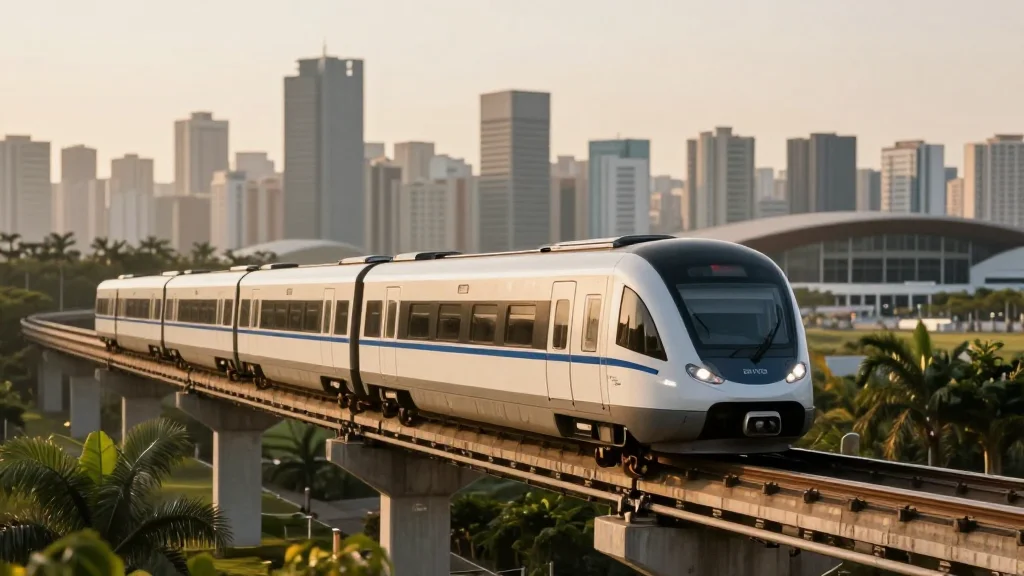
São Paulo Launches BYD SkyRail Line 17, Brazil’s First Medium‑Capacity Elevated Rail

Companies Mentioned
Why It Matters
Line 17’s opening signals a shift in how emerging economies can address urban mobility challenges without the massive civil‑engineering costs of traditional metros. The compact guide‑beam design and battery‑backed operation reduce construction time, land‑use conflicts, and vulnerability to power outages—key concerns for rapidly growing cities. Moreover, BYD’s entry into the rail sector illustrates the expanding influence of Chinese clean‑technology firms in Latin America, potentially reshaping procurement patterns and standards for low‑carbon transport. Beyond São Paulo, the project offers a proof point for other congested cities in Brazil and across South America that lack the fiscal space for full‑scale rail. If the line delivers on its promised emissions cuts and reliability, it could catalyze a wave of medium‑capacity, automated rail deployments, accelerating the region’s transition to sustainable, high‑frequency public transit.
Key Takeaways
- •Line 17, São Paulo’s first BYD SkyRail, began revenue service on March 31
- •The line uses an 800 mm concrete guide beam, allowing tight 45 m curves and 10% gradients
- •Trains draw 750 V DC and carry lithium‑iron‑phosphate batteries for backup power
- •Automation is Grade‑of‑Automation 4, enabling fully unattended operation
- •Projected CO₂ reductions are in the tens of thousands of tonnes annually
Pulse Analysis
The SkyRail debut in São Paulo arrives at a moment when Brazilian municipalities are scrambling for affordable, climate‑friendly transit solutions. Traditional metro projects have stalled across the country due to cost overruns and lengthy approval processes, leaving a service gap that medium‑capacity systems like SkyRail can fill. BYD’s strategy of leveraging its EV battery expertise for rail applications creates a unique value proposition: a system that can keep moving during power failures, a feature that resonates in a market where grid reliability is uneven.
Historically, Chinese infrastructure firms have focused on large‑scale projects—high‑speed rail, ports, and highways—where they can showcase engineering might. BYD’s pivot to compact urban rail reflects a broader diversification, targeting niche markets that value speed of deployment over sheer capacity. The partnership with São Paulo’s state government also signals a diplomatic dimension; China’s “new infrastructure” agenda is gaining traction in Latin America, and successful pilots like Line 17 could translate into a pipeline of contracts in Brazil’s other megacities, such as Rio de Janeiro and Belo Horizonte.
Looking ahead, the line’s success will hinge on ridership adoption and the ability to integrate with existing transport modes. If the R&D center delivers localized innovations—such as climate‑adapted battery management or cost‑effective maintenance protocols—BYD could lock in a competitive advantage that extends beyond the initial contract. For investors and policymakers, Line 17 offers a live case study of how modular, battery‑assisted rail can accelerate urban mobility while delivering measurable emissions cuts, a model that may soon be replicated across the Global South.
São Paulo Launches BYD SkyRail Line 17, Brazil’s First Medium‑Capacity Elevated Rail
Comments
Want to join the conversation?
Loading comments...