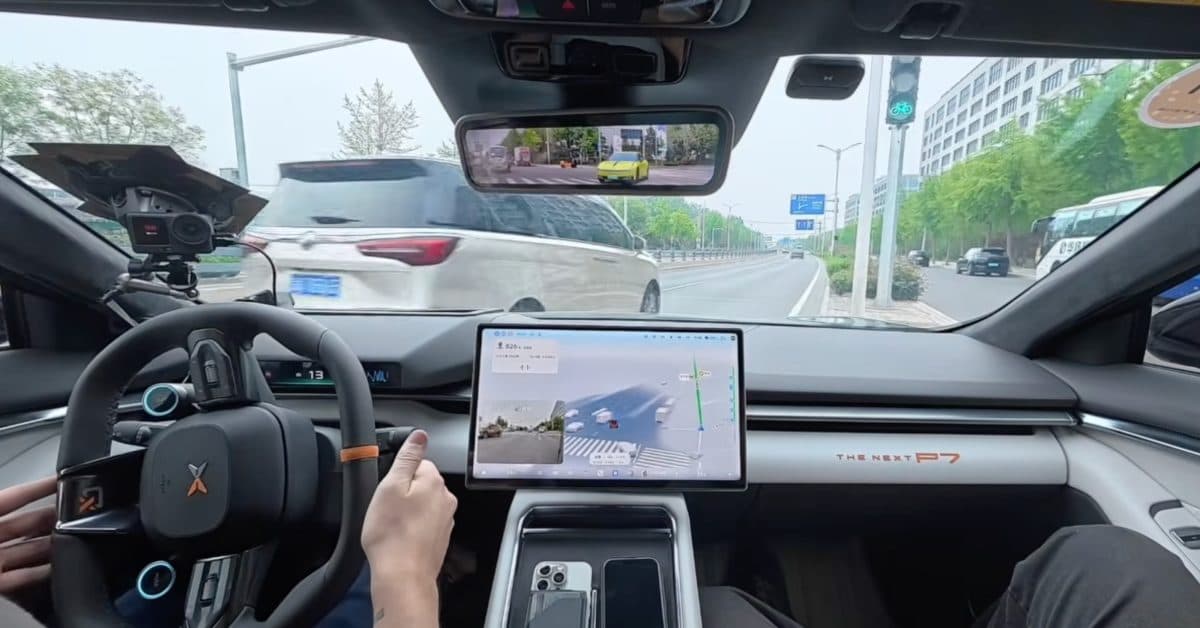
Xpeng VLA 2.0 Test Drive: Tesla Is Not Alone with ‘Full Self-Driving’ Anymore
Companies Mentioned
Why It Matters
Xpeng’s VLA 2.0 narrows Tesla’s lead in advanced driver‑assist, showing that high‑performance Level‑2 systems can be bundled into the vehicle price and challenging the subscription‑based FSD model. This accelerates competition in the world’s largest EV market and pressures global OEMs to innovate faster.
Key Takeaways
- •Xpeng's VLA 2.0 launched March 2026 via OTA to P7, G7, X9
- •End‑to‑end vision‑to‑action model cuts latency, improves driving efficiency 23%
- •Proprietary Turing AI chip delivers up to 2,250 TOPS in production cars
- •Volkswagen became first external customer, deploying VLA 2.0 in Chinese‑market SUV
- •Xpeng includes VLA 2.0 now, while Tesla charges $99/month for FSD
Pulse Analysis
Xpeng’s VLA 2.0 marks a watershed moment for Chinese autonomous‑driving technology. By replacing the traditional perception‑planning‑control pipeline with an end‑to‑end vision‑to‑action neural network, the system slashes processing latency and delivers smoother, more decisive maneuvers. The proprietary Turing AI chip, rated at 2,250 TOPS, provides the compute horsepower needed to parse 100 million extreme‑driving clips, yielding a 23% boost in efficiency and a dramatic 99% drop in hard‑braking events. This architecture mirrors Tesla’s own neural‑net approach but arrives with a localized training regimen that reflects Beijing’s chaotic traffic patterns, giving Xpeng a unique edge in its home market.
The real market impact emerges from Xpeng’s rollout strategy. VLA 2.0 is pushed to owners through over‑the‑air updates, eliminating the need for costly hardware retrofits and embedding the feature in the vehicle’s base price. In contrast, Tesla now relies on a $99‑per‑month subscription for its Full Self‑Driving (FSD) suite in the United States, a model that may prove less attractive as competitors bundle comparable capabilities. Volkswagen’s decision to adopt VLA 2.0 for its Chinese‑market SUV underscores the system’s commercial viability and signals that legacy OEMs are willing to partner with Chinese AI firms to accelerate their own autonomous‑driving roadmaps.
The broader implication is a rapidly flattening competitive moat around advanced driver‑assist systems. With BYD’s “God’s Eye,” Huawei’s multibillion‑dollar AI investment, and Xiaomi’s push into smart driving, the Chinese EV ecosystem is crowding out Tesla’s technological lead. As more manufacturers ship Level‑2 systems that can safely navigate the world’s toughest urban environments, regulatory approval pathways and pricing strategies will become decisive factors. Xpeng’s aggressive timeline—aiming to match Tesla’s FSD v14.2 performance by August 2026—illustrates the accelerating arms race that could reshape global standards for consumer‑grade autonomy.
Xpeng VLA 2.0 test drive: Tesla is not alone with ‘Full Self-Driving’ anymore
Comments
Want to join the conversation?
Loading comments...