Astronomers Fear Orbital Data Centers Will Interfere with Observations
Companies Mentioned
Why It Matters
The deployment threatens to compromise critical astronomical research by brightening the night sky, while raising regulatory and environmental debates about the sustainability of space‑based computing.
Key Takeaways
- •SpaceX targets first AI1 launches in 2027, with test units in 2026
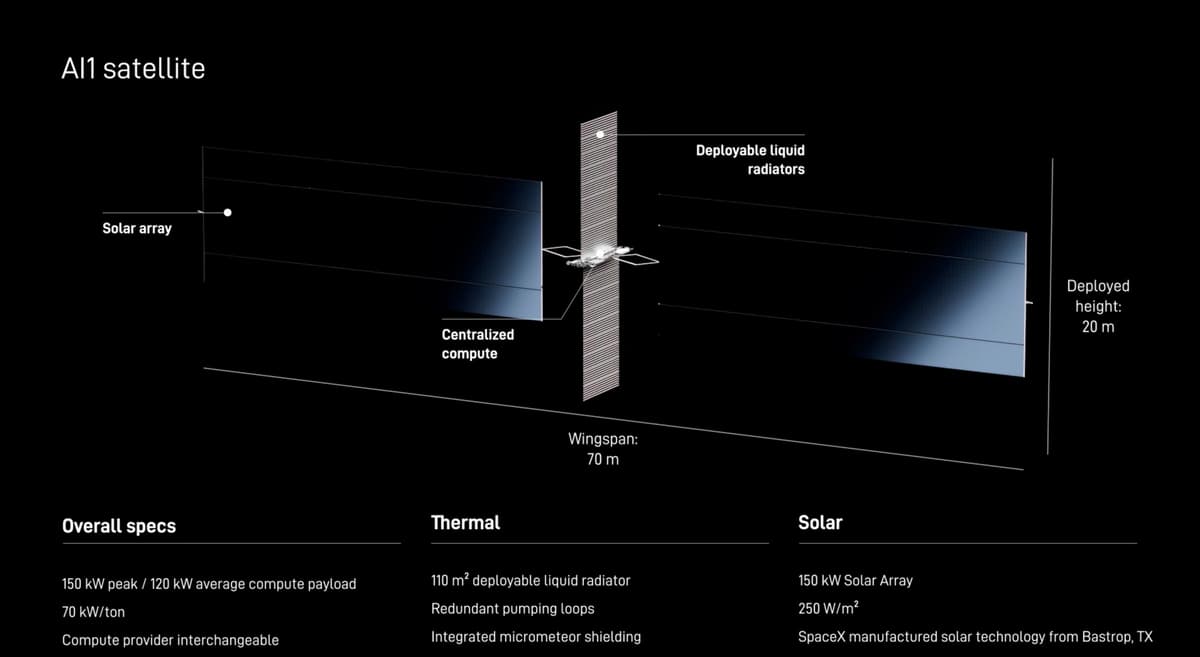
- •AI1 satellites will house 120 kW of compute, powered by 150 kW solar arrays
- •Astronomers predict bright‑lane glare comparable to a half‑moon at million‑satellite scale
- •Optical telescopes could face glints as bright as Venus from operational AI1s
- •Industry sees orbital data centers as risky versus renewable‑energy ground facilities
Pulse Analysis
SpaceX’s AI1 orbital data‑center concept marks a bold shift from traditional ground‑based cloud infrastructure. By embedding high‑performance compute modules inside a 70‑meter‑long satellite, the company hopes to sidestep terrestrial power constraints and deliver low‑latency services directly from low‑Earth orbit. The design eliminates complex phased‑array antennas, relying instead on laser links to existing Starlink nodes, which SpaceX claims simplifies production and reduces costs. A new factory in Bastrop, Texas, is already gearing up to mass‑produce the solar arrays and radiators needed for these power‑hungry platforms, with volume production expected by the end of next year.
Astronomers, however, see a different horizon. The projected fleet—potentially up to one million AI1 units—would create continuous “bright lanes” that could raise sky brightness to half‑moon levels, eclipsing faint celestial signals. Even in higher orbits, the satellites may produce glints rivaling Venus, jeopardizing time‑domain surveys that track supernovae and gamma‑ray bursts. Past mitigation efforts for Starlink’s visual impact have yielded limited success, and the larger AI1 structures could exacerbate the problem. The scientific community warns that without robust policy or technical safeguards, the next generation of researchers may lose access to critical observational windows.
Beyond astronomy, the AI1 initiative raises broader questions about the economics and sustainability of space‑based computing. While orbital data centers promise proximity to end‑users and reduced latency, they also entail massive launch costs, orbital debris risks, and uncertain energy efficiency compared with rapidly falling renewable‑energy prices on Earth. Regulators, industry stakeholders, and environmental groups will need to weigh these trade‑offs as the FCC reviews the massive satellite filings, potentially shaping the future balance between terrestrial and extraterrestrial data infrastructure.
Astronomers fear orbital data centers will interfere with observations
Comments
Want to join the conversation?
Loading comments...