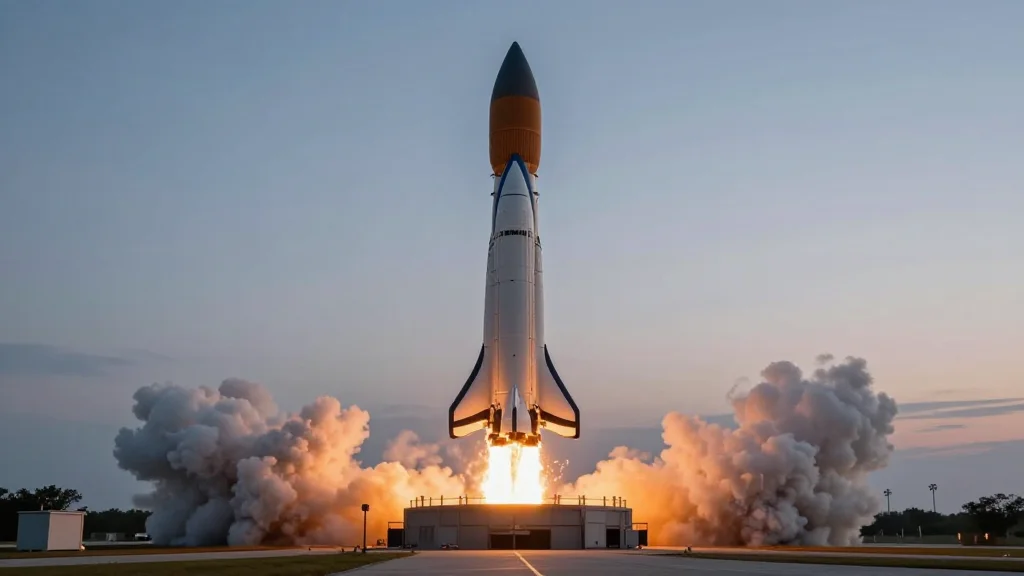
Blue Origin’s New Glenn Test Explosion Threatens Artemis Moon Schedule

Companies Mentioned


Why It Matters
The New Glenn explosion strikes at the heart of the United States’ strategy to regain leadership in deep‑space exploration. NASA’s Artemis program depends on a diversified launch portfolio; a prolonged outage at Blue Origin could force the agency to over‑rely on SpaceX, raising geopolitical and supply‑chain risks. Moreover, the incident highlights the technical challenges of scaling methane‑fueled engines, a technology that promises higher performance but also introduces new failure modes. For the commercial sector, the loss of a launch slot disrupts Amazon’s satellite broadband rollout, potentially delaying service to underserved regions and affecting revenue forecasts. The event also serves as a cautionary tale for other firms planning high‑energy static‑fire tests, prompting tighter safety protocols and more rigorous ground‑system validation before committing multi‑engine rockets to flight.
Key Takeaways
- •New Glenn exploded during a hot‑fire test at Launch Complex 36 on May 29, 2026.
- •Jeff Bezos said the cause is unknown but the company will rebuild the launch pad.
- •The blast could delay NASA’s Artemis III lunar landing from 2028 to 2029.
- •NASA, FAA, and independent experts will lead a joint investigation into the failure.
- •Amazon’s planned launch of 48 broadband satellites in early June is now postponed.
Pulse Analysis
Blue Origin’s setback underscores the fragility of the U.S. lunar supply chain. Historically, NASA has relied on a single provider for critical launch services; the Apollo era depended on the Saturn V, while the Shuttle era depended on the Space Shuttle fleet. The Artemis program deliberately diversified to include SpaceX, United Launch Alliance, and Blue Origin, but the New Glenn failure re‑exposes a single‑point vulnerability. If Blue Origin cannot return to flight before the end of 2027, NASA may be forced to renegotiate contracts, potentially incurring cost overruns and schedule slips.
From a competitive standpoint, the incident could accelerate SpaceX’s dominance in the heavy‑lift market. Starship, despite its own test‑flight challenges, is positioned to capture the bulk of NASA’s lunar cargo contracts if Blue Origin’s timeline slips. Conversely, Blue Origin’s deep pockets and Bezos’s public commitment to rebuild could mitigate long‑term damage, especially if the root cause is traced to a ground‑system issue that can be corrected quickly. The company’s ability to demonstrate a safe, repeatable hot‑fire test within the next 12‑18 months will be a litmus test for its credibility.
Finally, the explosion may catalyze regulatory scrutiny of methane‑engine testing. The BE‑4’s high thrust and cryogenic propellants present unique hazards that have not been fully mastered at scale. Expect the FAA to tighten oversight, potentially adding new certification milestones that could lengthen the development timeline for future methane‑based launchers. This regulatory tightening could benefit competitors using more mature kerosene‑based engines, reshaping the competitive landscape for the next decade.
Blue Origin’s New Glenn Test Explosion Threatens Artemis Moon Schedule
Comments
Want to join the conversation?
Loading comments...