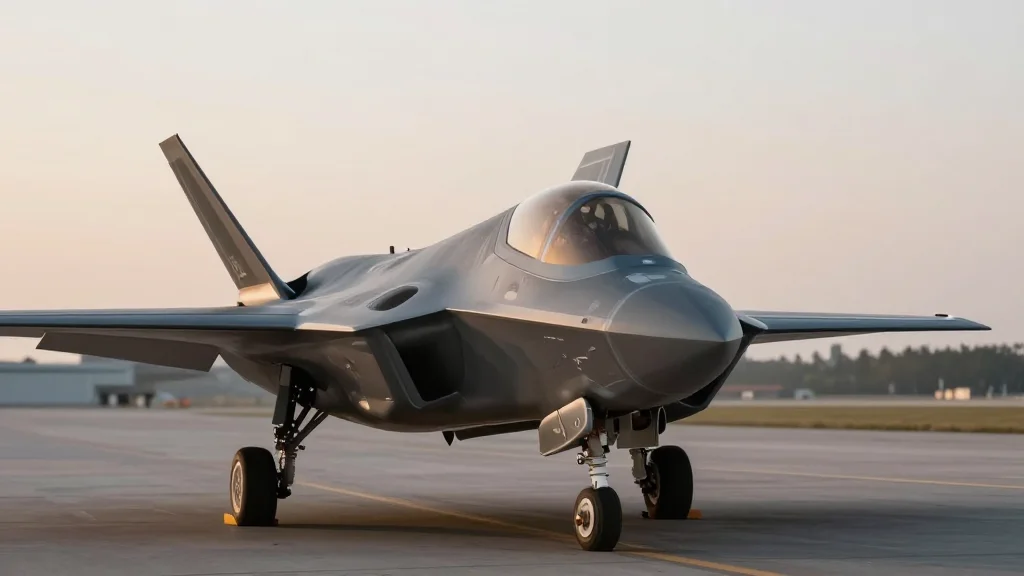
India Shortlists Three Private Firms for Next‑Gen Stealth Fighter Prototypes

Companies Mentioned
Why It Matters
The inclusion of private firms in the AMCA prototype programme marks a watershed moment for India's defence procurement strategy, potentially reshaping the country's aerospace ecosystem. By leveraging the engineering depth and financial muscle of Tata, L&T and Bharat Forge, the government hopes to accelerate development timelines, introduce competitive pricing and foster indigenous innovation. Success could reduce India's dependence on foreign platforms, enhance strategic autonomy, and create a new export‑ready combat aircraft lineage. Moreover, the decision sets a precedent for future high‑value defence projects, encouraging other private players to invest in advanced aerospace capabilities. If the prototypes meet performance targets, the private sector could capture a larger share of the defence market, prompting a re‑evaluation of the role of state‑owned HAL and influencing policy on public‑private partnerships across the defence sector.
Key Takeaways
- •Three private firms—Tata Advanced Systems, Larsen & Toubro, Bharat Forge—shortlisted for AMCA prototype contract
- •Five stealth fighter prototypes to be built at a new Andhra Pradesh facility, with first flight targeted for 2032
- •Prototype phase funded with an indicative ₹15,000 crore budget (~$1.8 bn)
- •Indian Air Force plans a later order of about 120 AMCA jets after prototype validation
- •Public‑sector HAL excluded from initial shortlist but may compete for the larger production tender
Pulse Analysis
India's decision to hand the AMCA prototype contract to private conglomerates reflects a broader policy shift toward market‑driven defence acquisition. Historically, the Indian aerospace sector has been dominated by Hindustan Aeronautics Ltd, which, despite its legacy, has struggled with cost overruns and delayed timelines on projects like the Tejas fighter. By opening the competition, the ministry is betting that the private sector's access to global supply chains and its experience in large‑scale engineering projects will compress development cycles and improve cost efficiency.
The stakes are high. The AMCA is envisioned as a fifth‑generation stealth platform capable of competing with the US F‑35 and Russia's Su‑57. Achieving stealth, supercruise and advanced sensor fusion requires sophisticated materials, engine technology and software integration—areas where Indian firms have limited indigenous experience. However, all three shortlisted companies have existing joint ventures with foreign OEMs: Tata with Airbus and Boeing, L&T with Lockheed Martin, and Bharat Forge with Rolls‑Royce. These partnerships could accelerate technology transfer, but they also raise questions about intellectual property control and the extent of foreign dependence.
Looking ahead, the success or failure of the prototype phase will set the tone for India's future defence procurement. A smooth prototype rollout could unlock a cascade of private‑sector contracts, stimulate domestic supply chains, and position India as a credible exporter of advanced combat aircraft. Conversely, technical setbacks or cost overruns could reinforce the argument for a stronger role for HAL or even a re‑centralisation of critical programmes under state control. The next twelve months—when tenders are issued and bids evaluated—will be a litmus test for the viability of India's new defence industrial model.
India Shortlists Three Private Firms for Next‑Gen Stealth Fighter Prototypes
Comments
Want to join the conversation?
Loading comments...