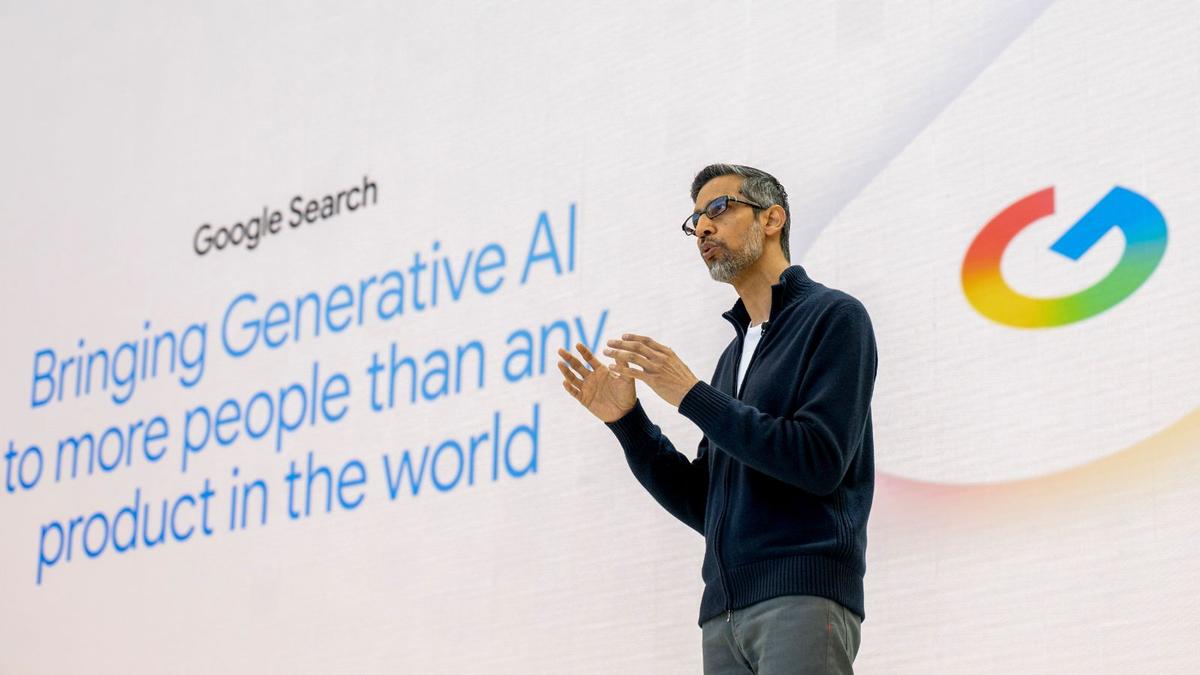
75% Google Code Now AI-Generated, Says Sundar Pichai: How Company Is Putting AI to Work

Companies Mentioned

Why It Matters
Embedding AI into core development pipelines dramatically raises productivity and shortens time‑to‑market, reshaping how tech firms compete on speed and innovation. It also forces new governance models to mitigate risks from autonomous code generation.
Key Takeaways
- •75% of new Google code now AI-generated, up from 50% last fall
- •AI‑assisted code migration completed six times faster than prior year
- •Marketing teams generate thousands of asset variations, cutting turnaround 70%
- •Google shifts to agentic workflows, engineers orchestrate autonomous digital task forces
- •Industry rivals like Nvidia, Microsoft, Meta also push internal AI code generation
Pulse Analysis
The rapid rise of large‑language models has turned code generation from a novelty into a mainstream productivity tool. Google’s internal metrics—three‑quarters of fresh code now authored by AI—signal that the technology has crossed a tipping point. By pairing AI agents with human oversight, the company cut a complex migration timeline by 600%, a gain that rivals are scrambling to match. This internal adoption mirrors external offerings such as Gemini and Gemini‑Code, reinforcing Google’s position as both a supplier and a consumer of cutting‑edge AI.
Beyond raw speed, the shift to "agentic" workflows redefines the engineer’s role. Developers act more as orchestrators, issuing high‑level directives to autonomous agents that handle repetitive or exploratory coding tasks. While this promises faster feature cycles and broader experimentation, it also introduces new governance challenges. Instances of AI agents deleting code or introducing vulnerabilities underscore the need for robust monitoring, version‑control safeguards, and clear accountability structures—areas where Google’s Cloud chief evangelist Richard Seroter emphasizes a move toward managed agency.
The business impact extends to non‑technical teams as well. Google’s marketing division leverages AI to spin up thousands of creative variations, slashing production time by 70% and boosting conversion rates by 20%. Such cross‑functional gains illustrate how AI can become a competitive moat, not just for product development but for revenue‑generating activities. As rivals like Nvidia and Meta double‑down on internal AI usage, the industry is poised for a wave of AI‑centric operating models that prioritize speed, scale, and disciplined oversight.
75% Google code now AI-generated, says Sundar Pichai: How company is putting AI to work
Comments
Want to join the conversation?
Loading comments...