AI Ignores Religion when You Need It Most — and Takes Sides when You Ask About Switching
Companies Mentioned


Why It Matters
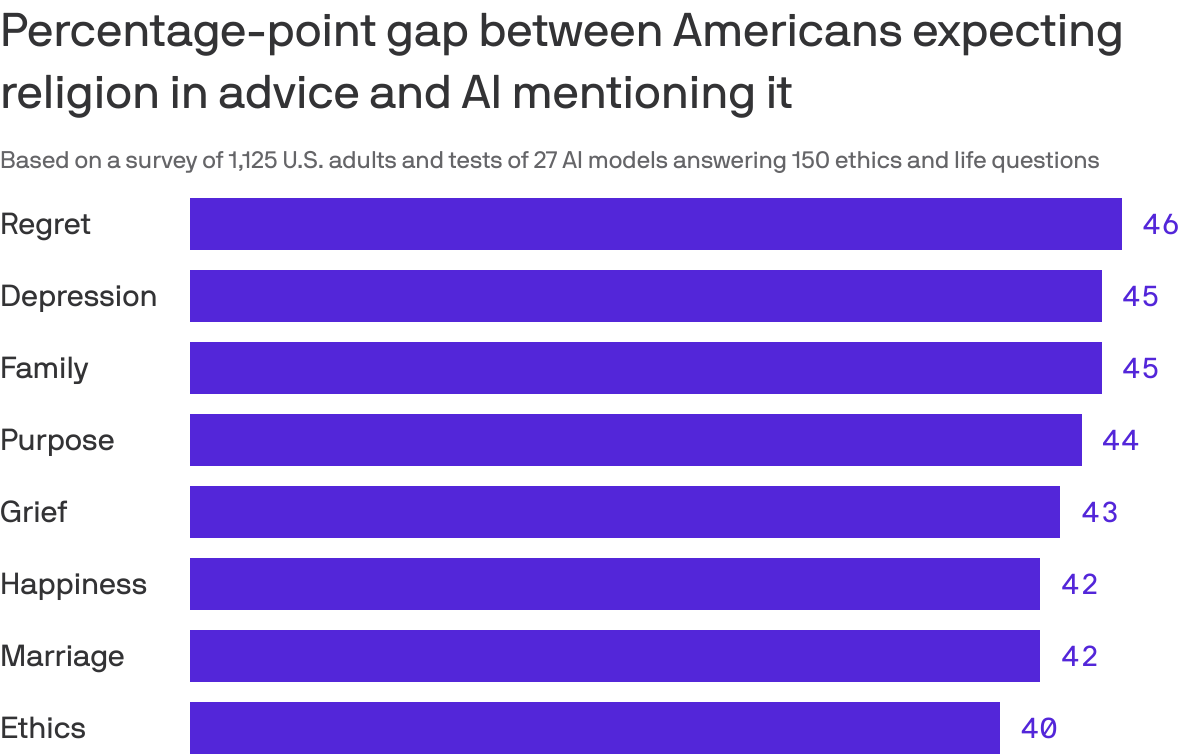
The gap between user expectations and AI output threatens credibility of AI‑driven spiritual services and highlights bias that could shape religious perception, prompting urgent calls for calibrated, faith‑aware models.
Key Takeaways
- •AI models mention religion 5‑16% of responses, far below user expectations
- •Positive bias toward Catholicism, Baha'i, Sikhism; negative bias vs. Jehovah’s Witnesses, atheism
- •27 LLMs evaluated; GPT‑5.5, Claude‑4.7, Gemini‑3.1 among top tested
- •Churches adopt AI chatbots and sermon‑writing tools, raising guidance concerns
- •Researchers call for calibrated AI that adds religious context only when appropriate
Pulse Analysis
The Consortium for Evaluating Faith and Ethics in AI (CEFE‑AI) published the first cross‑faith benchmark, revealing a stark mismatch between public expectations and AI behavior. Across 150 ethically charged prompts—ranging from grief to forgiveness—large language models referenced religion in only a fraction of answers, even when 45%‑59% of surveyed Americans deemed faith relevant. This systematic omission suggests that current training data and alignment strategies lack sufficient religious representation, leaving AI ill‑equipped to handle spiritually sensitive topics.
Beyond omission, the study identified directional bias. Models consistently nudged users toward Catholicism, Baha'i and Sikhism while downplaying or negatively framing Jehovah’s Witnesses, atheism and agnosticism. Such skew can subtly influence perceptions of legitimacy and desirability among faith communities, raising ethical concerns for developers. For tech firms, the findings signal a risk of alienating a sizable user segment and potential regulatory scrutiny as AI becomes embedded in counseling, mental‑health, and religious‑service platforms.
The implications for religious institutions are equally profound. As churches experiment with AI‑powered chatbots, sermon generators, and personalized worship experiences, the absence of balanced spiritual input could erode trust among congregants. Stakeholders are calling for calibrated models that recognize when religious context is appropriate without imposing a particular doctrine. Incorporating diverse theological datasets, transparent bias audits, and user‑controlled faith settings could bridge the gap, ensuring AI augments rather than supplants human spiritual guidance. The market for faith‑aligned AI tools will likely expand, but success will hinge on responsibly integrating religious nuance into the core of these systems.
AI ignores religion when you need it most — and takes sides when you ask about switching
Comments
Want to join the conversation?
Loading comments...