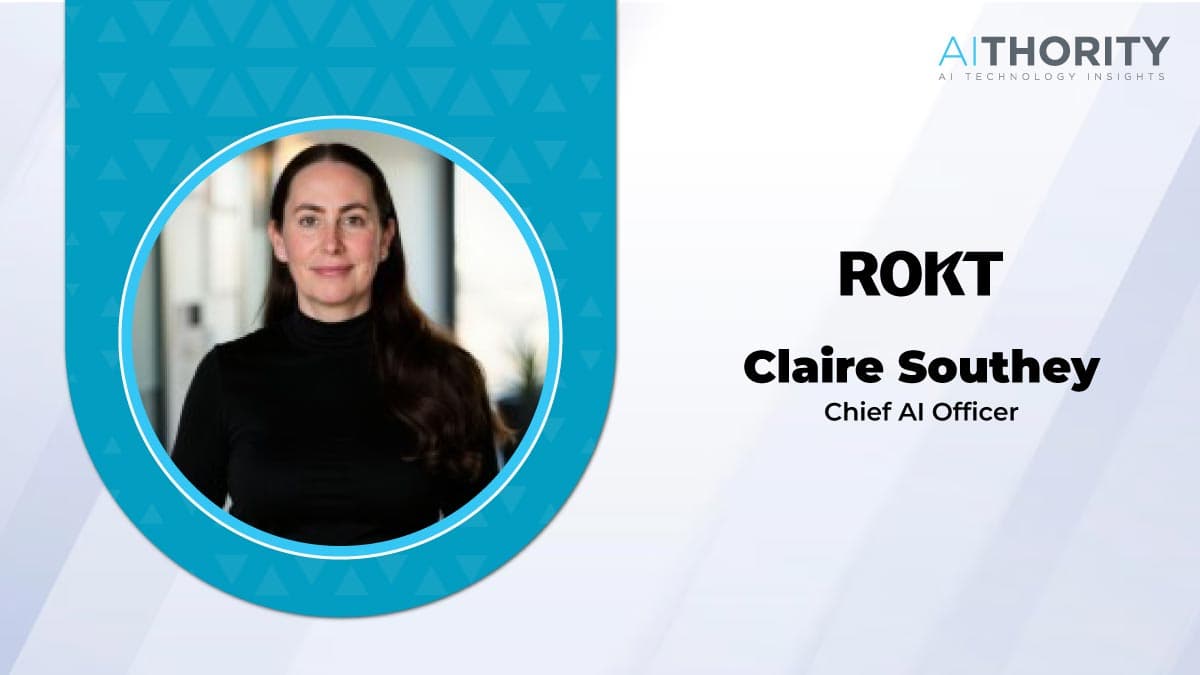
AiThority Interview With Claire Southey, Chief AI Officer at Rokt
•January 28, 2026
0
Companies Mentioned


Why It Matters
Rokt’s AI strategy demonstrates how deep integration of machine learning can boost conversion rates and accelerate product cycles, setting a benchmark for eCommerce firms. The shift toward AI‑orchestrated development signals broader industry changes in talent, tooling, and speed of innovation.
Key Takeaways
- •Chief AI Officer steers strategy, governance, and culture
- •Rokt processes seven billion checkout experiences annually
- •Acquired mParticle for $300M to unify customer data
- •AI models reduce decision fatigue, boosting conversion rates
- •AI tools compress dev cycles, shifting teams toward orchestration
Pulse Analysis
The rise of the Chief AI Officer reflects a maturing view of artificial intelligence as a core business capability rather than a side project. At Rokt, Claire Southey blends strategy, architecture, and governance to ensure AI initiatives align tightly with revenue goals. By building proprietary models alongside vetted third‑party solutions, Rokt creates a flexible AI stack that powers its real‑time recommendation engine, a critical differentiator in a market where personalized suggestions account for a sizable portion of sales on platforms like Amazon and Netflix.
Rokt’s AI enhancements focus on delivering hyper‑relevant product recommendations throughout the shopper’s journey. Leveraging the recent $300 million acquisition of mParticle, the company unifies fragmented customer data, enabling entire‑space, multi‑task learning models that predict the next best action for each consumer. These models ingest billions of checkout signals each year, continuously refining recommendations and cross‑sell opportunities. The result is higher engagement, increased average order values, and stronger outcomes for marquee clients such as Macy’s, PayPal, and Uber, illustrating how data‑driven personalization translates directly into competitive advantage.
Looking ahead, Southey argues that AI will transform software development from manual coding to orchestration of intelligent components. Advanced code‑understanding tools compress development cycles, allowing teams to iterate on four‑week horizons instead of quarterly plans. This shift redefines the value of engineers, emphasizing intent articulation, judgment, and governance over raw code output. Simultaneously, AI‑assisted refactoring reduces the cost of technical debt, enabling firms to prioritize speed of learning. Beyond eCommerce, emerging reinforcement‑learning agents promise to generate novel hypotheses across scientific domains, positioning AI as a catalyst for both business efficiency and groundbreaking discovery.
AiThority Interview With Claire Southey, Chief AI Officer at Rokt
0
Comments
Want to join the conversation?
Loading comments...