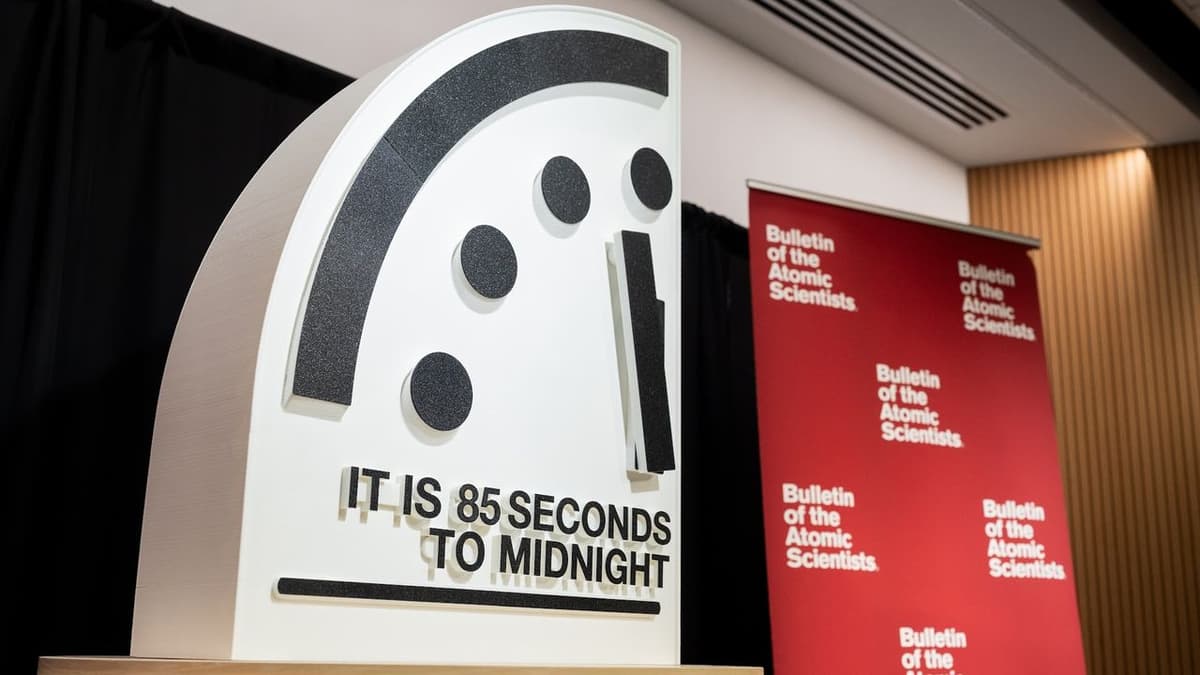
'Doomsday Clock' Ticks 4 Seconds Closer to Midnight as Unregulated AI and 'Mirror Life' Threaten Humanity
•January 27, 2026
0
Companies Mentioned


Why It Matters
The clock’s new setting signals a convergence of geopolitical, environmental, and technological risks that could trigger global catastrophe, urging policymakers to act now.
Key Takeaways
- •Doomsday Clock set at 85 seconds to midnight
- •Nuclear arms race intensifies among US, Russia, China
- •Climate inaction compounds existential risks
- •Unregulated AI and synthetic "mirror life" pose new threats
- •Autocratic trends hinder global cooperation
Pulse Analysis
The Doomsday Clock, a symbolic gauge created by Manhattan Project scientists in 1945, has long warned the world about the proximity of human‑made disaster. Its latest adjustment to 85 seconds before midnight marks an unprecedented level of urgency, reflecting not only the traditional nuclear threat but also newer, less understood dangers. By moving the hands closer to midnight, the Bulletin aims to galvanize public and political attention, reminding leaders that the window for corrective action is rapidly shrinking.
Three intertwined crises dominate the Bulletin’s assessment. First, the resurgence of a nuclear arms race sees the United States, Russia, and China expanding warhead stockpiles and modernizing delivery systems, while the landmark New START treaty lapses after six decades. Second, climate change mitigation stalls as fossil‑fuel dependence persists and renewable initiatives face political pushback, amplifying the planet’s vulnerability. Third, rapid advances in artificial intelligence and the nascent field of synthetic "mirror life" introduce unprecedented biological and informational hazards, from AI‑driven disinformation to engineered microbes that could bypass natural immune defenses. These overlapping threats compound each other, creating a feedback loop that accelerates global risk.
Addressing this multi‑dimensional peril requires coordinated international governance. Re‑engaging major powers in arms‑control dialogues, reinvigorating climate accords, and establishing robust regulatory frameworks for AI and synthetic biology are essential steps. Moreover, democratic resilience must be strengthened to counter autocratic tendencies that erode cooperation and accountability. By aligning scientific insight with policy action, the world can push the Doomsday Clock back, buying critical time to steer humanity away from the brink.
'Doomsday Clock' ticks 4 seconds closer to midnight as unregulated AI and 'mirror life' threaten humanity
0
Comments
Want to join the conversation?
Loading comments...