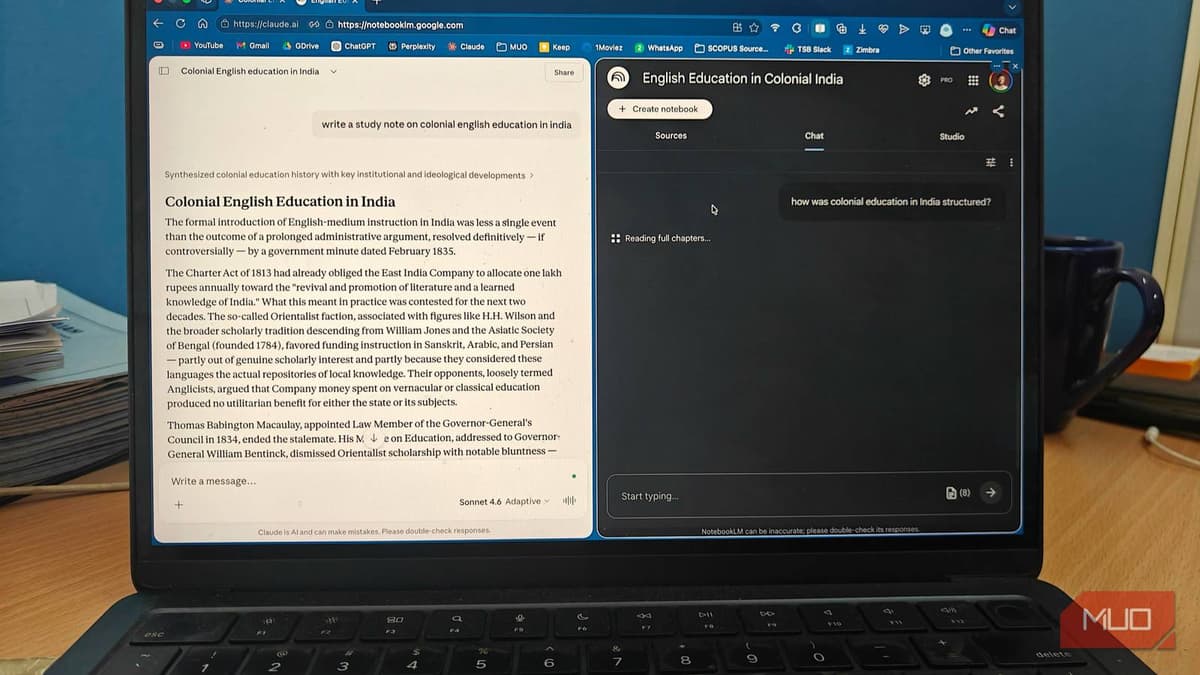
I Used Claude and NotebookLM Together for Research and Realized They're Solving Completely Different Problems
Companies Mentioned

Why It Matters
Researchers and knowledge workers need both source‑verified output and expressive drafting; combining Claude and NotebookLM delivers that dual capability, raising research quality and efficiency.
Key Takeaways
- •Claude excels at conversational reasoning and polished writing.
- •NotebookLM guarantees source‑grounded answers, minimizing hallucinations.
- •Combining both creates a workflow that balances fidelity and fluency.
- •Verify Claude drafts with NotebookLM to ensure citation accuracy.
Pulse Analysis
The AI market is rapidly segmenting into conversational assistants and document‑grounded engines. Claude, built on Anthropic's Constitutional AI, shines in open‑ended dialogue, complex reasoning, and producing narrative‑style content. In contrast, Google’s NotebookLM functions as a specialized research notebook, ingesting user‑uploaded files and generating answers that stay strictly within the supplied text. This functional split mirrors a broader industry trend where developers tailor models to either creativity or factual anchoring, giving users the option to pick the right tool for each task.
For academics, consultants, and enterprise analysts, source fidelity is non‑negotiable. Hallucinations—plausible‑sounding but unfounded statements—can undermine credibility and lead to costly errors. While Claude offers superior articulation, its reliance on internal knowledge bases can introduce extraneous information when users demand strict citation. NotebookLM mitigates this risk by limiting its output to the uploaded corpus, effectively acting as a citation‑aware engine. The tool’s inability to sustain a natural conversation, however, makes it less suitable for brainstorming or iterative drafting, highlighting the need for a complementary partner.
The practical solution emerging from these observations is a staged pipeline: first, upload all primary sources to NotebookLM to extract key points, summaries, and precise references; second, hand that distilled context to Claude for refinement, tone adjustment, and broader synthesis; third, loop back to NotebookLM for verification of any factual claims. This workflow not only curtails hallucinations but also accelerates the production of publication‑ready material. As AI adoption deepens across research‑intensive sectors, such hybrid strategies are likely to become standard practice, prompting vendors to develop tighter integrations that streamline the handoff between grounded and generative models.
I used Claude and NotebookLM together for research and realized they're solving completely different problems
Comments
Want to join the conversation?
Loading comments...