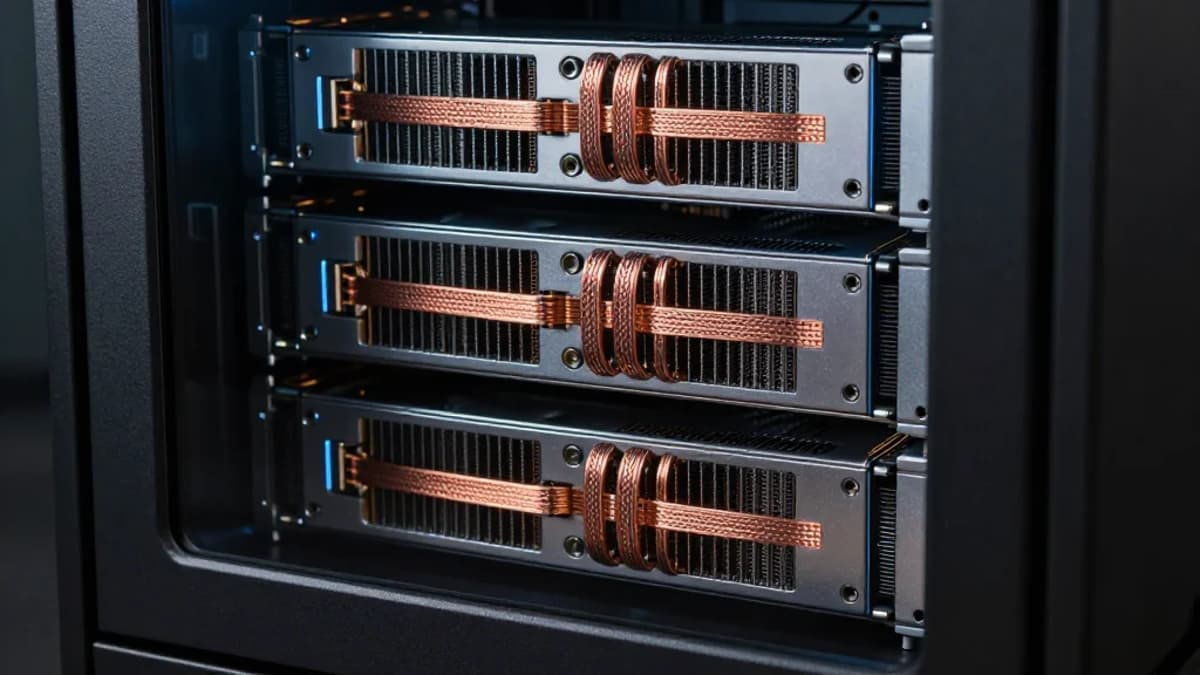
Nvidia Rubin's Rack-Scale Encryption Signals a Turning Point for Enterprise AI Security
•January 12, 2026
0


Why It Matters
Hardware‑level confidentiality transforms AI racks into provably secure assets, protecting billion‑dollar model investments from nation‑state and autonomous AI attacks.
Key Takeaways
- •Rubin encrypts all bus traffic across GPUs, CPUs, NVLink.
- •Confidential computing adoption reaches 75% of enterprises.
- •AI model breaches cost average $4.63M, exceed standard breaches.
- •GTG-1002 attack showed autonomous AI-driven intrusion.
- •AMD Helios offers open‑standard rack with lower compute.
Pulse Analysis
Nvidia’s Vera Rubin NVL72 marks a watershed moment for enterprise AI security. By encrypting every interconnect—from GPU‑to‑GPU NVLink links to CPU‑to‑GPU buses—the platform delivers cryptographic attestation of the entire rack. This hardware‑rooted trust eliminates reliance on contractual guarantees from cloud providers, allowing organizations to verify that their training and inference environments remain untampered throughout massive, multi‑petabyte runs.
The economic stakes are stark. Frontier model training costs are accelerating at 2.4× annually, pushing runs into the hundreds of millions. Yet IBM’s 2025 Data Breach Report shows AI‑related breaches cost an average $4.63 million—significantly higher than typical incidents—and 97% of those breaches lacked proper access controls. With 75% of enterprises now exploring confidential computing, the industry faces a talent and attestation‑validation gap that could slow adoption unless vendors simplify proof‑of‑integrity workflows.
Competition is heating up. AMD’s Helios rack, built on open‑standard specifications, offers a lower‑cost alternative with 2.9 exaflops of FP4 compute and massive bandwidth, but it does not embed encryption across every component as Nvidia does. For security leaders, the choice hinges on balancing performance, openness, and the need for cryptographic guarantees. Integrating hardware‑level confidentiality with zero‑trust policies, separate training/inference enclaves, and joint red‑team exercises will be essential to safeguard AI investments against increasingly autonomous, AI‑driven threat actors.
Nvidia Rubin's rack-scale encryption signals a turning point for enterprise AI security
0
Comments
Want to join the conversation?
Loading comments...